Canvas Score Calculator
Total your Canvas gallery from scoring-card ribbons, silver bonus ribbons, gold or house bonus tokens, and the visible icon composition across transparent art layers.
✦Canvas Scoring Presets
⚙Gallery Setup
🎖Scoring Cards and Ribbons
▧Transparent Layer Composition
Layer and bonus inputs
Canvas Score Results
▣Component and Spec Comparison
The comparison grid separates fixed Canvas scoring structure from optional expansion or house bonus tokens entered above.
📋Reference Tables
| Score area | What to count | Calculator field | Result use |
|---|---|---|---|
| Colored ribbons | Ribbons earned from each scoring card | A through D ribbons | Multiplies by card point values |
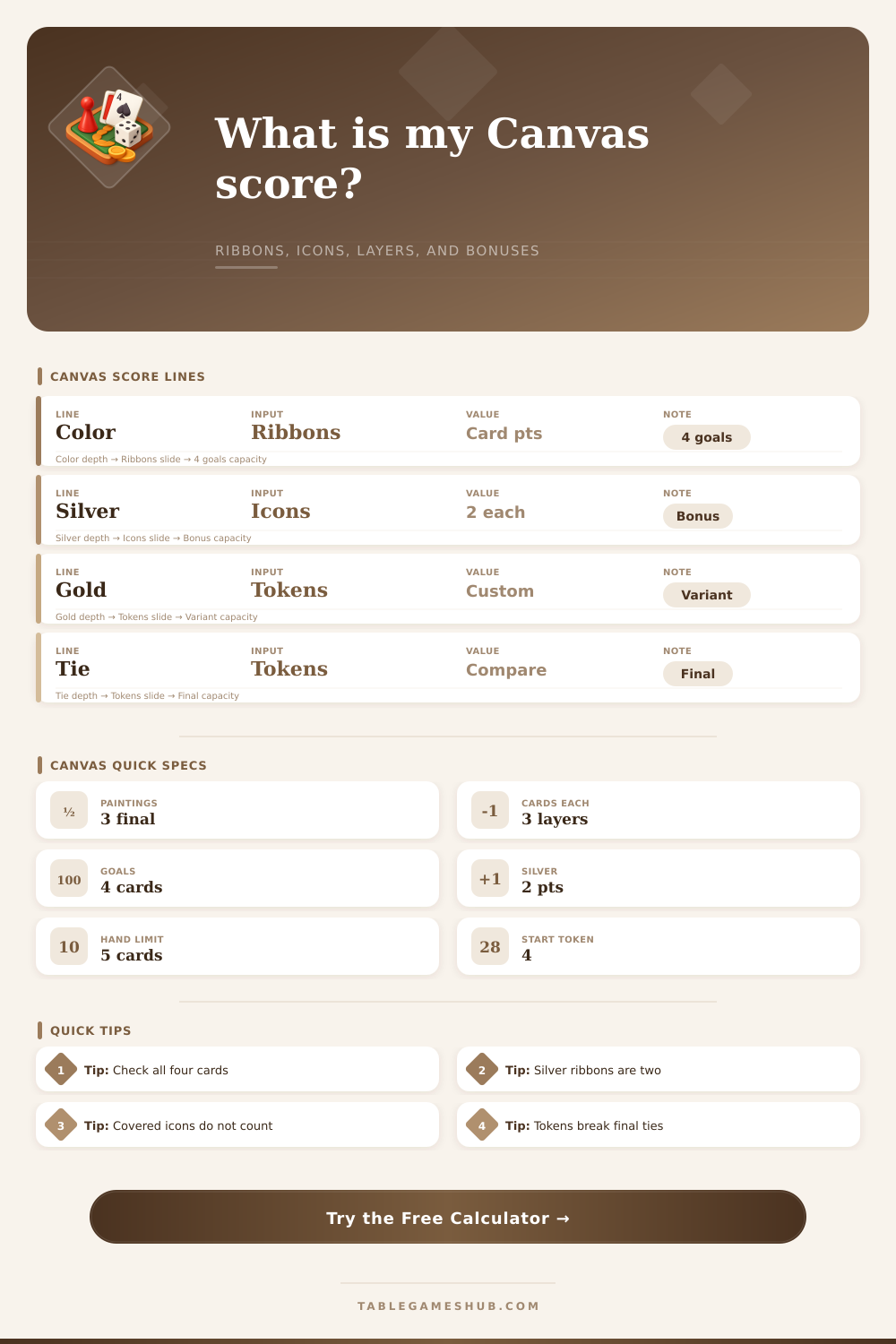
| Silver ribbons | Silver bonus icons that scored | Silver bonus ribbons | Always 2 VP each |
| Bonus tokens | Gold, variant, or table bonus tokens | Bonus tokens and value | Added after official ribbons |
| Tie-break | Inspiration tokens still held | Inspiration tokens held | Reported, not added to score |
| Scoring card archetype | Icon pattern | Best layer clue | Preset match |
|---|---|---|---|
| Harmony | Pairs and repeated motifs | Keep matching icons uncovered | Harmony Ribbon Run |
| Contrast | Several different icon families | Spread icons across layers | Contrast Icon Stack |
| Depth | All transparent cards matter | Avoid burying whole rows | Layered Masterpiece Push |
| Balance | Even left center right coverage | Check final sleeve order | Balanced Gallery Finale |
| Layer | Common job | Risk | Calculator cue |
|---|---|---|---|
| Background | Base icons and large art field | Can be covered by both later cards | Visible background icons |
| Middle | Connects scoring patterns | May hide background symbols | Visible middle icons |
| Foreground | Final visible accents | Can crowd the final icon row | Visible foreground icons |
| Hidden | Covered icons ignored | Lost scoring opportunities | Covered or hidden icons |
| Setup style | Paintings | Bonus handling | Best result card to watch |
|---|---|---|---|
| Base final scoring | 3 final paintings | Silver only if present | Final Score |
| Reflections mix | 3 final paintings | Silver and gold style tokens | Bonus Score |
| Learning game | 1 or 2 paintings | Use zero bonus tokens | Colored Ribbons |
| Custom challenge | Up to 5 paintings | Enter table value manually | Composition Grade |
❖Scoring Tips
Board games reach their crunch moment late in the game, when there’s a pile of completed paintings before you, a few ribbons clenched in your fist, and gamers staring at you demanding that you crunch some digits. “Oh yeah,” they say, “and make it fast.” Each painting is a masterpiece of layered artwork. Now you must count up all those points. Carefully examine each one to find out what’s hidden behind other cards or revealed by them. That’s where a calculator comes in. It do the math so you can focus on victory.
The first thing you’ll notice are the four scoring card and their corresponding colored ribbons. They represent principles of art such as balance, rhythm, harmony, and contrast. Using those artistic principles, you give out ribbons for your paintings if they follows them well. The point value for a ribbon depends on which card issued it. For example, a harmony ribbon may be four points while a contrast ribbon might be five points. Those values gets multiplied by however many ribbons you have and become part of your overall score. The chart below illustrates this easy so you can look up what value corresponds to each color.
How to Count Your Points
Two more points apiece come from silver bonus icons. If you’re rushing toward the end and counting too fast, you’ll miss these little bonuses. To get credit for a silver icon, you need it showing on the finished painting. That brings us to the tricky portion of the game. Seeing what’s in layers. Because the art cards are see-through, they combine into one picture when stacked up. Even if an icon seems visible, it doesn’t matter if it gets fully covered by next card. Ignore anything hiding your key symbols. It is a tiny detail, but it make the difference between winning and tying.
Underestimating the impact of covered icons hurts most players. On the surface, there are two matching stars, so you assume you’ve got a perfect match set. But what if one star is part of background and the other is a middle layer that’s fully opaque in that spot? Or what if a middle layer hide both? Those patterns don’t count. The calculator requires you to enter the number of visible icons in each layer: foreground, middle, background. That makes you stare at your own painting instead of simply appreciating it. Art appreciation becomes an exercise in objective data entry.
Gold or house bonus tokens add more complexity. The point values for these aren’t fixed because they vary by variant. Depending on the rules used some will grant additional points based off score/combination in specific categories. If these rules are being used then each player count them in and enters their custom value. It’s very simple to miss out a bonus token when playing without a tool.
If there is a tie then it comes down to inspiration tokens. These don’t add points directly; instead, they are tie breakers that reward resource management. Presets help you know what scores are normal. The “balanced gallery” preset shows what an average mid-tier score looks like. The top-of-the-heap “high silver showcase” gives you a sense of where bonuses change things in the standings. Knowing that before you finish your own game could of been useful. Do different strategies affect the bottom line? You should find out before your time ends. Do some people count ribbons too much at the expense of efficient layers? Do others squirrel away tokens of inspiration rather then cash them in for points? Play with those tradeoffs fast with this tool.
By the end of it all, you should have a solid idea of how you did. There shouldn’t be any debating about whether a covered icon counts for rhythm or if a silver bonus was properly awarded. After you enter your scores into the calculator, the last round become clear. Like the layers in art, the math will become obvious.
With everything figured out, sit back, relax and enjoy what you’ve made. That’s where the true reward of this game come from. Everything else (those tokens and ribbons), is simply the means to an end.