Pinochle Bidding Calculator
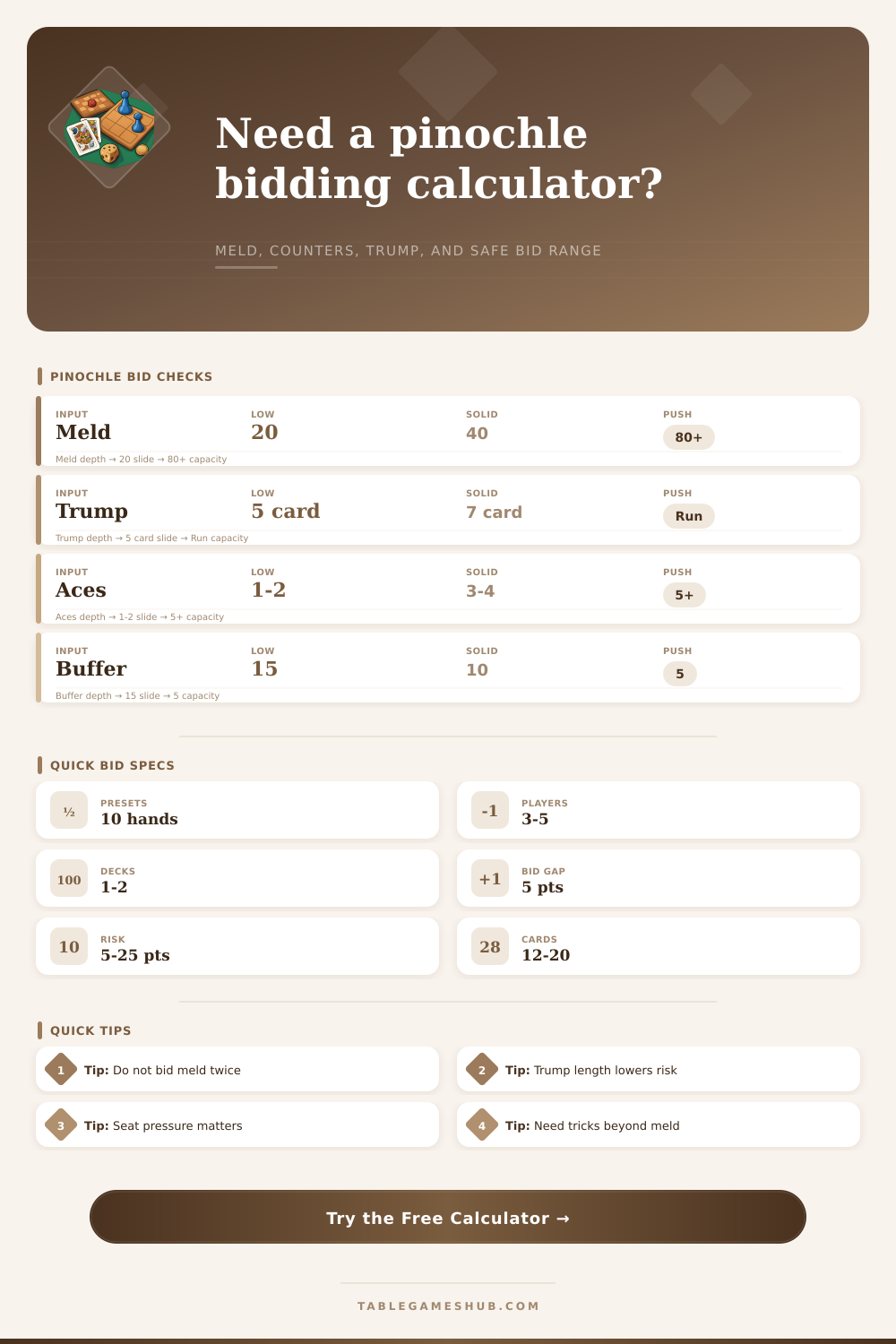
Estimate a practical pinochle bid from declared meld, likely trick counters, trump length, run strength, partner support, table pressure, and the safety buffer your table prefers.
1Preset Bidding Hands
Pick a realistic auction position, then tune the hand values to match your table's scoring scale.
2Game and Auction Settings
3Meld, Trump, and Trick Inputs
Bid Math Breakdown
4Pinochle Bid Component Grid
5Reference Tables
| Bid factor | What to enter | Strong sign | Risk note |
|---|---|---|---|
| Meld | Only meld you can show | Run, pinochle, aces around, extra marriages | Do not count partner meld unless your table allows known support. |
| Trump length | Cards in best suit | Seven or more in double deck, five or more in single deck | Long weak trump still needs high controls. |
| Top controls | Aces and tens in trump | Two or more protected high trump cards | Unprotected tens can disappear under stronger trump. |
| Side aces | Aces outside trump | Early winners before opponents void suits | Side aces lose value when seat pressure is high. |
| Risk buffer | Safety points to subtract | Lower buffer with strong trump and clear partner help | Raise buffer when the bid is being forced. |
| Common auction state | Typical bid action | Calculator cue | Why it matters |
|---|---|---|---|
| Early seat opener | Bid only clear strength | Recommended bid beats floor by one increment | Several players can still outbid or trap you. |
| Partner has spoken | Add limited support | Partner support field is positive | Support helps, but your own trump must still carry tricks. |
| Dealer last call | Can shade upward | Seat bonus improves call by a small amount | No later seat can punish a thin but playable raise. |
| Two active bidders | Demand more buffer | Pressure field subtracts from ceiling | Contested auctions often expose weak trump choices. |
| Meld pattern | Modern value | Bid effect | Check before bidding |
|---|---|---|---|
| Run in trump | Usually high | Raises both meld and trump confidence | Make sure the run is in the suit you can name trump. |
| Pinochle | Useful medium meld | Supports a raise when tricks are also present | Meld alone rarely protects a high contract. |
| Aces around | Strong control meld | Improves trick projection and opening confidence | Side aces can be pulled if trump is too thin. |
| Multiple marriages | Steady support | Good with partner help or a save bid | Queens and kings are not automatic trick winners. |
| Format | Cards each | Bid style | Calculator adjustment |
|---|---|---|---|
| Double-deck partnership | 20 | Higher contracts, partner support matters | Uses the default modern scale and stronger trump-length bonus. |
| Single-deck auction | 12 | Lower contracts, each ace is critical | Reduces hand size and expects tighter trick estimates. |
| Three-hand cutthroat | 15 | Solo control, little support | Discounts partner support and rewards top trump controls. |
| Five-hand call | 16 | Call-card or partner uncertainty | Lets support help while pressure keeps the ceiling conservative. |
6Bidding Tips
Tip: Separate shown meld from trick points before you raise. A hand with 80 meld still needs enough trump control to capture the counters required by the contract.
Tip: Treat partner support as partial value unless you know exactly what the table signal means. The safest bid is still built on your own trump and winners.
Having zero aces in your best suit plus 40 points of visible meld can cause some panic. Those cards might be on paper as it’s all marriages and runs, but they won’t take any tricks! This is where many pinochle players bids on potential instead of power. A big score means there should be a big contract, right? But you don’t get points for meld unless you capture the counters needed to fulfill your bid.
This is where the calculator helps fill that void. Telling the difference between the shown points and those earned through tricks taken. It feels academic until you begin racking up those penalty points during an intense auction. Trump length and control are considered independent variables from raw point value for this core logic.
How to Bid Safely in Pinochle
Seven cards in Spades sounds good, but what if they’re all low rank? They now can be easily beaten by someone who holds the Ace or Ten. Quantity isn’t enough, support your tricks with high controls. The tool takes your top controls and your number of trumps then adjusts your ceiling to match how many you will actualy win.
If you have length but no control over high cards, then that length is functionally useless for winning tricks. This is a huge change in strategy, but a small tweak in the interface. Casual players tend to bid too high because they rely on suit length without confirming their command over high cards. Likewise, your partner’s support are an uncertain amount here.
It can be tempting to bid up based off your estimate of your partner’s holding. The reference tables cautions against that urge directly. You may reveal certain meld patterns or even signal strength at the table, but still have no actual knowledge of your partner’s cards. If you account for partner support as partial value, then you will avoid over-reching.
It is better to bank on your winners and provide a cautious cushion for potential aid which may never arrive. Let the math deal with the risk assessment. Just enter honest estimates of what you know into its algorithm, not what you wish were true.
A final factor that I’ve observed being overlooked in quiet games but is crucial to success in competitive ones: seat pressure. Set penalties get steeper as the auction increases and so does the cost of failing to make a contract if opponents makes aggressive bids. Raise your risk buffer in the calculator to reflect this table dynamic.
You want a hand with more certain tricks (not necessarily more total points) to raise against two other aggressive bidder who are driving the floor up. What was a thin hand to raise at different seat can now be fatal. You get a top push limit, or your absolute ceiling bid, plus a suggested bid.
Don’t go over that ceiling bid, it’s too risky for too little benefit. That range tells you if you want to stay as you are or try one more raise. It makes the mental math (meld + tricks + outside pressure) very easy: one decision point.
You can play whatever formats you like, single deck auction, double deck partnership, etc. You won’t need to remember complicated formulas for each variation. Let the tool adjust to how you want to play then read the cards. Knowing at all times what’s being measured in the auction is key to successful bidding.
When you’re able to value concrete controls instead of chasing phantom tricks, the fear of making an opening call is replaced by a clear calculation of reward versus risk. This is the risk.