🧵 Calico Score Calculator
Total design goal tiles, cat tokens, button sets, rainbow buttons, partial goals, open quilt spaces, and end-game scenario cards.
Design Goal A
Design Goal B
Design Goal C
| Score source | Entered value | Points | Formula note |
|---|
| Design goal shape | Six-tile requirement | Common use | Calculator field |
|---|---|---|---|
| AAA-BB-C | Three of one, two of one, one single | Flexible color or pattern grouping | Status plus one-side and both-side values |
| AA-BB-CC | Three pairs around the goal tile | Pair-focused quilts and balanced sets | Often medium difficulty |
| A-B-C-D-E-F | All six surrounding tiles different | Rainbow or full pattern spread | Often high both-side value |
| AAAA-BB | Four of one, two of another | Strong cluster beside one goal | Useful for button-heavy boards |
| AAA-BBB | Two groups of three | Symmetric clusters around a goal | Strong if colors and patterns align |
| Cat token tier | Typical printed score | Pattern demand | Calculator handling |
|---|---|---|---|
| Small cat | 3 to 5 points | Shorter pattern group | Count times small cat value |
| Medium cat | 5 to 7 points | Moderate pattern cluster | Count times medium cat value |
| Large cat | 7 to 11 points | Harder shape or larger group | Count times large cat value |
| Near cat | 0 points | One tile short or broken shape | Audit note only |
| Multiple cats | Add printed values | Each earned token scores separately | Summed in cat points card |
| Button source | Score value | What to enter | Score note |
|---|---|---|---|
| Single color button | 3 points | One collected color | Enter as a different button color |
| Second same-color button | 3 points | Extra button token | Use extra buttons beyond first set |
| Six-color rainbow | 3 points | One rainbow set | Usually available after all six colors |
| Incomplete color group | 0 points | Do not enter | Only completed button tokens score |
| Button tiebreak note | No added points | Tiebreak basis | Shown only in the breakdown note |
| Final score band | Typical profile | Strongest source | Audit cue |
|---|---|---|---|
| Under 40 | Low cat and button conversion | One design goal or fewer | Check missed buttons first |
| 40 to 55 | Solid mixed score | Two design goals plus buttons | Review one-side goal values |
| 56 to 70 | Strong Calico board | Cats and exact goal work | Confirm rainbow bonus if present |
| 71 plus | Excellent high-conversion quilt | Exact goals and many cats | Audit every printed token value |
| Projected score | Pre-final estimate | Open spaces still matter | Final score can shift after tile draw |
Design goal control
Best for players who surrounded two or three goals with exact color and pattern sets. The calculator separates one-side values from both-side values.
Cat token control
Best for boards built around pattern shape clusters. Printed cat values are configurable, so mixed cat tiles can be audited cleanly.
Button set control
Best for color clusters and rainbow planning. Each completed button token scores 3, while six colors can trigger the rainbow bonus.
Partial goal audit
Partial adjacencies do not score in final rules, but tracking them explains why a board missed high-value design tile totals.
Scenario projection
Open quilt spaces and likely points per tile estimate a not-yet-final board without mixing projected points into official final score.
Tiebreak review
The tiebreak note can emphasize cats, buttons, design goals, or projection so score comparisons stay easy after calculation.
Score printed values, not shapes.
Cat shape difficulty only matters when earning the token; once earned, enter the printed cat value and token count.
Separate final from projected score.
Open spaces can estimate a future finish, but official final scoring uses only completed goals, cats, buttons, and rainbow bonuses.
To calculates the points for the game Calico, there is several different categories that must be calculated. The points for the game are not on the quilt itself. The points for Calico come from color clusters, the pattern groups, the button tokens, the cat tokens, and the rainbow bonuses.
Each of these point value must be calculated in order to determine the final score for the game. In order to calculate the score for the game, players must understand the relationship between each of the different category of the game, such as the relationship between the game tiles, the cat tokens, and the button tokens. The first category of points to calculate are the design goal.
How to Score Points in Calico
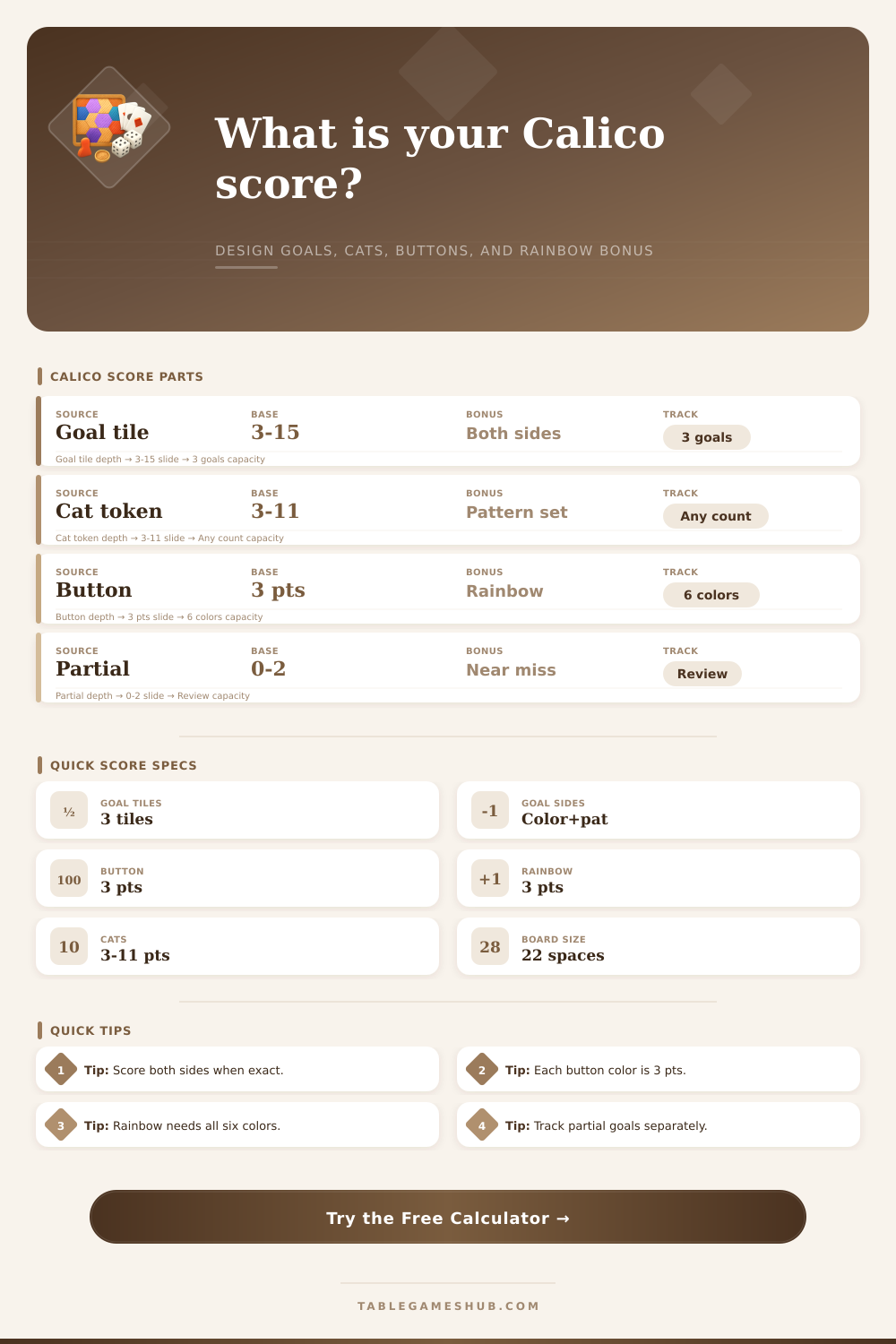
Each player receives three design goals on there game board. Each of these goals require six different tiles to create a specific shape on the quilt. For each of these goals, there is two possible point values for each goal.
Each goal can score for the color of the tiles, or each goal can score for the pattern of the tiles on the quilt. Each design goal will score for each of these categories if both the color and pattern of the goal is completed with the set of tiles for that player. If only one of these categories is completed, only that one earns the player points for that goal.
The relationship between these two categories is that the tiles used for each design goal are the same as the tiles that are used for the cat tokens and button token. The second category of points to calculate for Calico is the value of each of the cat token. Each player earns a cat token for creating specific shape on the quilt that is depicted on the printed cat token of that players board.
Each of the cat tokens has a specific point value. Small cat tokens earns three or four points each, while large cat tokens earn nine or eleven points each. These cat tokens will compete with the other categories for the same game tiles, and as such, a player may have to make a decision as to whether earning a high-value cat token is worth potential losing a game goal or button tokens.
The third category of Calico that players score points for are the button tokens. Each player earns a button token for each group of six colored tile that are completed. Additionally, each player can earn a bonus for five additional set of button tokens for that color.
Furthermore, should a player earn one of each color of button tokens, they will earn a three point bonus for the rainbow tokens. Each button token will compete with the other categories for the same game tiles. As such, a player must decide if earning button tokens is worth competing for those tiles.
In order to calculate the final score for Calico, players can use a calculator for the game. The calculator allows for players to enter their completed design goals, the number of cat tokens that they have earn, and the number of button tokens that they have earned. Each of these categories can be separated for the player to understand from which category they earn the most points.
For instance, a player with many cat tokens will have a more different point structure than a player who earned their points from button tokens. Players can use reference tables to understand the shapes of the design goals and the point value for each of the cat token tiers. These reference tables will provide players with knowledge of the shapes that each goal will require to be completed.
Additionally, these reference tables will allow players to understand the point values of each of the different cat tokens. By understanding each category and how many points will be earned from each of these categories, a player can make better decision during the game of Calico. The final score for players is the sum of all of the categories of scores earned in the game of Calico.
Players should keep track of each of the categories to ensure that the final score for the game is accurate. While the calculator will make this final audit of scores for each player to occur more quickly during the game, the decisions that they make with each of the tiles that are placed during the game determine the actual score for each player.