🎲 Bye Distribution Calculator
Forecast pairing byes, eligible player pools, bye-point impact, score-group pressure, and table waves for Swiss-style tabletop events.
Use this planner before posting pairings. It treats a pairing bye as one unpaired active player in an odd round, then checks how fairly those byes can be spread under your tournament policy.
| Round | Projected Active | Matches | Bye Assigned | Candidate Pool | Selection Chance |
|---|
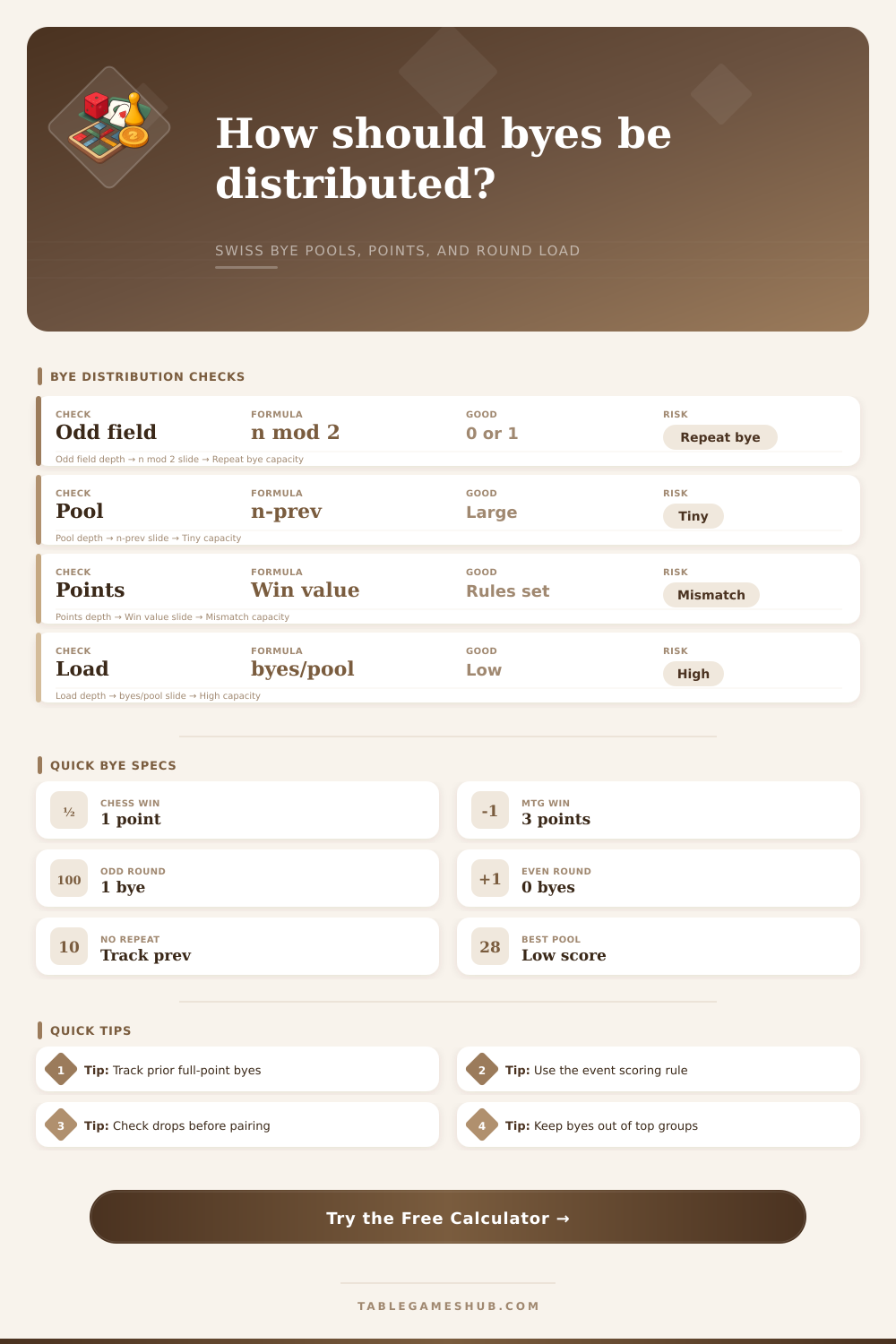
Each odd active round creates one pairing bye; each even round creates zero.
Players with a prior full-point pairing bye are removed from the first-choice pool.
The calculator uses the selected scoring model's win value for pairing-bye points.
Higher load means a smaller group is carrying more forced byes across the schedule.
Remaining projected rounds with an unpaired player.
Total pairings across the remaining event projection.
Worst projected table wave count for one round.
Distribution is currently workable.
| Reference Basis | Bye Trigger | Point Treatment | Organizer Check |
|---|---|---|---|
| FIDE Swiss basics | Odd paired field | Same as a win unless rules differ | No opponent and no color |
| US Chess practice | Odd active section | Full-point bye tracked | Avoid assigning a second full-point bye |
| Card match Swiss | Odd active players | Usually match-win points | Use event software policy |
| Club rotation | Odd attendance | House rule value | Publish rotation before round one |
| Scoring Model | Win | Draw | Typical Games |
|---|---|---|---|
| Chess or Go | 1 | 0.5 | Chess clubs, go opens, abstract games |
| Card match points | 3 | 1 | Trading-card Swiss and best-of-three matches |
| Win-loss only | 1 | 0 | Miniatures, ladder nights, short pods |
| Team match points | 2 | 1 | Team leagues and match-play events |
| Policy | Candidate Pool | Strength | Risk |
|---|---|---|---|
| Lowest eligible score | Bottom score group | Protects leaders | Small late-round groups |
| Random among lowest | Lowest score tied players | Simple and transparent | Needs clean prior-bye tracking |
| Rating tiebreak | Lowest score, lowest seed | Common chess-style habit | Can feel harsh to new players |
| Club rotation | Attendance list | Good for casual leagues | May ignore standings fairness |
| Protect top groups | Lower half of standings | Keeps title race cleaner | Larger manual review burden |
| Active Field | Round State | Immediate Bye | Distribution Note |
|---|---|---|---|
| 8 players | Even | 0 | Four clean matches; no forced bye |
| 9 players | Odd | 1 | One eligible player sits, then returns next round |
| 17 players | Odd club Swiss | 1 | Track prior full-point bye before round two |
| 31 players | Large odd Swiss | 1 | Candidate pool should come from low score bands |
| 63 players | Large card event | 1 | Drops may create another odd round later |
The situation comes up fairly often for tourney directors: you glance down at your roster and notice an odd number of players. It is not the end of the world, just a hiccup in neat pairing system called Swiss pairing. Now you’ve got thirty players and one sits out because he/she had to. Or maybe there are only seventeen players total and somebody will recieve a bye; a free point for doing nothing.
And in competition? Uh oh. Inherently unfair, as it seems, and now some poor sap begins the next round ahead of other competitors because they didn’t earn it through play. The calculator above does the math for you, predicting where these forced byes occur during your tournament and allowing you to mitigate them before they cause problems in the standings.
How to Handle Forced Byes in Tournaments
Uh oh. It seems inherently unfair when some poor sap begins the next round ahead of other competitors without earning it on course. The calculator above does the math for you, predicting where these forced byes occur during your season and allowing you to reduce them before they cause problems in the standings.
Byes aren’t merely vacant chairs; they’re money, and the root issue is that byes often carries one or more points (e.g., a bye typically means one point in chess), which immediately boosts scores. Depending on the game type, that may be equivalent to three in Magic: The Gathering or another card-game variant with match points. That’s money being injected into the score system, and if your eligible pool is small enough. Especially if some players end up receiving multiple byes, you run the risk of disproportionately funneling un-earned advantage to a few corners of the leaderboard.
Based off your chosen scoring model and who has already earned a bye, the tool will calculate your potential eligible pool and then tell you how much pressure that puts on each spot. Did you distribute the load evenly? Or did you inadvertently hand an insurmountable lead to someone simply because they was the lowest-rated person in a very small field?
What rules should apply? Consider this early; most organizers start by giving byes to the lowest-scoring players, and that’s fairly logical: It seems fairer. But if that group proves thin, it could bite you. Since there are three rounds with an odd number of players each, someone in that zero-point group will get a second bye. And now we have that repeat-bye problem that lots of rule sets attempt to prevent. If you have a small pool of players eligible for these byes, you risk concentrating too much unearned value in one corner of the leaderboard. To see how various policies affect your potential candidate pool, check out the reference tables on the page.
While it may make sense to use a rotation system for a casual league (feels more democratic), it doesn’t take competitive equity into account. Protecting the highest score groups keeps title race clean, but it also involves some extra manual review effort on your part. No decision here is perfect; it is only a question of trading administrative ease for perceived fairness.
Then there’s player drops. Tournaments change. Folks get tired, have to go home to their families or simply need to leave early to go to work. That’s why dropping out of a round can turn an even number of players into an odd number, which requires an unplanned bye. This completely changes how things work. By entering the expected drop rate, you can predict these changes in your calculator. Before making pairings it’s a good idea to check here, as a sudden odd field later in the event can throw off the whole rhythm of the tournament. When the pressure is high enough in round four, the last thing you want to be doing is scrambling for a solution. Just like planning for attendance, planning for attrition is part of the job.
Bye distribution is also linked with table management. A reduced field size means that, with an odd number of players, you only need to manage one less match… Sounds nice right? Except that might put you in a time crunch if your table waves were already pretty tight. The tool gives you the estimated round load and max waves. This way, you know whether it really buys you some breathing space or just leaves someone waiting around while everyone else plays their games. Especially when the length of matches can vary (such as miniature battles or board game leagues) then one long game could hold up subsequent pair.
Transparency is the thing. Everyone knows when byes look arbitrary. When you have a transparent policy that is clearly explained, people complain less. Consistency trumps mathematical exactness here: do you want rating tiebreakers? Do you want a randomly selected player from the group of those tied? Do you want to rotate through a published list? Whatever, just be consistent. The calculator doesn’t decide for you, it helps show what results will be of whatever input you give it. It shows the frictions. And you can tweak your scoring model, tweak your active player count, and see the landscape shift. Repeated testing like this is good because it takes the decision from an intuitive one to an informed strategic one.
Ultimately, how well your tournament runs depends entirely on the way it’s run. Good tournament directors handle the byes well; great tournament directors do so gracefully. Not everyone will show up and not everyone will stick around. But you do have control over how you adapt to that change. Predict the distribution in advance. There won’t be any surprises when the player who sits out in round two finds out why. They’ll know the system is watching out for them not to gain an undue advantage. This also makes the competition honest.
Once the pairings are posted and things settle down, you want people thinking about the games, not thinking about who earned a free point. If you get the logistics down, then winners are determined by skill rather than attendance quirks. That’s the standard we should of strive toward.