Briscola Score Calculator
Total a Briscola hand from captured aces, threes, court cards, zero-point cards, match bonuses, cappotto rules, and the exact race to 61 or 120 points.
Load a realistic hand or match state, then edit the captured card counts to match your table.
Enter the number of scoring cards captured by Team A. Team B is calculated from the full deck unless you unlock manual Team B counts.
Team A Captured Cards
Team B Captured Cards
| Side | Aces | Threes | Court cards | Zero cards | Adjustment | Total |
|---|
| Rank | Italian name | French name | Cards in deck | Points each | Total points |
|---|---|---|---|---|---|
| Ace | Asso | Ace | 4 | 11 | 44 |
| Three | Tre | Three | 4 | 10 | 40 |
| King | Re | King | 4 | 4 | 16 |
| Knight / Queen | Cavallo | Queen | 4 | 3 | 12 |
| Knave / Jack | Fante | Jack | 4 | 2 | 8 |
| Seven, six, five, four, two | Carte lisce | Plain cards | 20 | 0 | 0 |
| Card points | Result | Match award | Audit note |
|---|---|---|---|
| 61 to 119 | Normal hand win | Usually 1 point | Opponent has 59 or fewer. |
| 60 to 60 | Tied hand | House rule | Many tables replay or award no point. |
| 120 to 0 | Cappotto sweep | 1 or more | Only if one side captured every point card. |
| Less than 60 | Lost hand | 0 points | The other side must be above 60. |
| Total not 120 | Count issue | Review hand | Manual mode may need card-count correction. |
| Format | Players | Deck handling | Scoring side | Good calculator use |
|---|---|---|---|---|
| Classic duel | 2 | Full 40-card deck | Player vs player | Track exact captured ranks after each hand. |
| Partners | 4 | Full 40-card deck | Pair vs pair | Name teams by partners and race to a match target. |
| Three-player | 3 | Often one two removed | Each player or temporary sides | Use manual mode for unusual removed-card tables. |
| Called ace | 5 | Full deck, hidden partner | Caller side vs defenders | Score caller team after partner is revealed. |
| Briscolone | 2 to 5 | No trump by house rule | Table dependent | Set trump field to no trump for notes. |
| Check | Expected value | Why it matters | Calculator field |
|---|---|---|---|
| Aces plus threes | 0 to 8 cards | They carry 84 of 120 total points. | Aces, threes |
| Court cards | 0 to 12 cards | Kings, queens, and jacks add 36 points. | K, Q/C, J/F |
| Plain cards | 20 total | They do not score but confirm captured-card count. | Zero cards |
| Card points | 120 total | Any other total means a rank count is missing. | Result table |
| Match points | Target chosen | Rubber or tournament scoring may end the match. | Match target |
Count high cards first. Aces and threes are worth 84 points together, so a quick high-card audit catches most wrong Briscola totals before you check the lower court cards.
Use manual mode for variants. Three-player, called-ace, and house-rule tables can remove or assign cards differently, so manual Team B counts are best when the full-deck complement is not exact.
In a heated match of Briscola, it’s not uncommon to start forgetting how many cards you have as you frantically try to get rid of them. To avoid an argument that lasts for next twenty minutes (you’ll be splitting hairs), you need a concrete system of scorekeeping. That way arguments can be resolved quickly. The game can proceed nicely and you won’t end up losing your friends.
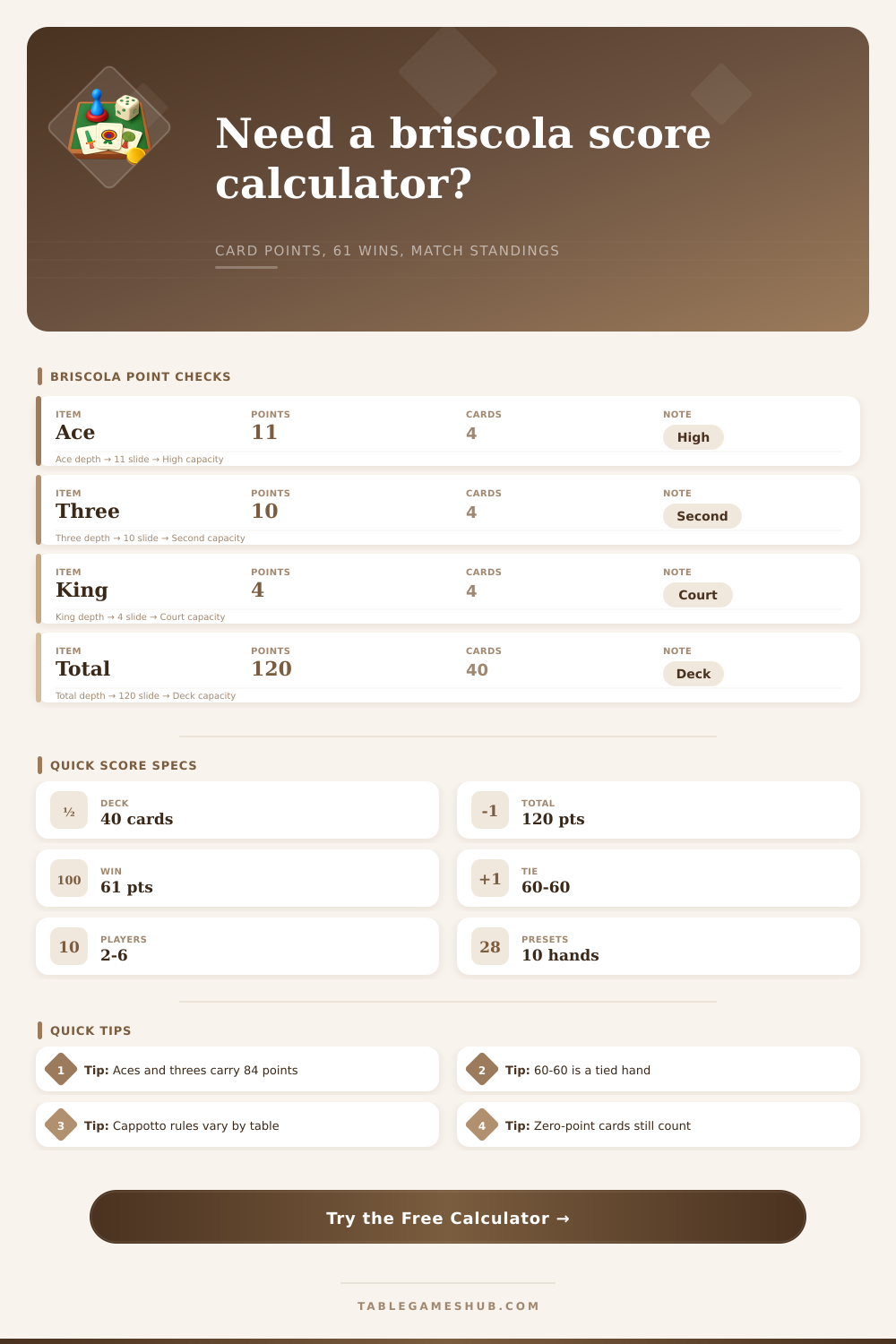
Even amidst the chaos of play, the scorekeeping for Briscola isn’t complicated: there are a total of one hundred twenty points across the entire deck, with eighty-four of those points livig in just eight cards. Only five ranks holds any weight. Cards rank as follows: the ace is eleven points and the three is ten points. Everything else is zero until you hit a king (four points), queen (three points), or jack (two points). All others, the seven to the two, don’t contribute anything toward your score. They’re important for taking tricks, sure, but nothing more then that.
How to Keep Score in Briscola
That leaves eighty-four of the one hundred twenty points living on only eight cards. Control the aces and threes and before you’ve even considered the court cards, you’ve got the majority of the game’s score tied up. Smart players keeps an eye out for these high-value cards. Log what you capture. The calculator above will do the math for you. This helps you avoid mistakes from doing math in your head when your hands is tired after playing for hours.
Point values are core, but understanding how to enter the results is just as important. The first step here is to enters the high cards first. Otherwise, you run the risk of thinking you won because you had more tricks instead of higher-point cards. Even though you may have gotten six tricks, they might all be in low-value cards like sevens and twos, and you lost anyway. You’ll enter which team got which jack, queen, king, three, or ace. In a normal deck, it will automatically calculate the rest for the other team. That’s critical since this will help ensure you don’t double count anything. There’s no sense in entering that Team A got two aces if now there are only two available for Team B. The system does that math for you so you can concentrate on the game and not the numbers.
That’s how matches work: they’re not necessarily just one hand. Most sets of house rules requires three or five points for victory in whole session. That’s where the tie-breaker rules enter. Technically, if both players gets 60 points each, it’s a tie… but what do tables does with ties? They might replay the hand, or award half-points, or give the point to the dealer. Your table can set these options in the settings, but make sure you set them at the start of play, not mid-game once there is controversy over the tie. Fun is ruined by ambiguity and having the rules clear from the outset means everybody will accept result when the game concludes.
And finally, there is the sweep. Commonly referred to as the cappotto, this occurs when an entire side takes every one of those hundred and twenty points, leaving their opponents with zero. Usually it’s worth a match point or two of bonus, but it rarely happens and most tables don’t award it. Instead, they stick straight to the win no matter how dominant either side become. This can be toggled off in the configuration area if your crew plays like that. Failing to plan for it ahead of time will derail the last hand with arguments about counting a sweep as three points or one. That table on the page explains the variations clearly so you know exactly what to select based off your preference.
What I love about making this process digital is how it removes any bias from self reporting. By nature, we tend to recall our victories while forgetting defeats. An objective log ensures a fair round by round accounting while providing for fast audits. Did the points come out to exactly one hundred twenty? If not, then somebody either miscounted or missed a card; you’ll know right away. That instant cycle keeps the game honest and interesting.
Without flipping through score book, you can follow along with the teams throughout a few hands. Briscola is, after all, first and foremost a social experience, about memory, about timing, and above all about interacting with the people sitting around your table. The points system are merely the framework that supports it. As soon as everyone knows the outcome and by what margin, there’s no drama left in the equation. It becomes once more about the cards themselves, not the arguments over the scorecard. It is about laughing off a poor call or congratulating someone on a good bluff without having to wonder if the final tally makes sense. Clean scores make for clean games, and clean games are the kind we look forward to replaying the following week. You should of seen how much better it works now.