🃏 Bridge High Card Points Calculator
Total A-K-Q-J values, distribution points, short-suit adjustments, balance shape, opening thresholds, and partnership strength in one bridge hand audit.
| Item | Your hand | Partner estimate | Formula or note |
|---|
| Honor card | Point value | Control value | Calculator use |
|---|---|---|---|
| Ace | 4 HCP | 2 controls | Top honor count, slam controls, and opening strength. |
| King | 3 HCP | 1 control | High-card strength and guarded-suit quality. |
| Queen | 2 HCP | 0 controls | Secondary honor value, often stronger with an ace or king. |
| Jack | 1 HCP | 0 controls | Lowest standard honor point, useful in connected suits. |
| Distribution method | Void | Singleton | Doubleton or length rule |
|---|---|---|---|
| HCP only | 0 | 0 | No distribution points added. |
| Length points | By suit length | By suit length | One point for each card beyond four in a suit. |
| Short-suit points | 3 | 2 | One point for each doubleton, often after a fit is known. |
| Dummy support | 5 | 3 | One point for each doubleton when supporting partner. |
| Combined audit | Shows both | Shows both | Uses the larger of length total and short-suit total. |
| Hand range | Typical points | Common shape | Practical read |
|---|---|---|---|
| Pass or compete later | 0 to 11 | Any shape | Usually below normal opening strength unless shape is exceptional. |
| Minimum opener | 12 to 14 | Balanced or 5-card major | Enough to open in many standard systems. |
| No-trump opener | 15 to 17 | Balanced | Common strong no-trump range with no singleton or void. |
| Strong opener | 18 to 21 | Balanced or strong suit | Enough to invite game opposite modest responder values. |
| Very strong | 22 or more | Any shape | May need a strong artificial opening in many methods. |
| Partnership target | Total points | Contract family | Calculator signal |
|---|---|---|---|
| Partscore area | Under 25 | Low-level contracts | Results card marks this as below usual game strength. |
| Game area | 25 to 32 | 3NT or game in a suit | Partnership total is usually enough to investigate game. |
| Small slam area | 33 to 36 | Six-level contracts | Controls and fit should be reviewed carefully. |
| Grand slam area | 37 or more | Seven-level contracts | Needs strong controls and trick source confirmation. |
| Shape pattern | Balance band | Likely strain | Point-count caution |
|---|---|---|---|
| 4-3-3-3 | Balanced | No-trump friendly | Do not inflate with short-suit points. |
| 4-4-3-2 | Balanced | No-trump or suit fit | Doubleton may matter only after a fit is known. |
| 5-3-3-2 | Balanced by many methods | No-trump or 5-card suit | One long-suit point can be reasonable. |
| 5-4-3-1 | Unbalanced | Suit-first auction | Singleton value depends heavily on fit. |
| 6-3-2-2 | Unbalanced | Long-suit source | Length points may describe trick source better. |
Audit the 13-card hand first
Point totals are only meaningful when the four suit lengths add to thirteen and each suit has no more honors than cards.
Shape points need context
Short-suit points become more useful after a trump fit is known; balanced no-trump hands usually lean on HCP instead.
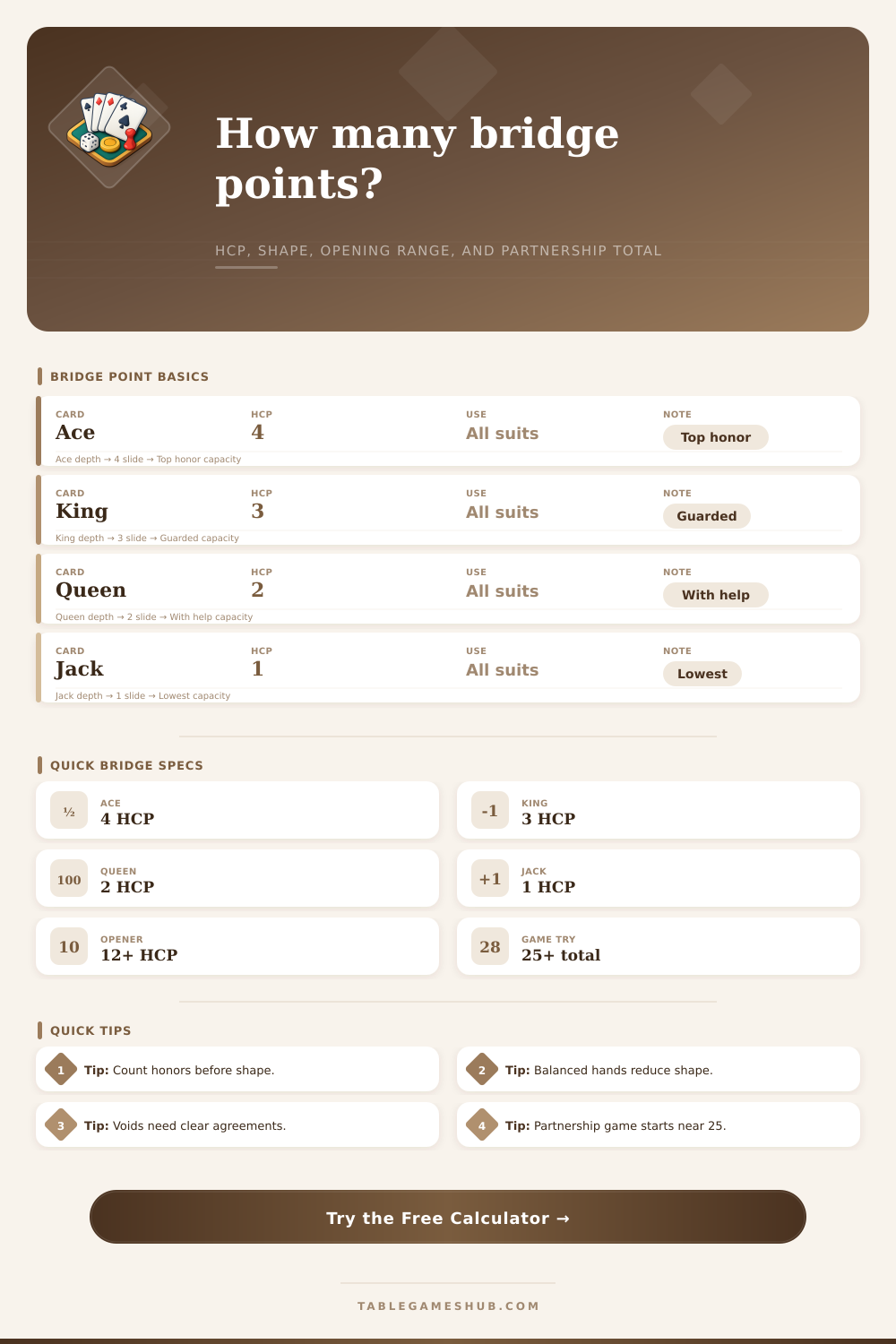
Bridge high card point are a method of determining the value of a bridge hand before the start of the game. Each bridge hand contain four top honors. Each ace contains four bridge high card points, each king contains three bridge high card points, each queen contains two bridge high card points, and each jack contain one bridge high card point.
A player can sum up these points for that particular bridge hand. This total will allow for the comparison of the value of each bridge hand. However, the bridge high card point total is only one part of the value of a bridge hand.
How to Count High Card Points in Bridge
The other components of a bridge hand that contributes to the total value of that bridge hand are the shape of the bridge hand and the fit of the bridge partnership. The distribution of the bridge hand is another component of that bridge hands value. The distribution of the bridge hand is the number of cards that is in each of the four suit in the hand.
A long suit in a bridge hand can produce tricks after the draw of the trump cards. A void in a bridge hand allow a player to ruff any loser cards that are played by an opponent. There is calculators that can be used to add the number of points for each suit length or to award points to a hand for short suits within the partnership.
The addition of points for the length of the suits reward a player for the potential of created winning tricks. Adding points to a hand for short suits allows a partnership to reward the ability to eliminate losing tricks played by an opponent. Because each of these methods of calculating distribution are different, the total number of bridge high card points will vary depending on the method that a player uses to calculate distribution.
The total number of bridge high card points for a bridge partnership is more important then the total number of high card points in a single bridge hand. Bridge is played in partnerships, and the total number of high card points for the partnership is used to determine the contract for the game. A player can enter the bridge high card points for each player into a calculator to determine the total number of bridge high card points for the partnership.
A player whose own bridge hand contain a low total of bridge high card points may still have a strong bridge hand if the partnership contains a high total of bridge high card points. Another component of a bridge hand is the balance of the hand. A balanced bridge hand has each of the four suits in even number, such as a four-three-three-three bridge hand.
An unbalanced hand may have a suit with five cards and the others with three card each. Bridge hands that are balanced can produce tricks in no-trump contracts. Unbalanced bridge hands may be unable to reach their full point values without trump cards.
Considering the balance of a hand is important to determine if a hand with high card point values may still be difficult to play. Vulnerability for the bridge partnership and the bidding system for bridge is additional factors that contribute to the value of bridge high card points for each bridge hand. Vulnerability is the current state of the bridge game and can change the total number of bridge high card points that are required for bidding on a particular number of tricks.
A bridge hand with twelve bridge high card points may be a comfortable number to bid upon for vulnerability in the partnership, but may be a pass hand if vulnerability is high for the partnership. The bridge point calculator allow a player to set the vulnerability for there partnership. Many bridge players makes mistakes when awarding bridge high card points.
One common mistake is to award points for distribution before establishing a fit between bridge partnership bridge hands. Another mistake that players may make is to ignore the location of the honors within each of the bridge suits. An ace in a short bridge suit is different in value than a king within a long bridge suit.
A calculator is a valuable tool in determining the number of high card points for a bridge hand. However, no calculator can determine the order of the bridge cards or the bids for tricks between partnership bridge players. Experienced bridge players use reference tables to understand the value of bridge hands.
These tables has the ranges of bridge high card points for various types of bridge hands. Players can use these tables to agree upon the ranges of bridge high card points that each player will use in partnership with their bridge partner. These tables can show the adjustments to the high card point total when using different methods to award points for the length of each of the bridge suits.
The process for evaluating a bridge hand has a specific order to the steps that a player should perform. First, the bridge high card points should be counted. Second, the distribution and balance of the bridge hand should be considered.
Third, vulnerability and the total number of high card points for the partnership should be considered. Finally, the total number of high card points should be used to determine if the contract for the bridge game is justified by that total. Using this specific process allow the player to ensure that their arithmetic is correct while allowing them to use their judgment to make a decision about the hand.