🎱 Snooker Angles Calculator
Calculate cut angles, cue ball deflection paths, and object ball trajectories for any snooker shot
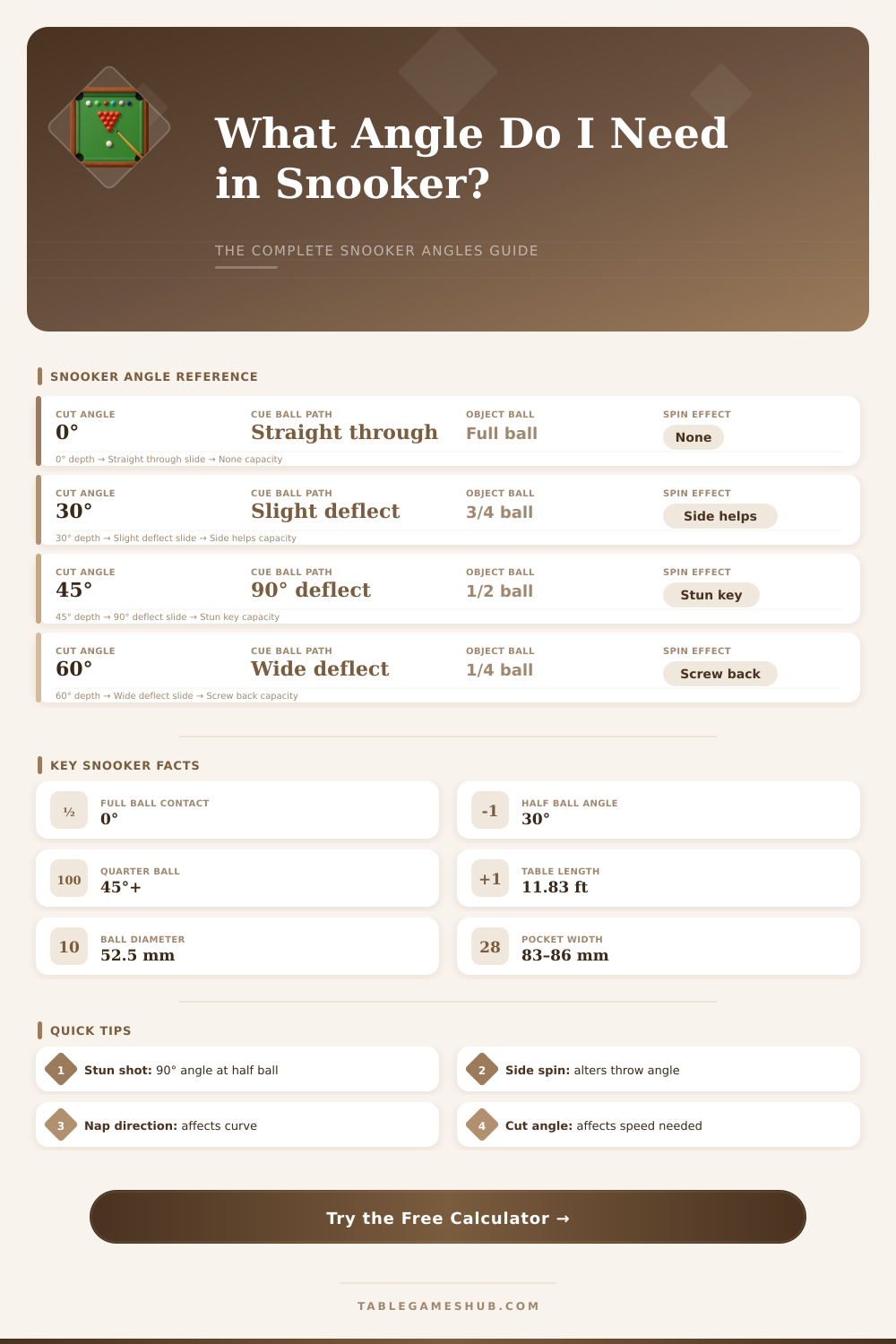
| Cut Angle | Contact Point | Cue Ball Deflection (Center) | Object Ball Direction | Recommended Spin |
|---|---|---|---|---|
| 0° (Straight) | Full Ball | Straight through | Straight | Any |
| 10° | Near Full | ~80° separation | 10° from aim | Top for follow |
| 14° | 3/4 Ball | ~76° separation | 14° from aim | Top / Center |
| 20° | Between 3/4 & 1/2 | ~70° separation | 20° from aim | Center / Stun |
| 30° | 1/2 Ball | ~60° separation | 30° from aim | Stun for position |
| 45° | Between 1/2 & 1/4 | ~45° separation | 45° from aim | Stun essential |
| 49° | 1/4 Ball | ~41° separation | 49° from aim | Running side helps |
| 60° | Fine Cut | ~30° separation | 60° from aim | Running side |
| 75° | Very Fine | ~15° separation | 75° from aim | Running side crucial |
| 90° | Max theoretical | Tangent line | 90° from aim | Stun only |
| Spin Type | Cue Contact Point | Effect Before Contact | Effect After Contact | Best Use |
|---|---|---|---|---|
| Center Ball | Middle of cue face | Rolls naturally | Stun at contact point | Safety / General |
| Top Spin (Follow) | Above center | Accelerated roll | Follows through after hit | In-off / Close follow |
| Bottom (Screw) | Below center | Back-spin applied | Reverses back toward player | Getting back up table |
| Left Side | Left of center | Curves slightly right | Throws object right, CB goes left | Widening angles |
| Right Side | Right of center | Curves slightly left | Throws object left, CB goes right | Widening angles |
| Stun (Firm CB) | Center (firm) | Roll then stun | Dead stop or slight follow | Position control |
| Stun Run-Through | Just above center | Slight over-roll | Runs through slightly | In-off / Long follow |
| Deep Screw | Well below center | Heavy back-spin | Sharp reverse from long range | Break building |
| Table Size | Playing Area (ft) | Playing Area (cm) | Pocket Width (mm) | Standard Use |
|---|---|---|---|---|
| Full Size | 11.83 x 5.92 ft | 360.6 x 180.3 cm | 83–86 mm | Professional / Club |
| 3/4 Size | 10 x 5 ft | 304.8 x 152.4 cm | 86–90 mm | Home / Amateur |
| Half Size | 8 x 4 ft | 243.8 x 121.9 cm | 90–95 mm | Home / Practice |
| Mini | 6 x 3 ft | 182.9 x 91.4 cm | 95–100 mm | Children / Space-saving |
| Shot Type | Cut Angle | Contact | Cue Ball After (Center) | Difficulty |
|---|---|---|---|---|
| Straight pot | 0° | Full ball | Follows through straight | Low |
| Slight angle | 5–15° | Near full | Slight deflect | Low |
| Standard pot | 15–30° | 3/4 to 1/2 | Moderate deflect | Medium |
| Half ball pot | 30° | 1/2 ball | 60° separation | Medium |
| Angled pot | 30–45° | 1/2 to 1/4 | Wide deflect | Medium–High |
| Fine cut | 45–60° | 1/4 or less | Slight deflect | High |
| Very fine cut | 60–80° | Edge contact | Almost no deflect | Very High |
| Plant / Set shot | Varies | Via 2nd ball | Stops at contact | Very High |
Snooker is a game that rely on the principles of geometry and physics. The game of snooker rely on geometry to help players understand the angles at which the cue ball and the object ball interacts with each other. Without an understanding of these angle, players may end up missing there shot or leaving the cue ball in a poorly position for the next shot.
The cut angle is the angle between the line of aim and the direction in which the object ball will travel into the pocket. If the angle of hit is zero degrees, it is referred to as a full ball hit. A full-ball hit will make the cue ball and the object ball travel in a straight line.
Angles, Spin and Power in Snooker
If the angle of hit is thirty degrees, it is referred to as a half ball hit. A half-ball hit will make the cue ball deflect at a specific angle away from the object ball. If the angle of hit is more greater than forty-five degrees, it is referred to as a fine-cut shot.
A fine-cut shot will make the cue ball move very little after striking the object ball, allowing the object ball to travel toward the pocket. The spin that a player places on the cue ball will also impact the movement of the cue ball after it hit the object ball. If a player strikes the cue ball in the center, it will travel in a straight line.
However, if a player hits the object ball with a stun shot, the cue ball will follow the ninety degree rule. The ninety-degree rule state that the cue ball and object ball will travel away from each other at right angles. If a player hits the cue ball with top spin, it will roll forward on the table after it hit the object ball.
However, if a player hits the cue ball with bottom spin or screw, it will move backward away from the object ball after contact. If you add side spin to the cue ball, the side spin will change the path of the object ball. Additionally, if you add side spin to the cue ball, it will cause the object ball to move slight off of its intended line.
The distance between the balls and the size of the pool table will also affect the outcome of a pool shot. If the distance between the balls is short, the shot will be more easier to execute. However, if the distance between the balls is long, it will be more difficult to make the shot.
The size of the pool table also affect the outcome of a shot. For instance, on a pool table with large pocket, it is easier to pot the object ball. On a pool table with small pockets, it will be more difficult to pot the object ball.
Finally, the power with which a player hits the cue ball will impact the outcome of the shot. If a person hits the ball with high power, the object ball will travel fast and will hit the cushion at a specific angle. Alternatively, low power will allow a player to have more control over the cue balls position after it is hit.
Many factors will impact a players ability to pot the ball, even if they understands how the angles of the balls relate to each other. For instance, the nap of the pool tables cloth will cause the pool balls to curve. Additionally, if the pool balls are not clean, the spin will not work as effective as it should.
This is because if the balls are dusty, the cue tip will not effectiveley grip the cue ball. Another factor that will impact a players ability to pot the balls is the tension in there body. If the player has too much tension in their muscle, their bridge will wobble, which will impact the accuracy of the shot that they make with the cue ball.
In order to play snooker effective, a player must consider the contact thickness, the spin that they intend to add to the ball, and the risk of the distance between the balls. For stun shots, players can use the ninety-degree rule. Additionally, using spin allow a player to control the position of the cue ball.
Thus, if a player understands the relationship between the angles, spin, and the power with which the cue ball is hit, they can effectively control the cue ball and the games movement.