Threes Dice Game Calculator
Score a Threes turn, compare expected reroll damage, estimate the chance of staying under a target, and choose the safest die to keep from the current roll.
Each preset fills a different Threes table state and runs the calculator immediately.
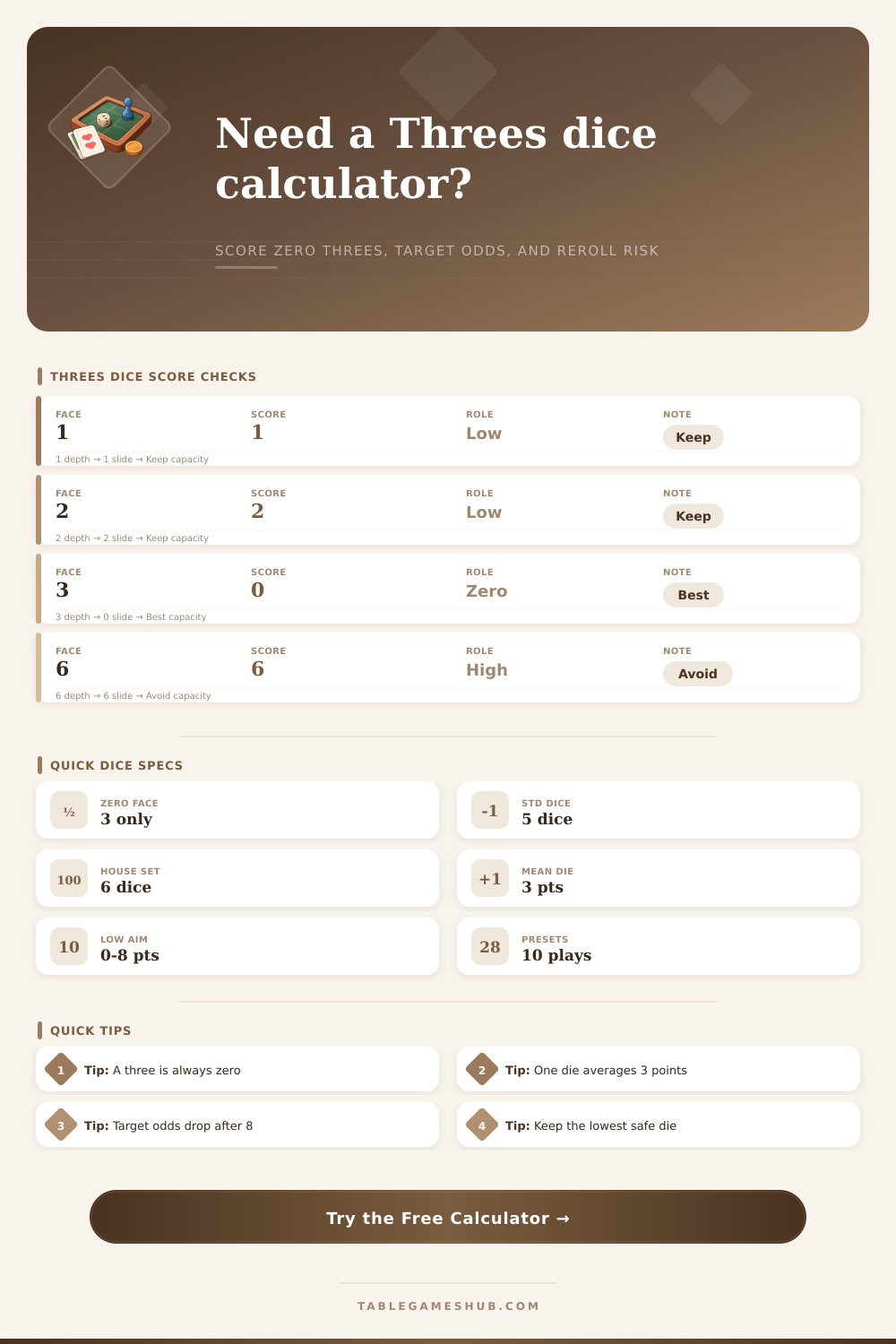
Enter the dice showing now if you want a keep recommendation. A three has score zero; every other face scores its pip value.
| Die face | Threes score | Keep priority | Reason |
|---|---|---|---|
| 1 | 1 point | Second best | Smallest scoring die when no three is available. |
| 2 | 2 points | Third best | Usually acceptable when the target is not extremely tight. |
| 3 | 0 points | Best | Always reduces risk because it adds nothing to the score. |
| 4 | 4 points | Low priority | Keep only when forced or when reroll risk is worse. |
| 5 | 5 points | Very low | High enough to break many cutoff targets. |
| 6 | 6 points | Last resort | The worst single face in a low-score turn. |
| Dice rolled | Chance of at least one three | Expected points | Typical use |
|---|---|---|---|
| 1 die | 16.7 percent | 3.0 | Endgame, forced final die, or last keep decision. |
| 2 dice | 30.6 percent | 6.0 | Close turns where one zero can still save the score. |
| 3 dice | 42.1 percent | 9.0 | Middle turn with a realistic chance to find a three. |
| 4 dice | 51.8 percent | 12.0 | Early roll after one die has been kept. |
| 5 dice | 59.8 percent | 15.0 | Opening standard Threes roll. |
| 6 dice | 66.5 percent | 18.0 | House variant with a larger starting hand. |
| Target allowance | 1 die chance | 2 dice chance | 3 dice chance |
|---|---|---|---|
| 0 points left | 16.7 percent | 2.8 percent | 0.5 percent |
| 3 points left | 50.0 percent | 25.0 percent | 12.5 percent |
| 6 points left | 100.0 percent | 58.3 percent | 33.8 percent |
| 9 points left | 100.0 percent | 86.1 percent | 63.0 percent |
| 12 points left | 100.0 percent | 100.0 percent | 86.1 percent |
| Table state | Dice to roll | Safe keep | Calculator note |
|---|---|---|---|
| Opening standard turn | 5 dice | Any three | Start by looking for zero points before low pips. |
| No three showing | 3 to 5 dice | One if present | A one costs little and keeps the turn moving. |
| Target under 8 | 2 to 4 dice | Three or one | High faces can make the target nearly unreachable. |
| Final die | 1 die | Lowest visible | Expected value is 3 points before the die lands. |
| Six-dice house play | 6 dice | Threes first | More dice gives better zero odds but a higher total EV. |
Target check: subtract your locked non-three points from the score you need to beat before deciding whether a reroll has enough room.
Keep check: if no three is showing, keeping a one is usually the smallest damage; keeping a six is almost always a forced move.
There’s a moment in Threes that will come for all of us when five dice appear and your brain shuts off. Two ones, a four, two sixes. The number on the screen are high. Your every instinct force you to re-roll. Anything has got to be better then those dang sixes! Except … if you do, you risk busting out.
This is where calculator comes in handy. It won’t tell you what to do, but it’ll translate your gut anxiety into real probability. Threes’ core mechanic are simple. Three scores zero, while everything else add its pips to your total. As rounds go by, you don’t want to fall too far behind; you still want to keep your points low enough to remain in the game.
Use Math to Play Better
For most players, rolling a three is simply one of several lucky outcomes. In fact, it is the entire plan. On average, each face of every die represent three points, and so a random throw of dice slowly but surely marches you towards elimination. By inputting your present board state, i.e., how many threes you have safely off to the side and how many non-three points you’ve already banked, the calculator will estimate the odds of one additional roll doing more harm then good.
That’s because presence or absence of a three already secured alters your whole risk profile: you’re not a blank slate anymore. What you get out of this are the chances in percentages that you’ll be under your cutoff point. So it will tell you the probability of remaining under based off your decision to reroll. And you can know when to stop rolling when that figure gets into the “I’m not sure I want to fight the dice anymore” range of ten or twenty percent.
It also flags which die to retain from a new roll, favoring zero over one. That makes sense on its face, but again, when it comes down to it, it’s reassuring when you need it most. There’s also a table of reference material on the site which add a bit more depth to your gaming experience.
The table shows the number of dice rolled compared to the chance of rolling at least one three. For instance, with five die, there’s about a sixty percent chance of having a zero face show up. Sounds great…that is until you consider there’s still a potential for the other four die to show a two through a six. Two and six are bad news bears and can quicky ruin your game.
The last round is also a bit of a game of psychology. The closer you get to that magic number, the less room there is for mistakes. Suddenly the need to go after a flawless zero seems attractive; it sounds nice on paper. However, nice doesn’t keeps you in the game. Survival is key. Staying alive can mean playing it safe for a score of two or even a four, and choosing to settle might just save your tournament life.
The pre-set scenarios in the calculator help mimic those crunch time situations and give you a chance to make decisions with no fear of forfeiting real-world points. In short, being good at Threes means transitioning away from a hope-based strategy and towards one based on risk management. You don’t have any influence over the dice, only over your level of aggression in interacting with them.
Learning which starting hands are likely to result in a loss is every bit as useful as learning how to get a low score. It’s unforgiving math, yes, but it’s still math that you can learn to predict if you’re willing to spend some time understanding it. Armed with these tools to help you see what’s most probable, you’ll make better choices, choices made out of probability, not panic.
So next time you find yourself on the edge of rolling once more or accepting mediocrity, consider this: The dice don’t give a single f… About your dreams. All they know are averages and frequencys. Trust the math, nail those zero-scoring threes when you get them and don’t be tempted to risk a lead on a dream roll.
Patience isn’t just a virtue, it’s a statistical edge and it’s what distinguishes winning consistency from the casual player. You should of known that sooner.