⚠ OSHA DART Rate Calculator
Estimate DART, TRIR, and severity from case counts and worked hours.
| Measure | Value | Formula | Read |
|---|
| Metric | Formula | Input focus | Read |
|---|---|---|---|
| DART rate | DART x 200k / hours | DART cases | Core safety rate |
| TRIR | Recordables x 200k / hours | Total recordables | All case burden |
| Severity rate | Lost days x 200k / hours | Lost workdays | Time impact |
| Case share | DART / recordables | Mix of cases | DART share |
| DART band | Rate | Read | Use |
|---|---|---|---|
| Low | 0.00-0.99 | Clean zone | Keep tracking |
| Moderate | 1.00-1.99 | Stable zone | Watch trends |
| Watch | 2.00-3.99 | Needs review | Check causes |
| High | 4.00+ | Elevated risk | Prioritize action |
| Scenario | Hours | DART | Read |
|---|---|---|---|
| Office admin | 160k | 1.25 | Low volume |
| Warehouse peak | 168k | 3.57 | Watch lifts |
| Construction crew | 124k | 6.45 | Higher exposure |
| Plant line | 300k | 5.33 | Track closely |
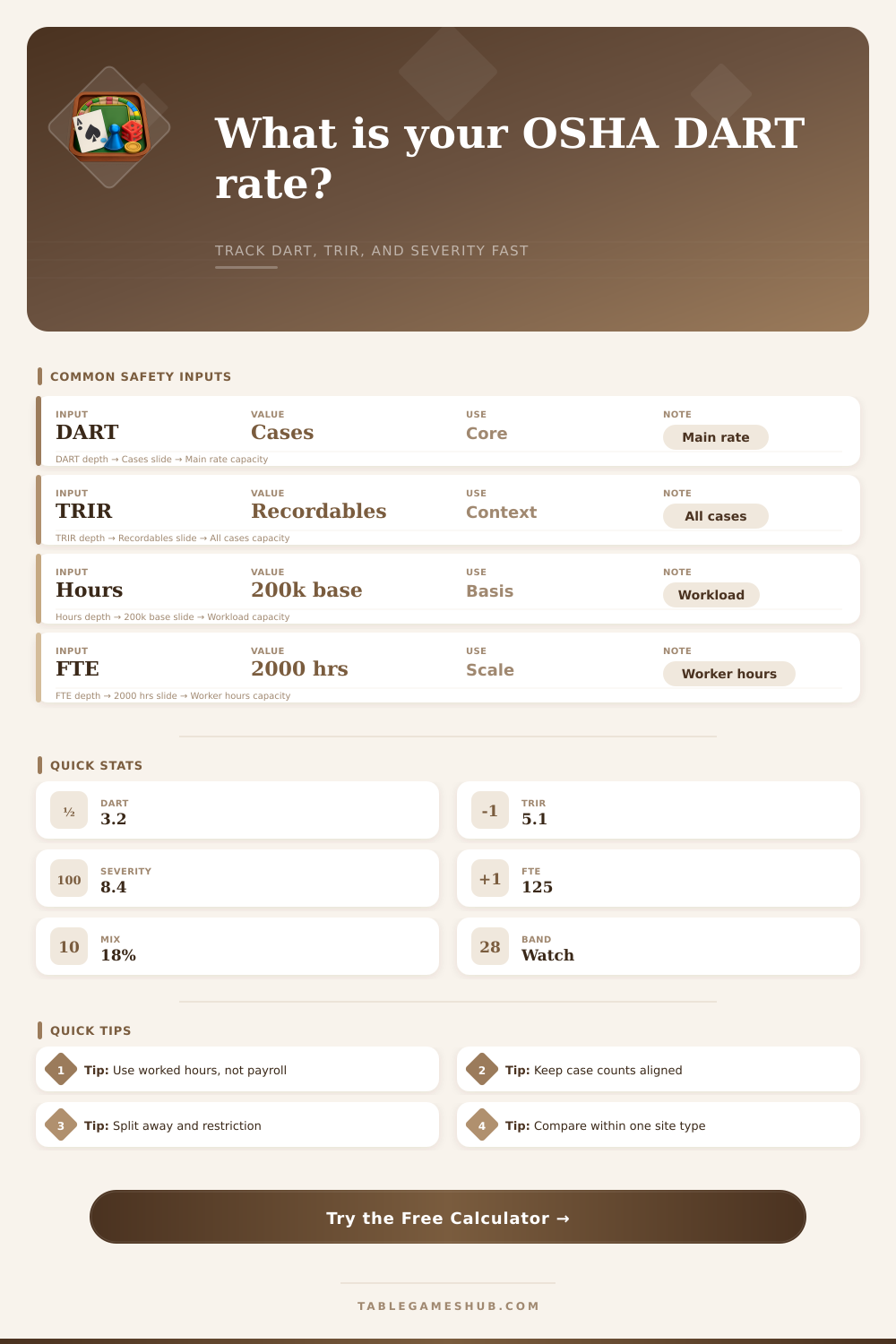
Use worked hours only
Worked hours keep the rate honest. Estimated payroll or scheduled time can tilt the result away from the OSHA formula.
Keep case buckets consistent
DART, days away, restricted, and transferred numbers should come from the same reporting snapshot so the mix stays readable.
This OSHA DART rate calculator turns worked hours and case counts into DART, TRIR, severity, and average-day metrics so you can review reporting periods with cleaner math.
DART stands for Days Away, Restricted, or Transferred. DART is use to measure work-related injury that cause a person to miss work. There are specific type of incidents that is tracked because these types of incidents impact the normal operation of a workplace.
A person may miss a shift due to an injury. Additionally, a person may have restricted duty due to an injury. Furthermore, a person may be transferred to a different position due to there inability to perform their original duties.
How DART Measures Work Injuries
DART normalizes these incident with 200,000 hours of work. 200,000 hours is the amount of hour that 100 employee put in for a year with a work schedule of 2,000 hour each. 200,000 hours is used for comparing DART rates for small crew to large plants, thus allowing for both group to have an even playing field when comparing their rates.
DART is used alongside the Total Recordable Incident Rate or TRIR. The difference between the two is that TRIR keep track of all logged incidents with OSHA, but the DART metric track only those that make a person either away from work, restricted in their duties, or even transferred to another position in the company. The severity rate metric track the total number of day that workers are away from or restricted from their duties.
The average days per DART case track the average length of time that a worker is away from or restricted from their duties for a single instance of DART. All of these metric will provide a complete view of the impact of workplace safety on productivity and employee schedule. DART uses actual worked hours to calculate the rate.
Many people will calculate this using payroll hours instead. Payroll hours include days off from work for the worker. Worked hours only include the hours that a worker is actually performing their job.
Using payroll hours will give a DART rate that is too low. Additionally, if someone calculates the DART rate using incorrect mathematics to obtain a low rate, that rate will not reflect the actual safety of the workplace. DART rates should also be calculated separately for days away from work and days restricted in their work.
Days away from work might require the improvement of fall protection on a job site. Days restricted from work might require a better ergonomics program to prevent injury. Severity rate is an important rate for determining the impact of workplace injuries on a company’s total output.
An injury that takes a worker away from work for 20 days is a more impactful rate on a company than five worker getting injured that only last for a few days. In other words, severity rate allow for an understanding of the impact of the number and severity of workplace injuries. Banding for DART rates allow individuals to categorize the company’s DART rate.
If the DART rate is below 1.0, then the company is in the low band for DART rates. If the DART rate is between 2 and 4, the company is in the watch band. And if the DART rate is above 4, then the company is in the high band for DART rates.
The DART and severity rate for a company should be monitored together to determine the nature of the problem within the company. If the DART rate is in the moderate range with a high severity rate for incidents, then there are few injury in the company but the injuries that occur are more severe. If the company has a high DART rate but with a low severity rate for injuries, there are many workplace injuries but they are not that severe.
Additionally, it is also important for manager to look at the quarterly trend of DART and severity rates for the company rather than just one month at a time. DART and severity rates will smooth out the impact of one bad month within a quarter. Quarterly trends are essential to monitoring the direction of the safety of the workplace over time.
Finally, DART rates should be paired with incident log for each company. The DART rate will reveal that there is a problem within the workplace, but incident log will reveal the cause of the problem.