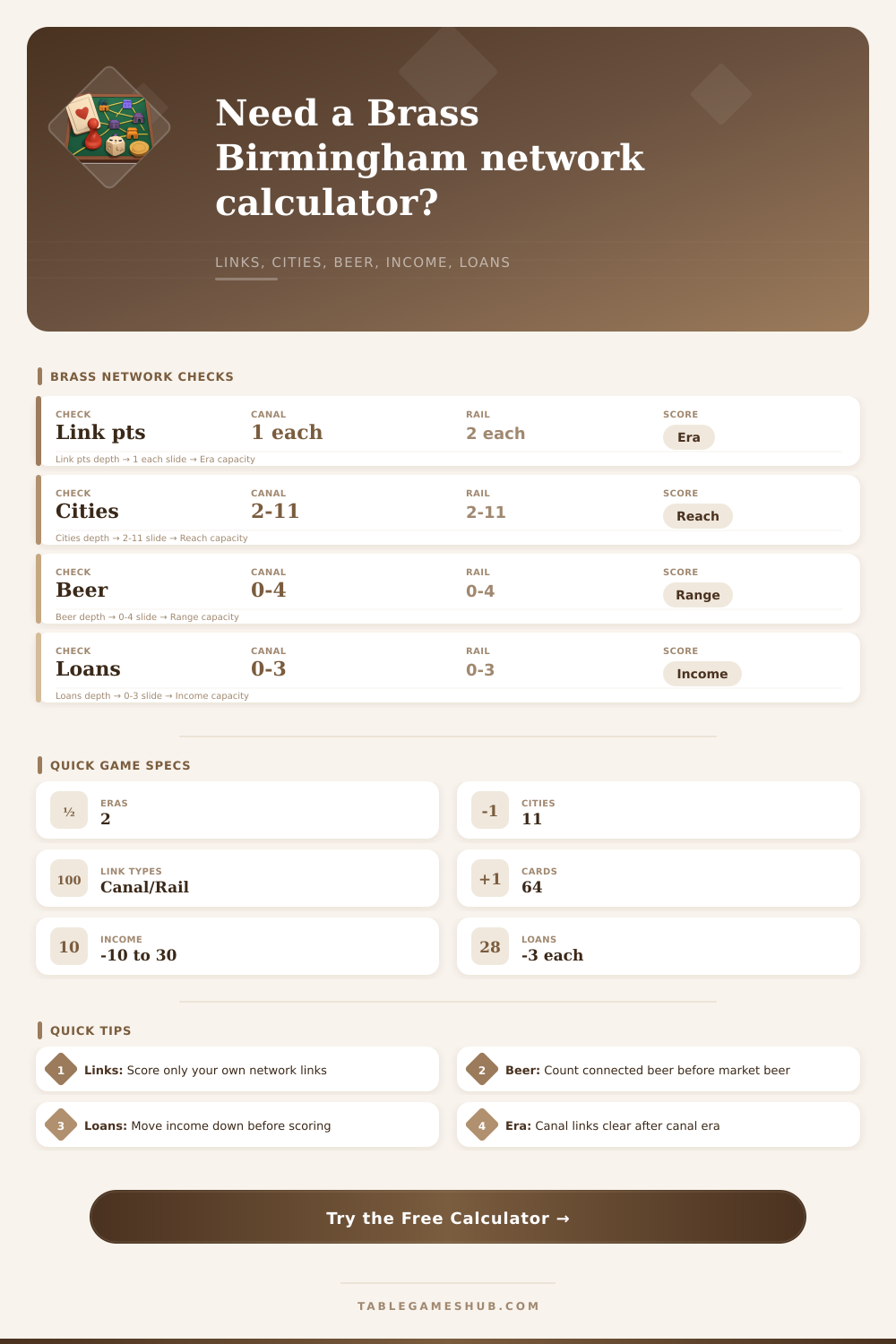
Brass Birmingham Network Calculator
Total a Brass Birmingham network from canal or rail links, connected cities, flipped industry tiles, beer reach, income movement, loan pressure, and era scoring checks.
1Network State Presets
Load a named board state, then edit the links, cities, flipped tiles, beer, income, loans, and era settings to match the player network being scored.
2Links, Cities, Industries, and Beer
3Board Component and Spec Grid
4Brass Birmingham Reference Tables
| Link type | Era used | Score per owned link | Network scoring note |
|---|---|---|---|
| Canal link | Canal era only | 1 victory point | Scores during canal era scoring, then canal links are removed. |
| Rail link | Rail era only | 2 victory points | Scores at the end of the rail era and remains part of final network reach. |
| Mixed transition | Canal to rail reset | Separate by era | Canal link score does not carry rail link pieces forward. |
| Disconnected spur | Either era | Scores if owned | The link scores, but reach notes warn when cities are isolated from beer or sale paths. |
| Industry family | Flipped input name | VP per flipped tile | Income steps per flipped tile |
|---|---|---|---|
| Cotton mill | cotton | 5 VP | 2 income steps |
| Iron works or coal mine | iron or coal | 3 VP | 1 income step |
| Manufactured goods | manufacture or goods | 4 VP | 1 income step |
| Pottery or brewery | pottery or brewery | 6 VP or 4 VP | 2 or 1 income steps |
| Reach state | Beer source | Sale support | Calculator treatment |
|---|---|---|---|
| Connected brewery | Your network or connected opponent beer | Can support cotton, goods, and pottery sale | Counts in beer barrels reachable. |
| Merchant beer | Printed merchant spot | Used only when selling to that merchant | Count only if the sale route reaches the merchant. |
| No beer reach | No connected barrel | Sale may be blocked | Warning appears when flipped sale industries exceed beer reach. |
| Rail beer demand | One beer often supports rail building | Matters for rail network expansion | Rail presets highlight low beer reach. |
| Step | Track or board action | Score impact | Audit reminder |
|---|---|---|---|
| Flip industry tiles | Move income marker up by tile income icons | Industry VP scores when flipped | Enter flipped tile code before loans. |
| Take loans | Move income marker down 3 per loan | No direct VP change | Calculator caps the marker from -10 to 30. |
| Score links | Canal or rail link points by era | Added to era network total | Mixed mode reports canal and rail separately. |
| Cleanup | Canal tiles and links clear before rail era | Flipped canal industries already scored | Unflipped canal-era industries do not score. |
5Network Scoring Tips
Separate link scoring from reach: owned canal or rail links score by era even when the shape is awkward, but the same shape may still block beer-supported sales.
Audit income before cash collection: flipped tiles move the income marker up, then each loan moves it down 3 spaces before the next income collection.
In Brass: Birmingham, you’re building up a network. You need to draw lines between certain spots around the board, Your brain can only handle so many variables. So when you’re focused on visual connections, it’s easy to miss whether or not those connections lead toward the beer that will sell. That’s where a lot of people fall short, failing to realize there’s a difference between visual reach and mechanical scoring.
After inputting your industry flips and link ledger, let calculator do the math. Avoid those nail-biting moments when you’re not sure if you’ve counted victory points correcty. The tool separates the joy of track-laying from the grind of keeping tabs on your earnings.
How to Count Points and Manage Money in Brass: Birmingham
Links built in canals last through only one era (score one point per link) then vanish into thin air, whereas rail links endure longer (two points per link), though they also cost more to construct. Recognizing this trade-off shifts your perspective on expansion. Maybe you’ll pack as many links as possible near Birmingham so that selling is denser different than just having more links, which can be worth fewer victory points overall. Does it pay off? That’s where the tool shines: it allows you to visualize whether or not your plan will generate enough victory points to make those cards worthwhile.
The game punishes optimism on income management. When you flip a tile in industry row, your income marker go up. Sounds great!… Until you realize, oh yeah, I want to buy some cards. For that, I need cash. Cash comes from loans. Each loan pulls your income marker back three spots. It is a brutal arithmetic loop. You borrow to build, building increases income, and debt pushes income back down.
The calculator takes all of that into account. You can enter your existing loans, and it will show you what happens to your marker as a result. If your income gets pushed down too low, you stall out. That’s the part that trips up most folks. Suddenly, they find themselves staring at a pile of empty card slot with zero dollars to fill them.
The mid-game economy focuses on beer. The economy in the middle of the game revolves around beer. Sure, you’ve got a bunch of fancy looking rails running through half the board, but no way to get beer to them? Your cotton mills and pottery shops might as well be for decoration. The tool rates your beer reach separately from your link points. Because they do two different thing. Link points score you points, and beer gives you resources in game.
Many people fail to understand that there’s a distinction between merchant beer and connected brewery beer. Merchant beer is a one-time resource, whereas connected brewery beer enables multiple sales. This means if you’re building a network based off solely on merchants, you’re playing a significantly more difficult game then you think. The page has some great reference tables to illustrate this. It shows how each state of reach supports or blocks different industries.
When the game moves from canal to rail, the board state shift radically. Canal tiles vanish. Unflipped industries is permanently lost. That puts a rush on those last few rounds of initial era. Do you use actions to lay links so that you can get some benefit from them later? Or do you flip tiles just for victory points?
That’s where the calculator comes in… You can put your canal and rail scores side-by-side and see how it works out. Does your network hold up to the cleanup stage? Are you strong enough to make the switch to rail? If your score drop once you switch over, you were focusing too much on short term rewards. You did this at the cost of building long term infrastructure.
To understand Brass: In Birmingham, you have to hit three competing targets: maximum income, the most link points, and enough resource reach. Very few of these will align neatly. This is what makes Brass such an interesting game. The tool allows you to clearly audit which areas need work. What used to be a feeling (is my network healthy?) becomes hard numbers.
Do I really need to connect to Coventry? If so, how many points am I getting from this connection? Can it help me make the sales I need to? Until you play with these inputs you won’t know what works. While most glamorous looking strategy might be appealing, sometimes they are the quietest ones. They increase income and slowly build up victory points in the background.
Keep an eye out on those loans. Monitor where you get your beers from. You should of let the numbers show you the way forward before the board is wiped clean for good.