Keep Highest Dice Calculator
Model roll-and-keep dice pools with exact top-dice distribution math, low-die drops, one-pass reroll rules, flat modifiers, target totals, and kept-die threshold hits.
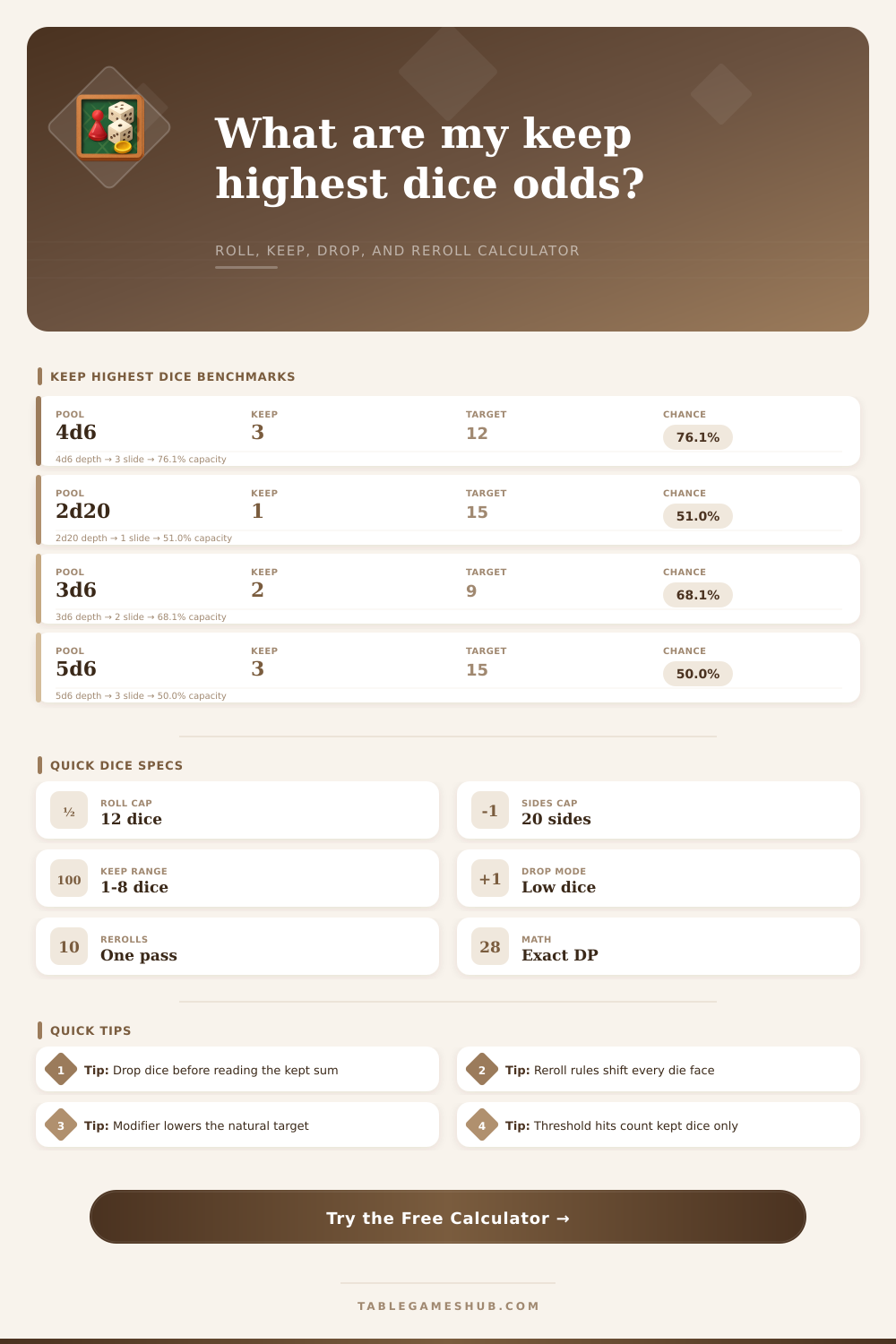
| Profile | Roll | Keep | Typical read |
|---|---|---|---|
| Ability score | 4d6 | Highest 3 | Natural 3 to 18 attribute total |
| D20 advantage | 2d20 | Highest 1 | One check die after advantage |
| Risk attack | 3d6 | Highest 2 | Compare top dice against defense |
| Action pool | 4d6 | Highest 1 | Read the single best face |
| Die | Single mean | High face | Threshold note |
|---|---|---|---|
| d4 | 2.5 | 4 | Threshold 4 is strict |
| d6 | 3.5 | 6 | Threshold 5 fits many pool games |
| d10 | 5.5 | 10 | Threshold 8 is a high read |
| d20 | 10.5 | 20 | Threshold 15 is a hard check |
| Chance | Band | Table meaning | Adjustment lever |
|---|---|---|---|
| 75%+ | Comfortable | Target is usually reached | Raise target or keep fewer dice |
| 50-74% | Contested | Target is a live check | Small modifier changes matter |
| 25-49% | Difficult | Roll needs above-average dice | Add dice or allow reroll 1s |
| Below 25% | Severe | Target needs an exceptional roll | Lower target or keep more dice |
| Option | Rerolled faces | Second result | Use case |
|---|---|---|---|
| No reroll | None | Original die stands | Baseline roll-and-keep math |
| Reroll 1s | Face 1 only | Second die must stand | Common heroic house rule |
| Below threshold | Faces under input threshold | Second die must stand | Push for kept threshold hits |
| Non-maximum | All but top face | Second die must stand | Extreme best-face model |
There you are at the table, surrounded by people who have rolled dice before. A friend proposes: “roll four six-sided dice and drop the lowest die.” Another counters: “No, it’s more fair to keep just the highest three dice.” A third says: “If I get any ones, I roll again. It is bad luck. The room falls silent, each person attempting to imagine the probabilities (though nobody wants to throw anything).
Almost every tabletop game night has this moment of hesitation, where there is a disconnect between our intuitive understanding of dice and their actualy behavior given certain house rules. People have an instinctive feel for this, typically more dice equates to more numbers. However, if you introduce conditions like keeping the best or discarding the worst, things stops working that way. It’s not clear what effect it has on the distribution.
How Dice Rules Change Your Chances
For example, rerolling one’s feels like a small benefit, but in fact, it eliminates the lowest number completely from the pool of possibilities, which alters shape of the probability curve. That’s where folks screw up: they think of it as a small adjustment instead of a fundamental change to the mathematics.
Fortunately the above tool does all that tricky math for you. It calculates each possible scenario in an exact way. It will even include modifiers added after the sum and drops on lower dice. You can adjust inputs and it essentially changes your character’s or strategy’s risk profile. E.g., if you add more dice to a pool with same number of highest dice then you greatly reduce variance. There are fewer legendary successes and fewer spectacular failures.
Much of game design philosophy is about this tradeoff. Take two examples: keep-highest vs. You could also just add up the results. Three six sided dice adds up to a nice bell curve around 10-11. If you instead take five dice and discard all but your best three, suddenly center of gravity moves way upwards. You are filtering out low end. This drags up the average and narrows range of possibilities.
That’s what people do when they play certain critical checks in Dragon Age and some iterations of D&D. They desire the drama but not the sting of an utter failure because of one dice.
There’s one other wrinkle that the calculator considers: reroll rules. In many heroic fantasy settings, a character won’t roll again if they get the lowest result, but will reroll an “1” (or perhaps a “2”). It works like this: First, it changes the chance of any given number showing up (including 1). Then, it sorts the dice to see which numbers is highest. Why? That way, final results match how they would be in-game, rather than just being an approximation of how we think they might work.
Threshold hits add another layer of depth to single-die pools. Many moddern RPGs aren’t just about reaching a numerical goal; it’s also about having sufficient numbers of hits above a certain number. With the tool, you can keep track of which dice hit their mark and then see if they were over a certain threshold. For example, this would help balance encounters when one side has a big pool of weak dice and someone else on the other side have a few powerful dice.
Knowing this stuff makes you a more informed decision maker at the table. When your buddy wants to try something different, you’ll be able to back up your argument. You’ll also be able to adjust your own game designs more precisely. Knowing the odds means you’re just not arguing about things anymore; you have the facts. The math doesn’t lie as to how often things happen. It only shows the structure underneath all the chaos.
Next time someone says “let’s drop the low die,” you’ll know exactly what you gain and lose in reliability, and what you gain/lose in variance. The dice still goes wherever they please, but you’ll know the terrain on which they roll.