🎯 Bocce Ball Score Calculator
Score a measured frame, count balls inside the opponent, update the race total, and flag cap or mercy situations.
| Measure | Value | Calculation | Note |
|---|
| Frame result | How points are counted | Typical score | Calculator handling |
|---|---|---|---|
| One ball closest | Only the nearest ball is inside the opponent | 1 point | Winner gets one frame point |
| Two balls inside | Two winner balls beat opponent's nearest ball | 2 points | Both live balls score |
| Sweep frame | All winner balls are closer than any opponent ball | 3-4 points | Limited by balls and frame cap |
| Exact nearest tie | Closest balls measure equal | 0 or remeasure | Uses selected tie rule |
| Match format | Balls per side | Common race | Scoring note |
|---|---|---|---|
| Singles | 4 balls | 9 or 12 | One player controls every throw |
| Doubles | 4 balls | 12 or 13 | Most common casual and league setup |
| Team fours | 4 or 8 balls | 12 or 15 | Use cap if frames swing too sharply |
| Tournament race | 4 balls | 11, 12, or 13 | Record frame-by-frame totals |
| Pallino length | Imperial check | Metric check | Frame feel |
|---|---|---|---|
| Short | Under 25 ft | Under 7.6 m | Compact frame with tight clusters |
| Standard | 25-45 ft | 7.6-13.7 m | Balanced court-length frame |
| Long | 45-60 ft | 13.7-18.3 m | More roll and separation |
| Very long | Over 60 ft | Over 18.3 m | Check house boundaries |
| Cap or mercy setting | What it changes | Best use | Score sheet effect |
|---|---|---|---|
| No frame cap | All inside balls count | Standard scoring | Maximum equals live balls |
| 2 point cap | Limits big frames | Casual short races | Trim excess inside balls |
| 4 point cap | Matches common four-ball max | Doubles and league play | Usually no trim |
| Mercy lead | Flags a large updated lead | Round-robin pacing | May end match by house rule |
Measure from the pallino center
Use the same center-to-center method for every ball in the frame; mixing edge and center measurements can change which balls count.
Only the winner's inside balls score
After the closest ball is identified, count only that team's balls that are closer than the opponent's nearest live ball.
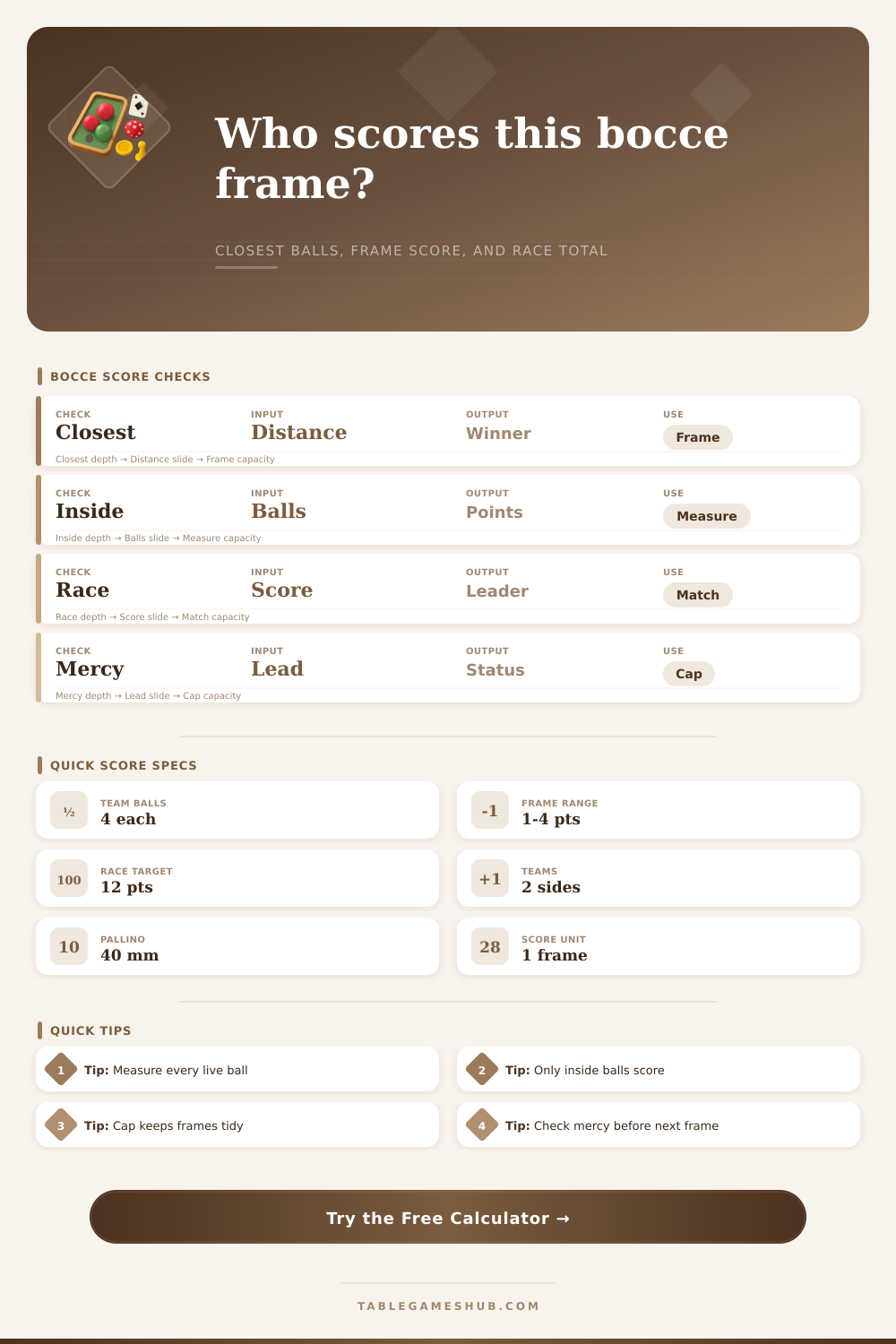
Use the bocce ball score calculator to turn measured ball distances into a frame winner, frame points, updated race score, and cap or mercy note.
Bocce require a person to evaluate the position of ball on a court. The scoring of bocce depends upon how close the balls of each team are to a target ball call the pallino. Each frame of bocce begins with one player tossing the pallino onto the court, and each team tossing four ball into the pallino.
The team whose balls is the closest to the pallino wins the frame. However, each team only wins the frame if their balls are more closer to the pallino than the balls of their opponent. Because the difference in distance between each ball and the pallino may be very small, it is common for the players of each bocce team to disagree as to which ball is the closest ball to the pallino.
How to Score Bocce and Avoid Arguments
These disagreements are normally create due to the difficulty in measuring small distances, and due to the fact that each player may use a different method for measuring the distance between their balls and the pallino. Bocce dispute are common if the balls of each team are clustered near the pallino, and occur due to each team member measuring the distance between their balls and the pallino with different method. For instance, one player may measure from the center of the ball to the center of the pallino, but another player may measure from the edge of the ball to the edge of the pallino.
Furthermore, if one of the balls of a team rolls into the pallino, the opponent may dispute the distance of the balls of that team for the simple reason that the opponent claim that their ball touched the pallino. The use of the calculator to determine the winner of each frame will avoid these disputes between teams by allowing each player to use a consistent method for measuring distances between balls and to apply any house rules for that game of bocce. The calculator will perform the math for the teams after each player input the distance of each ball from the pallino, and the current race score for bocce.
The position of the pallino will impact the play of bocce. The position of the pallino will impact the number of point scored by each team during each frame of bocce. For instance, if the pallino is tossed such that it is a short distance from where the balls were initially positioned, the balls will tend to cluster near the pallino.
In the case where the balls cluster near the pallino, even small measurement error will impact the score of each player. Alternatively, if the pallino is tossed a long distance from each team’s balls, the balls will be spaced out across the court. In this case, the balls thrown with more control are more likely to win frames than balls thrown with more force and the risk of banking into the opponent’s balls.
Many league will set a minimum distance from each team’s balls to the pallino to avoid disputes between teams. This minimum distance can be entered into the calculator before play begins. A dead ball occurs when a player’s ball rolls out of bounds, or rolls into the back wall of the bocce court.
Any ball that is declared a dead ball is no longer count toward the frame. However, the team whose ball became a dead ball is one ball short of their total count for the frame, which does affect the strategy of the team during that frame. Any dead balls can be recorded in the calculator to ensure that only live balls are counted.
If the dead balls are not recorded in the calculator, it is possible to accidental include one of these balls in the total ball count for the frame. Including a ball that is no longer in play will result in an incorrect count for the frame winner and the race total. The players can set mercy rules and frame caps for that game of bocce.
Mercy rules can be used for games in which one of the teams has a large lead for the opponent. For instance, a seven point lead between teams might be decisive in a short bocce race, but might not be decisive in a long tournament. The mercy rule can be programmed into the calculator to make it easy for the players to recognize when the lead of one of the teams reach a certain threshold.
Frame caps can be used to limit the number of points that one of the teams can score in a single frame. Without a frame cap, a team may score a large number of points within a frame if the balls of that team are all within the balls of their opponent. A frame cap will limit the number of points that one team can score in a single frame however.
Ties occur when two or more balls are within the same distance from the pallino. In these situations, a tie rule must be established to decide which team receives the frame. Common house rules state that the balls must be measured again to determine the closest ball to the pallino, or the team that tossed the last ball into the frame wins the frame.
This tie rule can be programmed into the calculator in advance of the game begins. By setting the tie rule prior to the game, players can avoid any arguments regarding the winner of a frame during the game. Overall, scoring bocce involves the players agreeing on the distance of each ball from the pallino, and resolving any arguments that may occur between the players regarding that distance.
The calculator allows the players to make the rules that will be used during the game visible to each player, allowing them to focus upon playing bocce.