Axis and Allies Dice Calculator
Model d6 combat by attack and defense value, opening bombardment, casualty order, and retreat rounds to compare expected hits with survival odds.
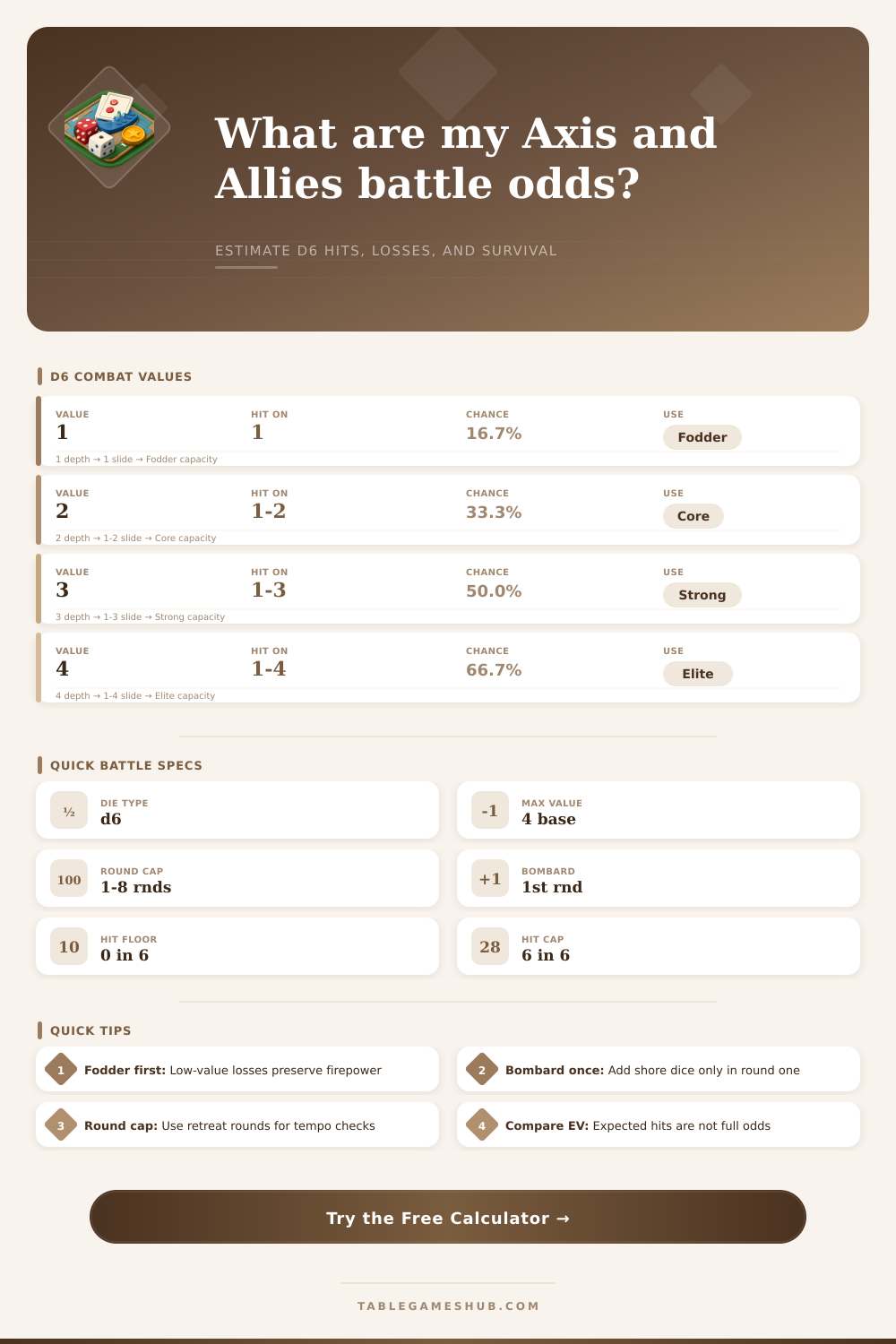
| Combat value | Natural hit roll | Hit chance | Expected hits per 6 dice |
|---|---|---|---|
| Value 1 | 1 | 16.7% | 1.00 |
| Value 2 | 1-2 | 33.3% | 2.00 |
| Value 3 | 1-3 | 50.0% | 3.00 |
| Value 4 | 1-4 | 66.7% | 4.00 |
| Value 5 after modifier | 1-5 | 83.3% | 5.00 |
| Value 6 after modifier | 1-6 | 100.0% | 6.00 |
| Step | What the calculator does | Why it matters | Output affected |
|---|---|---|---|
| Opening support | Adds bombard-style dice in round one only | Raises early casualty pressure | Win odds, losses |
| Roll dice | Builds hit distributions for every combat value | Uses full probability, not one average roll | Survival odds |
| Simultaneous fire | Both sides score hits before losses are removed | Defenders still fire when destroyed that round | Expected losses |
| Casualty order | Removes low or high value units first | Changes future-round firepower | Round breakdown |
| Retreat cap | Stops unresolved battles at the selected round | Useful for strafe planning | Contested odds |
| Modifier type | Timing | Typical use | Calculator setting |
|---|---|---|---|
| Bombard-style support | First round only | Naval or artillery-like opening dice | Bombard dice and threshold |
| Landing attack boost | First round only | House-rule beach assault bonus | Landing force +1 attack |
| Coastal disruption | First round only | House-rule defender penalty | Coastal defender -1 defense |
| Global attack shift | Every round | Scenario-wide attack advantage | Attack threshold modifier |
| Global defense shift | Every round | Scenario-wide defensive terrain | Defense threshold modifier |
| Preset | Attack profile | Defense profile | Best use |
|---|---|---|---|
| Infantry Territory Trade | Many value 1, one value 3 | Small value 2 screen | Routine land exchange |
| Amphibious Beach Landing | Mixed land plus bombard | Layered defense | First-round support test |
| Capital Crack With Air | High value air-heavy force | Large stack | Long combat swing check |
| One-Round Strafe Check | High opening punch | Medium defense | Retreat after one round |
The combat calculator will allow you to calculate the mathematical probability that you will succeed in your battle. Many player rely on the feeling of momentum to determine how they will win there battles. However, the feeling of momentum isnt a mathematical certainty.
The combat calculator calculates the survival odds that the combat calculator calculates are more accurate than the feeling of momentum. You can use the combat calculator to determine the actual percentage of your battles, and it can help you to decide whether an attack is a strategic or risky move for your army. To use the combat calculator, you will have to input the number of unit that you have into the calculator.
Find Your Army’s Chance to Win
The units will represent the quantity of troops that you have in your army. Additionally, each unit will have a value, and that value will represent the quality of the troops that you have in your army. Using low-value units can protect your high-value units.
High-value units will provide more “hits” during the battles. Losing your high-value units early in the battle will result in fewer expected hits, which will result in fewer win probability for your army. The combat calculator will also factor in the opening bombardment that your army will deploy before the battle.
The opening bombardment will roll support dice before the main combat occurs between the two army. By reducing the number of defender for your enemy during the opening bombardment, the remainder of the battle will be easier for your army. The combat calculator will account for the opening bombardment as a separate initial burst of support dice that occur before the main battle.
Another function of the combat calculator is the ability to model an amphibious landing. Performing amphibious landings is a risky tactic for your army because there are often modifiers that will affect your army or the enemy during amphibious landings. These modifier will change the calculated win probability for your army.
Even small change in the hit threshold will result in a large change in the number of casualties that will occur in the battle. The combat calculator will calculate the impact of these effect modifier on your armys survival odds. It is important to understand that the expected hits for your army are not the same as the win guaranteed for that battle.
The expected hits for your army are a statistical average of the wins that would occur if your army fought the same battle repeatedly. The expected hits will not guarantee a specific number of hit will be made by your army during the battle. Many players chase the number of expected hit.
However, instead of focusing on your expected hits, you should focus on your survival odds for the battle. Another use for the combat calculator is to plan for a retreat for your army. The combat calculator will allow you to define the number of round that your army will fight before it retires from the battle.
Planning for a retreat will prevent you from committing all of your army to one battle and losing them all to a loss in the battle. Finally, the combat calculator cannot determine the outcome of the dice that will be thrown into the battle. The outcome of the dice will determine the outcome of the battle.
The combat calculator cannot determine if the dice will roll a string of high rolls or low rolls for your army. However, the combat calculator will allow you and your army to know the baseline probability of your army winning the battle. Knowing the baseline probability allows you to make decisions about your armys battle based off logic instead of desperation.
The combat calculator allows you to go from hoping for a win to having a strategy for determining the probability of a win for your army.