Auction Pitch Calculator
Score a Pitch hand from the bid, table variant, captured point cards, game pips, target score, and setback rule, then see the post-hand standings.
points made = captured point cards + game point
if points made < bid, bidder score = -bid x penalty
game point = 1 when bidder pips > opponent pips
comfort = expected points / bid, adjusted by trump read
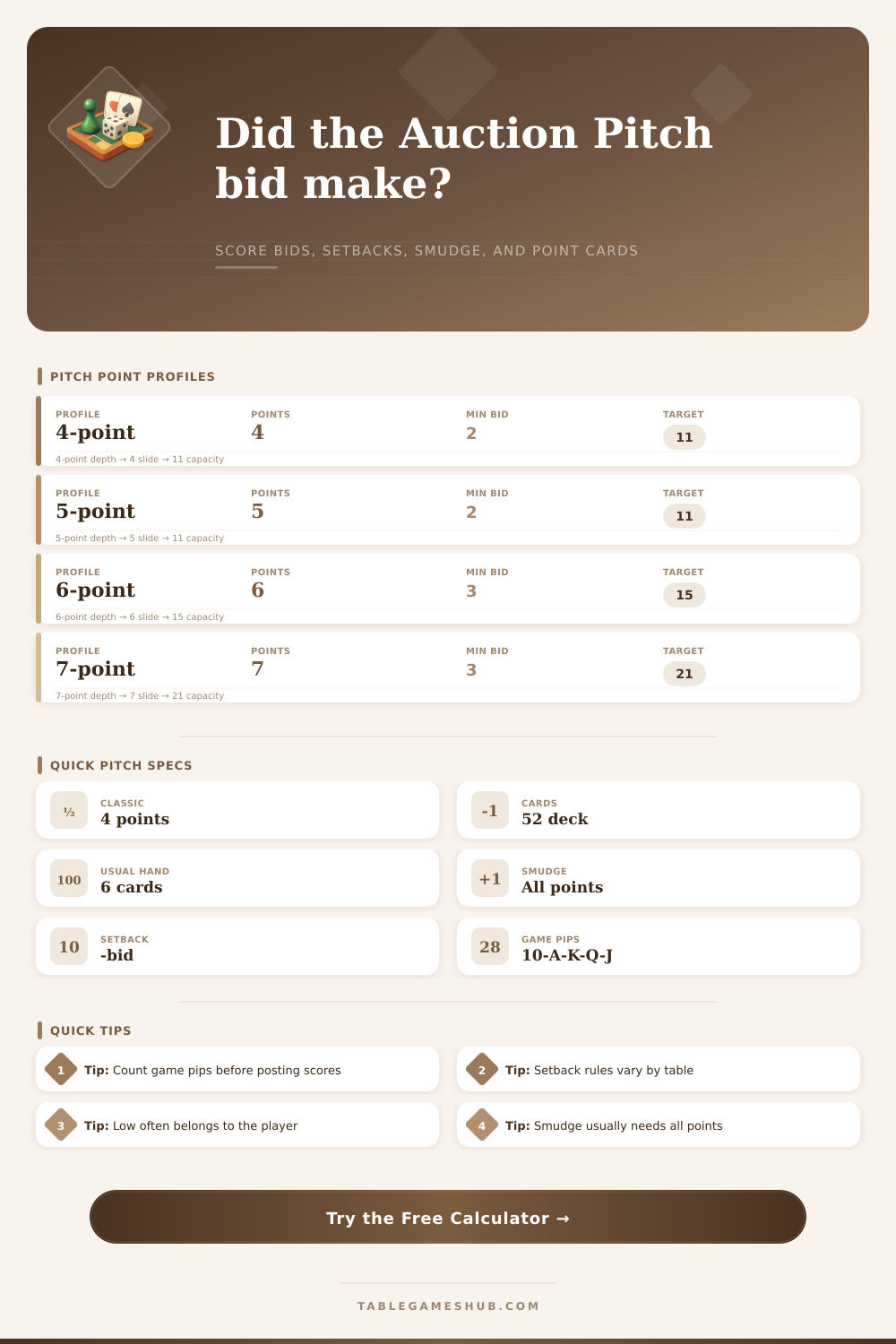
| Point profile | Available points | Common point cards | Typical target |
|---|---|---|---|
| Classic 4-point Auction Pitch | 4 | High, Low, Jack, Game | 11 or 15 |
| 5-point Pitch | 5 | High, Low, Jack, Off-Jack, Game | 11 or 21 |
| 6-point Pitch | 6 | High, Low, Jack, Off-Jack, Joker, Game | 15 or 21 |
| 7-point Pitch | 7 | High, Low, Jack, Off-Jack, two Jokers, Game | 21 or 31 |
| 10-point Auction Pitch | 10 | High, Low, Jack, Off-Jack, Jokers, 3, 10, Game | 31 or 42 |
| Bid level | Meaning on score sheet | Made result | Missed result |
|---|---|---|---|
| Minimum bid | Usually 1, 2, or 3 by table | Score points won or bid | Set back by bid |
| Middle bid | Needs multiple point cards | Strong swing if game point lands | Opponent often scores earned points |
| Max point bid | Requires every available point | May trigger smudge rule | Large setback |
| Shoot / smudge | Often all points and all tricks | House bonus or instant win | Table-defined setback |
| Game pip card | Common pip value | Why it matters | Calculator input |
|---|---|---|---|
| Ten | 10 | Largest game-pip card | Add to bidder or opponent pips |
| Ace | 4 | High rank and useful pips | Add 4 pips |
| King | 3 | Face-card pip support | Add 3 pips |
| Queen | 2 | Small game-pip edge | Add 2 pips |
| Jack | 1 | Point card plus pip card in many tables | Add 1 pip if captured |
| Table setup | Players | Common hand | Cards exposed |
|---|---|---|---|
| Partnership Pitch | 4 | 6 cards | 24 of 52 |
| Cutthroat Pitch | 3 | 6 cards | 18 of 52 |
| Five-player Auction | 5 | 6 cards | 30 of 52 |
| Six-player partners | 6 | 6 cards | 36 of 52 |
Before entering a hand, choose whether a made bidder scores actual points, the bid only, or a capped result. That one table rule changes close games.
Count High, Low, Jack, Off-Jack, and Jokers as point cards, then compare game pips separately so the Game point is not double-counted.
When the bidding gets heated in an Auction Pitch game, there’s a chance you’ll forget what points were earned on the last hand, which ramps up the tension. Adding a bit of bluffing into the mix makes it even more intense, with your brain trying to keep up with the complex scoring rules. That mental overhead take away from card play, where it should be.
This calculator lets you enter your total pips and captured points independently, leaving all math to it. Where many casuals stumble is distinguishing between game points and point cards, here’s where it matters: the core mechanic. It require not only knowing what was dealt, such as whether you had the jack. You must know if you held the high card and keep track of the pip value of all tricks taken to determine who get the bonus point in the game. And whether you are playing a seven-point version with jokers, or more traditional four-point pitch, it will use the rules set up for your table.
How to Use This Calculator for Pitch Games
Most groups will begin playing with standard rules and gradually change to more aggressive scoring as they discover that it keep their scores higher and ends games faster. They’ll use the calculator on the bidding side by turning off “Score Actual Points Won” and instead just have players get points for making their contract. That makes the game about confidence rather than counting.
If all you get for winning are the bids, then you’d better be certain you’re going to win every single point card before you risk overbidding. Failing to meet your bid can lead to dramatic setbacks. Depending on local tradition, this could result in a penalty ranging from losing nothing at all to doubling your debt. The calculator will ask what the penalty is at your table.
On one extreme, it can be that you lose twice as much than you bid (resulting in some huge swings), forcing everyone to be honest with how good or bad of a hand they have. Alternatively, you might simply lose whatever is in your hand. This means there are no repercussions except for taking a chance and getting crazy on the bid, which leads to some fun but chaotic rounds.
It’s important to know beforehand if you’re going to yell “double” so that everyone stays friends at the table. Finally, note that some teams have a shoot or smudge rule. If one team takes all of the tricks in the hand and all available points, it’s a rare event like winning the lottery in the game. The calculator has a spot for you to mark whether this was the case, and it will then figure it out automatically.
The rule either awards an immediate win (a smudge) or simply adds a big bonus on top of your target score. Adding this rule brings the tension of late-game situations, for example, when someone bids exactly 12 points because he needs 12 to make it home, who may decide to go for broke with a huge bid and hope he sweeps everything.
Then there’s all this point-counting chaos, where you award value to each card and add it all up trick by trick; these small points is what drive the game. Otherwise, whoever wins the most tricks gets the additional point. So defensive play, not just aggressive offense (can be rewarded), since you might lose four tricks but gain points by playing high-pip cards in those losing tricks. That is why you need the tool so you know how to award the right game point: did you win or lose? To prevent disputes about whether a King counts more then a Queen.
To account for this wide variety of inputs, the page includes some handy reference tables that normalize things based off how many cards are being distributed and how many people is playing. It’ll remind you, for instance, that an eight-card hand is different than a six-card hand; the fewer the cards there are, the more they’ll be exposed to the community pool, so it’s safer to bid conservatively earlier in the game (more uncertainty means less risk). You can also adjust the calculator with your own confidence level. This level will change over time as you see other players’ patterns emerge, such as calling too aggressively, or as the deck wears down.
So, what’s the point? To be fast at scoring, yes. You should of also get out of the mode of stopping yourself and counting your fingers (or arguing with someone about whose are what).
If you can let the game flow without getting hung up on admin confusion, the tension doesn’t go away… it changes from ‘who forgot how many points do they have’ to ‘how am I going to beat them’. And that’s what makes the night of cards an actual competition instead of a casual game people want to play again next week. It is about being focused on the current deal rather than getting lost in yesterday’s paperwork.