Altiplano Score Calculator
Total final VP from goods outside orders, warehouse rows, fulfilled orders, boats, houses, house bonuses, roads context, optional missions, and the coin tie-breaker.
▣Scoring Presets
📦Goods Bag and Tiles
Enter final tile counts you still own: bag, container, planning spaces, action spaces, role tile, extensions, and warehouse. Do not include goods already delivered to order cards.
🏠Cards, Orders, Extensions, and Roads
🏚Warehouse Rows
Count only completed warehouse rows. Use the printed VP at the end of each completed row on your warehouse board.
Completed rows by printed VP
Warehouse audit
✦House Bonus Icons
For each house card, enter how many house bonus icons of each good type you have. A matching house icon adds 1 VP for each owned tile of that type, excluding tiles on orders.
Final Altiplano Score
▦Goods Value Grid
📋Altiplano Scoring Tables
| Score Source | How to Count | Calculator Input | End Scoring Note |
|---|---|---|---|
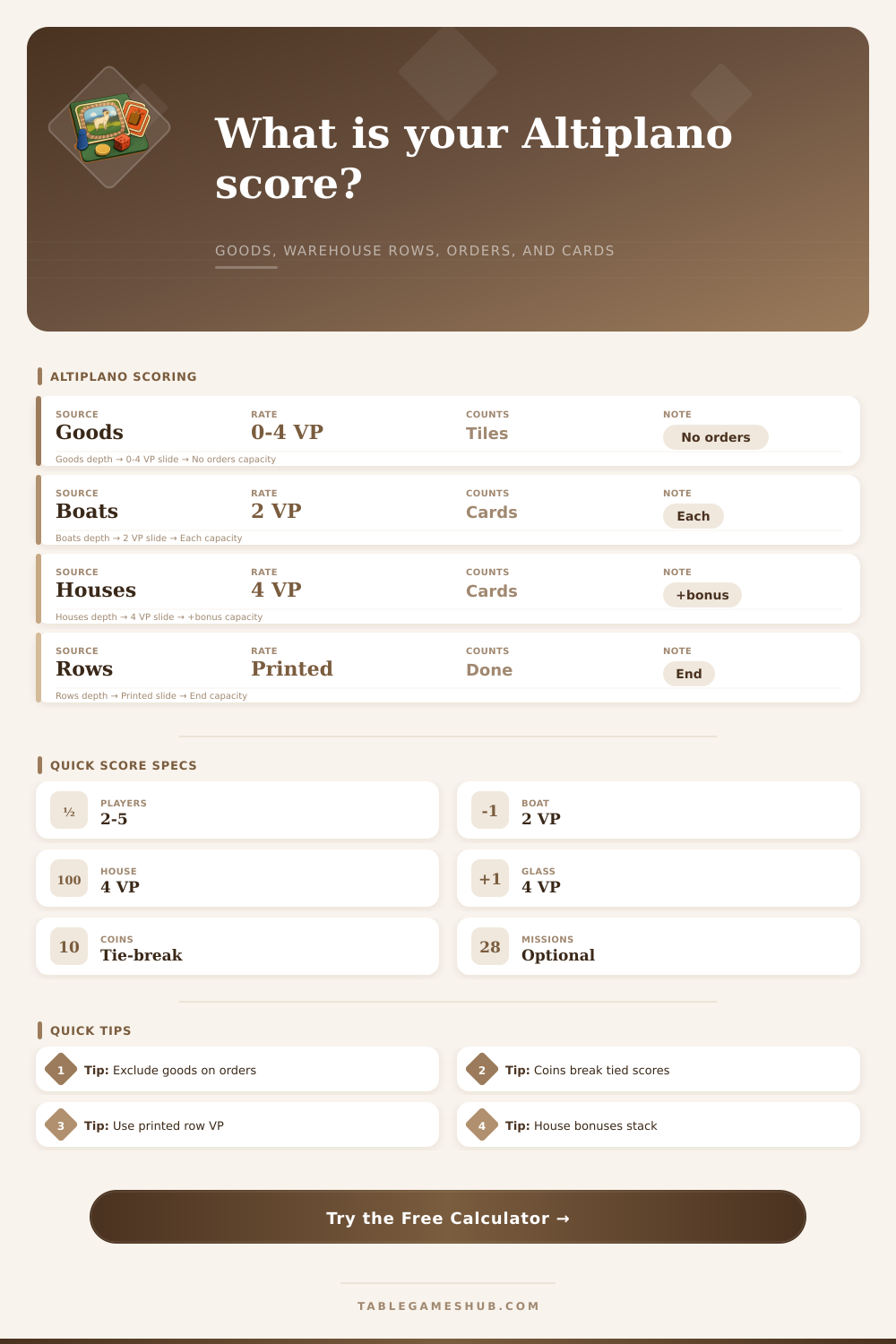
| Goods tiles | Count owned tiles, including warehouse | Goods grid | Do not count tiles placed on orders |
| Boat cards | 2 VP per boat | Boat cards built | The gained boat good is counted separately if owned |
| House cards | 4 VP per house plus matching tile bonuses | Houses and house icons | Multiple icons of a type stack as separate bonuses |
| Orders | Printed VP from fulfilled orders | Fulfilled order VP | Unfulfilled orders and their goods score nothing |
| Warehouse rows | Printed VP at the end of each completed row | Rows by printed VP | Corn may substitute in rows but has no base VP |
| Road and coins | Roads are context; coins break ties | Road spaces, coins | Road corn should be in the corn tile count |
🗺Player Count Reference
| Players | Corn Used | Common Goods | Scarce Goods |
|---|---|---|---|
| 2 players | 12 corn | 12 wood and stone | 7 alpaca, fish, glass, cacao |
| 3 players | 17 corn | 15 wood and stone | 9 alpaca, fish, glass, cacao |
| 4 players | 22 corn | 18 wood and stone | 11 alpaca, fish, glass, cacao |
| 5 players | 25 corn | 20 wood and stone | 12 alpaca, fish, glass, cacao |
✓End Scoring Checklist
| Step | What to Pull | What to Leave | Calculator Check |
|---|---|---|---|
| 1 | Bag, container, planning spaces | Warehouse stays in place | Add owned goods by type |
| 2 | Action board, role tile, extensions | Goods on orders | Keep order goods excluded |
| 3 | Boat and house cards | Unbuilt market cards | Enter card counts |
| 4 | Completed orders and missions | Unfulfilled orders | Add only scored VP |
| 5 | Completed warehouse rows | Incomplete row VP | Use printed row values |
💡Scoring Tips
As we sit back down for the final round of Altiplano, there’s a hush on the table while everyone goes over their boards. Rows of filled-in warehouses, random tiles, and cards that could be worth something but also might not, this is where many player start questioning what they’ve done. Did I get the right number of wool tile? Can I still use my house bonus if I have some goods in my sack? Points is earned from so many places that it’s too easy to make a mistake. A quick check through each player’s score will help catch those mistakes, it will also show exactly how well your little empire did.
The most popular error is overcounting goods tiles. Sure, it can be easy to look at all the tiles you’ve accumulated throughout the game and just count them up, but the rules state clearly what does and doesn’t gets counted. When adding up your total score, only include goods that are in your warehouse, on one of your action spaces, or in your container or bag. Any tiles spent fulfilling order cards aren’t part of the count. Once you trade them for points, they is no longer part of the game. They should of not been double-counted here. That’s why the scoring guide breaks out the points you earn from orders versus goods you hold. Keep in mind when tallying things up, you must distinguish between things that are sitting in front of you and things that are no longer there because you converted them into victory points.
How to Count Your Score
The other rule to keep in mind is warehouse rows. Warehouse row only get points when they’re filled. They gets nothing if they are almost filled. That’s one tough thing to learn for newbies. Rows don’t have a points value based off the sum of their tiles. They have a points value based on what’s printed at the end of them. The victory points printed may be less than the sum of the tile prices, but that doesn’t matter. What matters is that those victory points will come if you fill out the row so you need to think about the entire board and not just individual tiles. Do I want to finish this low-valued row now? Or do I want to save space for this higher-valued row in hopes of getting higher points?
But there’s one more wrinkle to scoring: infrastructure. On the one hand, the boat cards are simple. Each one give you two points and provides some resources which can be used to populate rows of your warehouse. The house cards, meanwhile, are more interesting. They gives you four points at minimum and will award additional points depending on what goods you’re holding. For instance, if you have a house with a wool icon, and you still possess multiple wool tiles in your bag, then those wool icons count as bonus points on top of your starting score. This creates an incentive to specialize in a few resources instead of trying to do everything which helps when scores are close.
The number of players changes the dynamic. In a 2 player game, there is less fish/glass/etc, so these items are worth more in the early game. On the other hand, with 5 players, every player require wood/stone/etc for their base actions, meaning they’ll have a greater demand on commonly available goods. Knowing which resources are tight/difficult to get will guide whether or not you want to spend/hoard those resources. The table shows this clearly so you can change your strategy based on who else is there.
While coins don’t contribute straight to your point total, they can be the deciding factor in case there’s a tie at the end of the game. While it doesn’t happen often, it’s possible that players could have the same number of points at the end of the game. Whoever has the most coins then wins. Even if you’re well out in front, it’s a good idea to keep an eye on how many coins you’ve earned while you’re keeping score. Someone could always sneak up on you in the last minute.
But don’t add up total just yet. Altiplano takes time to play and, more than most games, requires a careful eye. Each coin, row in the warehouse, card, and good must be counted individualy. Only then do they combine into a grand total. A step-by-step system will prevent missing any points. Like your trading network, which you constructed turn-by-turn, score it with equal precision. If you didn’t get it right, then that final sum is what matters and when you do get it right, the win feels like a prize well-earned.