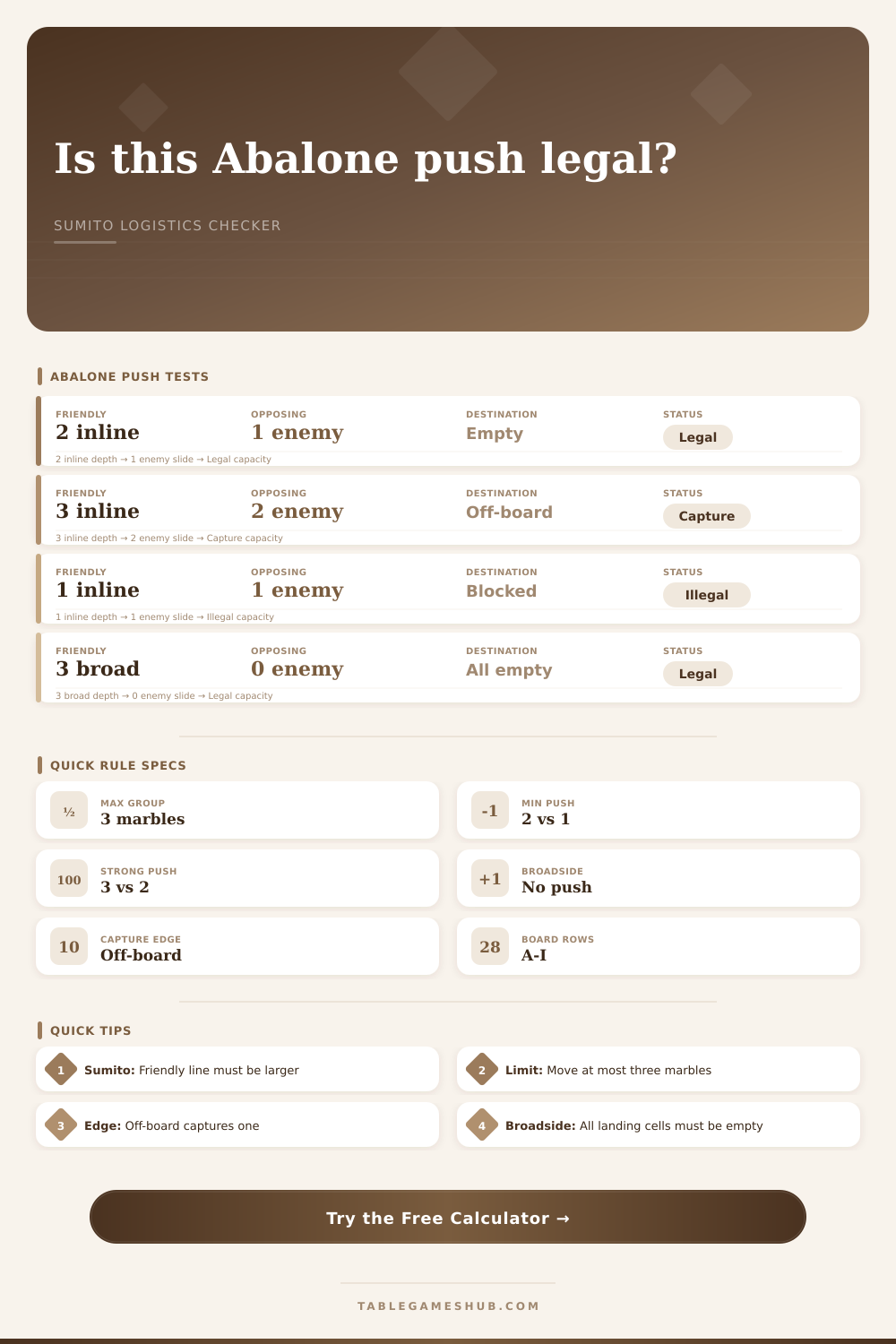
Abalone Push Calculator
Check whether an Abalone move is legal by counting friendly marbles inline, opposing marbles inline, destination state, movement mode, captures, and coordinate notes.
| Friendly Inline Group | Opposing Inline Group | Destination Requirement | Rule-State Result |
|---|---|---|---|
| 1 friendly marble | 1 or more opposing marbles | Any state | Illegal push. One marble cannot push an opposing marble. |
| 2 friendly marbles | 1 opposing marble | Empty or off-board | Legal sumito. Off-board destination captures the opposing marble. |
| 3 friendly marbles | 1 opposing marble | Empty or off-board | Legal sumito with larger force than the opposing line. |
| 3 friendly marbles | 2 opposing marbles | Empty or off-board | Legal sumito. Off-board destination captures one leading marble. |
| 2 friendly marbles | 2 opposing marbles | Any state | Illegal push because the friendly line is not larger. |
| 3 friendly marbles | 3 opposing marbles | Any state | Illegal push. Three opposing marbles cannot be pushed. |
| Move Mode | Opposing Ahead | Destination State | Logistics Check |
|---|---|---|---|
| Inline step | 0 opposing marbles | Empty board space | Legal movement if selected friendly marbles are connected in the line. |
| Inline push | 1 or 2 opposing marbles | Empty board space | Legal only when friendly inline count is larger than opposing inline count. |
| Inline edge push | 1 or 2 opposing marbles | Off-board | Legal capture if the sumito ratio is legal and the edge is in that direction. |
| Inline blocked push | 1 or more opposing marbles | Occupied by any marble | Illegal because the opposing line has nowhere legal to move. |
| Broadside move | 0 opposing marbles | All landing cells empty | Legal for two or three connected friendly marbles moving sideways. |
| Broadside blocked | Any opposing marble | Blocked landing lane | Illegal. Broadside movement cannot push or enter occupied cells. |
| Row | Spaces In Row | Typical Labels | Edge Notes |
|---|---|---|---|
| A and I | 5 spaces | A1-A5, I1-I5 | Outer rim rows. Off-board checks often involve these rows. |
| B and H | 6 spaces | B1-B6, H1-H6 | Near-rim rows with short diagonals toward the edge. |
| C and G | 7 spaces | C1-C7, G1-G7 | Outer flanks are edge-adjacent; center spaces are internal. |
| D and F | 8 spaces | D1-D8, F1-F8 | Wide rows with several internal line options. |
| E | 9 spaces | E1-E9 | Longest center row; only E1 and E9 are rim spaces. |
| Status | Meaning | Capture Count | What To Verify On Board |
|---|---|---|---|
| Legal Slide | Friendly marbles move into an empty adjacent space without pushing. | 0 | Confirm the friendly group is connected and the landing space is empty. |
| Legal Sumito | A larger friendly inline group pushes one or two opposing marbles. | 0 | Confirm the destination beyond the opposing line is empty. |
| Legal Capture | A legal sumito pushes the leading opposing marble off the board. | 1 | Confirm the opposing line is on the rim in the declared direction. |
| Illegal Block | The destination is occupied, off-board without an opponent, or the ratio fails. | 0 | Check the inline counts, destination, and broadside lane clearance. |
A few marbles is grouped together and poised to come loose, while your opponent sit across from you, tense as you watch an Abalone match unfold. A pair of his marble aligned with a trio of yours, the numbers seem stacked in your favor. But wait: have you counted corectly? Is there space behind his stones? Could you be wrong by one marble?
That’s when Abalone catches players out, not because its rules are complicated but because its geometry will make no allowances for error. Once you’ve set the scene, the math is handle by this tool. You would of had no more embarrassing moments when you claim a push that the board refuse to allow.
How to Use the Abalone Move Calculator
The key is to push. Pushing is called sumito, and it’s pretty simple at first glance. You want there to be more of your marble in a row than theirs. But in practice, people frequentely get confused about how many marbles are “in a row.” They struggles to know what counts as a connected group.
The calculator asks this question directly, Are your marbles in a straight line? If they aren’t, then it can’t pushes. And it won’t let you try. Why? Because a crooked group doesn’t count. That’s a small bit of geometry. It kills a lot of cool-looking-but-actually-bad moves that might seem okay from your notebook.
In inline mode, it will ask if your leading marble has sufficient back-up power. So if you’ve got three marbles lined up behind you, and your opponent’s got two ahead, you’re favored. The space you’re trying to move into also need to be open, otherwise the push is dead immediately.
But that’s not what happens with broadside moves. In broadside moves, you’re moving sideways; pushing people isn’t possible. And in this mode, the rules changes dramatically: every single cell where you land has to be fully vacant. That’s right, it’s a clearance operation, not a forcible displacement.
Many players attempt to jam their three-marble group into a tight gap without considering that if they have even one blocked lane, it fouls up whole move. The pages of reference tables lays this out clearly: Broadside moves is all about available space, not force ratios. One occupied cell mean an illegal move regardless of how strong you feel your group is.
The edge play sounds counter-intuitive until you realize that’s how you win marbles: you try to get your opponent’s marble up against the edge so you have room to slide behind it. That’s when you can capture. The problem is verifying that your lead marble is close enough to the edge before pushing it in that direction.
It asks whether your lead marble is on the outer ring, that’s what the calculator let you check. But it does ask whether the direction leads off the board for captures. If you push a ring marble into a direction where it will still stay on the board, nothing happen; it just slides around. But if the marble is already on the ring and the direction goes off the board, then it’s gone. That’s the difference between a capture and a slide.
Games are won/lost here. You can spend twenty turns dominating the middle of the board without ever establishing a route to the edge where captures occurs.
There’s also an extra level of precision added with coordinate notation. Labeling a marble as B2 or E5 lets you see where on the board a push should go without needing to draw out a diagram. This tells the device that when you say you’re pushing diagonally, you aren’t actualy going horizontally. It acts as a way to check your spatial reasoning skills.
And given there are only sixty-one holes in the board, some rows will run out of space earlier then others due to their asymmetrical layout. There are nine spaces on Row E, but only five on Row A. That matter because it limits how far you can align marbles before reaching the boards natural limit.
To put it simply, Abalone is a game of limited motion. It’s always about establishing lines of force and preventing your opponent from doing the same. The calculator doesn’t make your move decisions, doesn’t judge your tactics. It only lets you know whether what you want to do follows the physical laws governing the game.
Test it when you’re unsure about the weird broadside maneuver, or the devious 3-versus-2 push. Confirm that your sumito isn’t going to land you in hot water. After learning how to distinguish between a legal block and an illegal slide, you won’t hesitate about your geometry no more; just play the game.