Blokus Territory Calculator
Count 20x20 board coverage, selected-color pieces played, remaining piece squares, blocked corners, and final score logistics.
| Coverage band | Occupied squares | Coverage percent | Open board squares |
|---|---|---|---|
| Early board count | 0 to 100 | 0% to 25% | 300 to 400 |
| Mid-board count | 101 to 220 | 25.3% to 55% | 180 to 299 |
| Late-board count | 221 to 320 | 55.3% to 80% | 80 to 179 |
| Full-table count | 321 to 356 | 80.3% to 89% | 44 to 79 |
| Piece group | Pieces per color | Squares each | Total squares |
|---|---|---|---|
| Pentominoes | 12 | 5 | 60 |
| Tetrominoes | 5 | 4 | 20 |
| Triominoes | 2 | 3 | 6 |
| Domino and monomino | 2 | 1 or 2 | 3 |
| Selected-color state | Remaining squares | Score entry | Count note |
|---|---|---|---|
| Pieces remain | 1 or more | Negative remaining squares | Pentominoes, tetrominoes, and minor squares all count. |
| All pieces placed | 0 | +15 | Use when the selected color has no unplayed pieces. |
| Monomino placed last | 0 | +20 | Use only when the one-square piece was the final placement. |
| Inventory mismatch | Check count | Review inputs | Pieces played plus pieces remaining should equal 21. |
| Preset | Active colors | Board count focus | Selected-color inventory |
|---|---|---|---|
| Opening four-color board count | 4 | Early occupied squares | Many pentominoes remain |
| Balanced midgame territory check | 4 | Mid-board coverage | Mixed large and minor pieces remain |
| Dense late-board coverage tally | 4 | High board fill | Small selected-color inventory remains |
| Corner-locked end count | 4 | Blocked-corner cleanup | Remaining square penalty count |
When there’s no more room on the board, Blokus come to an end. That means managing limited choice. At first, it’s only in the corners, then things get tight. Pentomino geometry is rigid, so shapes that look like they fit don’t always. Follow your territory, it will tell you what moves is possible. (The calculator will do the math for you; no need to guess at coefficients of any equation in the heat of battle.)
Each square that are covered earns you a point. Each piece not played comes with a penalty. Tetrominos is worth -4 points and pentominoes is worth -5. If you don’t pay attention to these, they can realy hurt. This is where tool splits out your unused pieces by type and helps show you just how many points it will cost you. Players will be quick to only look at squares covered and forget about the penalty for piece they haven’t used yet.
How to Score Points and Manage the Board
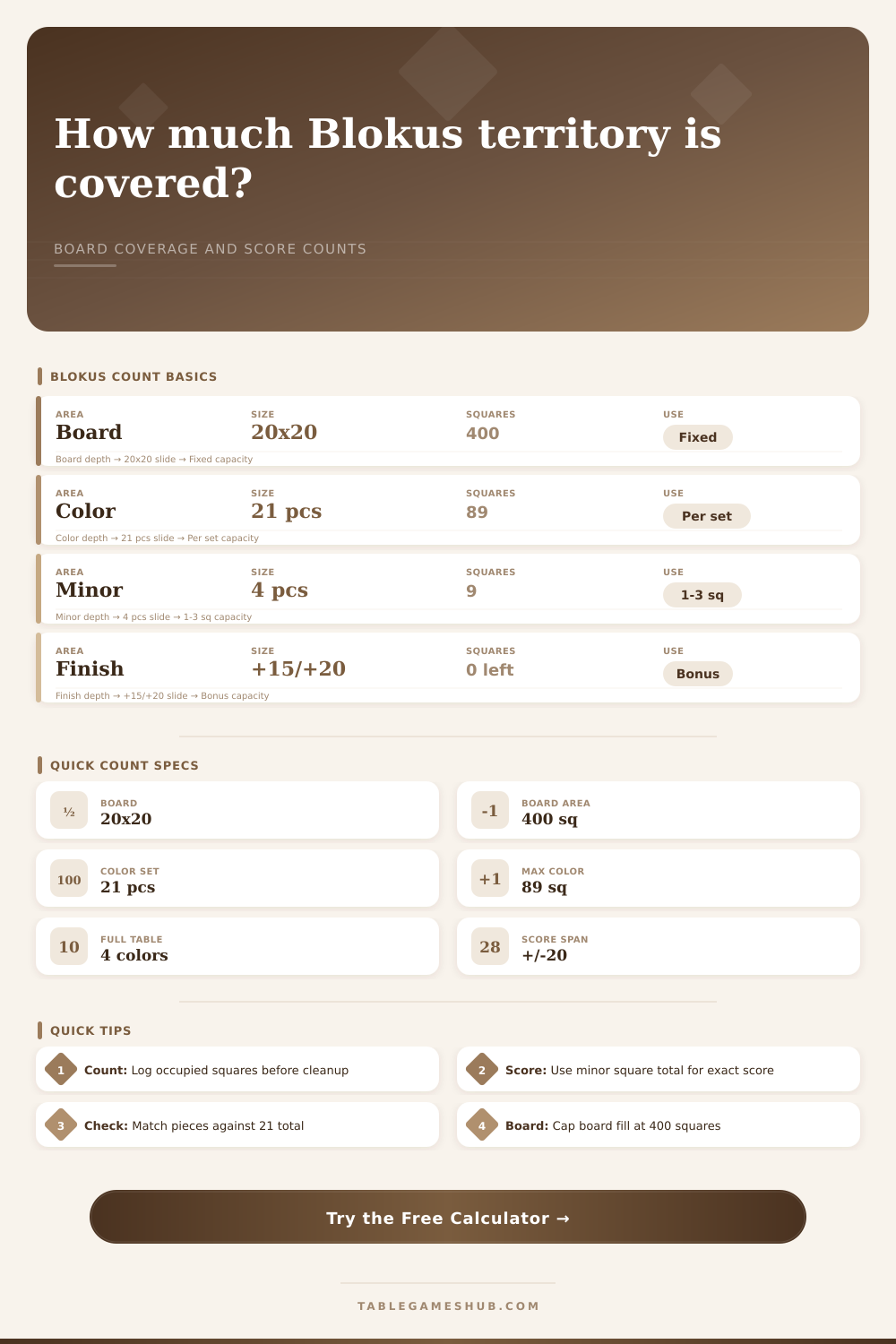
This is a game of numbers. The board have four hundred squares; it’s not going anywhere. At start of the game, twenty-one pieces occupy eighty-nine squares in total. At full strength (four players), they will occupies three hundred fifty-six squares, leaving only forty-four vacant square. It’s a tight squeeze, and the calculator calculate the density of the board. Once you get up into the seventies in percentage occupancy, the game turns survival different than expansion.
Big shapes won’t fit any more; you’re looking for little gaps; single squares or spots for one or two dominos. This gets complicated when there is corners being blocked. That isn’t scored in the usual way. You can log those blocked usable corner, and then know how many option your opponent has left. It’s a logistics check, and if someone blocks off entry points that’s what you tally up. That won’t alter the final score, but it will change how you understand the board.
If you know someone’s got their back against wall by blocking their corners, you could of been more aggressive. The last part is the kicker: bonus points. You get 20 points for placing the monomino last and 15 points for placing all your furnitures. There’s an honesty component, as your score include the bonuses using a calculator that assumes you used everything up. Claiming a bonus while having some pieces left means someone figures out your mistake.
The reference tables below show how different coverage bands correlate with board density, so you know what’s at stake. And it alters how you play the midgame: Rather than simply reacting, you plan with this tool. Five points per pentomino? That mean I can hold onto two, but only if I can find a way to fit them in sub-optimal spots. And now you’re trying, because there’s a finite amount of space on the board and a finite number of pieces, and you want an empty hand.
The calculator turns abstract pressure into concrete numbers. From then on, do you guess if you’re winning? No; you know. Now it’s about controlling the cost off those pieces you can’t place in the endgame.