🎲 Rummikub Calculator
Opening threshold — draw odds — turn pressure — rack score
| Tile family | Copies in set | Points each | Meld note |
|---|---|---|---|
| 1-3 | 8 each | 1-3 pts | Low run filler |
| 4-6 | 8 each | 4-6 pts | Middle value |
| 7-9 | 8 each | 7-9 pts | Smooth bridge |
| 10-12 | 8 each | 10-12 pts | High run |
| 13 | 8 each | 13 pts | Strong finish |
| Joker | 2 | wild | Any tile |
| Shape | Tile rule | Minimum | Calculator use |
|---|---|---|---|
| Group | Same number, 3 colors | 3 | Fast opener |
| Group+ | Same number, 4 colors | 4 | Safer board |
| Run | Same color, consecutive | 3 | Quick clears |
| Run+ | Same color, longer chain | 4+ | Flex meld |
| Players | Rack size | Opening target | Average game time |
|---|---|---|---|
| 2 players | 14 tiles | 30 pts | 20-30 min |
| 3 players | 14 tiles | 30 pts | 25-40 min |
| 4 players | 14 tiles | 30 pts | 30-45 min |
| House drill | 12 tiles | 25 pts | 15-25 min |
| Stage | Players | Turns to wait | Best move |
|---|---|---|---|
| Early | 2 | 1 | Watch rack |
| Mid | 3 | 2 | Plan draw |
| Late | 4 | 3 | Hold joker |
| Emergency | Any | 1 | Go now |
Joker safety
Keep one joker flexible if the board still needs a bridge. Replacing it later can free more of your rack than forcing an early dump.
Opening discipline
If your laydown is close to 30, count the deadwood too. A cleaner rack often beats a bigger first move that leaves no follow-up plan.
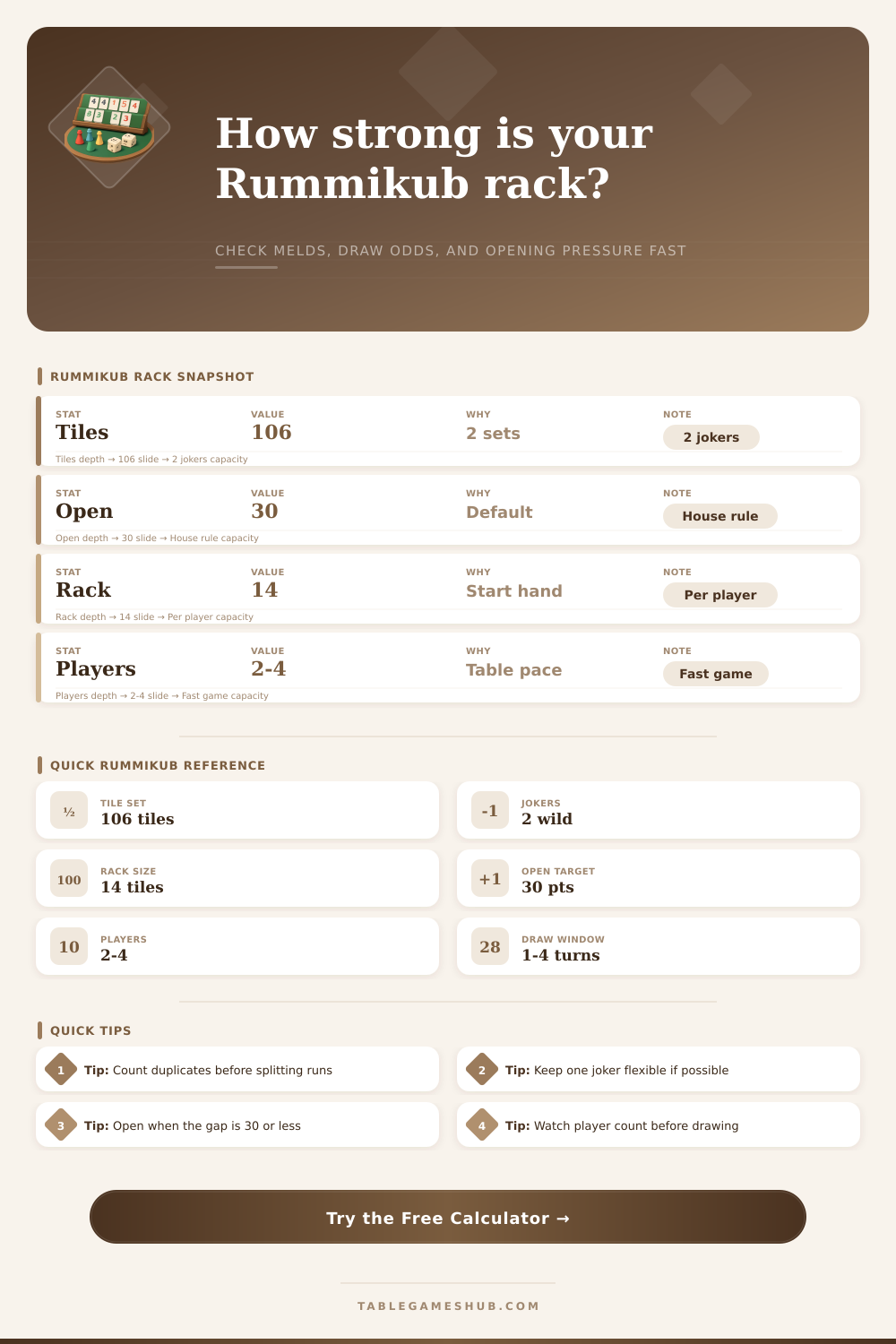
Rummikub is a tile game in which players has to manage their rack of fourteen tiles. Players must decide when to lay down their tiles on the table, and the timing of a players first move are important for the game. Rummikub’s rules states that players isnt allowed to play any of their tiles on the table until their initial meld is worth thirty or more points.
An initial meld must contain at least three tiles, which can be either a group of three tiles of the same number within each of three different colors, or a run of three tiles that have consecutive numbers within a single color. A second special type of tile is the joker; these can be used as wild cards to help a player form a meld. However, jokers are rare in a player’s rack; there are only two jokers in a standard set of Rummikub tiles.
How to make your first move in Rummikub
When making the first move in a game of Rummikub, a player should consider a variety of factors. For instance, a player can look at the different potential melds that can be formed with the player’s tiles, as well as to consider which of the player’s tiles is considered deadwood (those that dont appear to be able to be part of any meld). A player should avoid discarding too many of their tiles too soon, as this will provide other players with a momentum in the game.
However, if a player waits too long to play their tiles, another player may be able to finish the game before the player can play their tiles. Thus, players can attempt to form an estimate of the value of their remaining tiles. However, a better strategy may be to calculate how many of the player’s tiles can be played, and how many of those tiles are deadwood.
Additionally, the number of players in the game can impact a variety of aspects of the game. For instance, with a two-player game, each player will draw more tiles during the game than there would be in a four-player game. Thus, each player will have more opportunities to play tiles that total at least thirty points.
Furthermore, the number of players that will play the game will impact the speed at which the game is played. In the two-player game, each player will draw their tiles more frequently. However, in the four-player game, each player will draw their tiles less frequent.
Thus, in addition to calculating the average value of the player’s tiles (by dividing the total points that the player’s rack contains by the number of tiles that the player has), a player can also calculate how many opportunities they have to draw their tiles during the game. Beyond calculating the value and draw frequency of a player’s remaining tiles, another factor to consider is the value of the low-value tiles that the player has left. Tiles that contain the numbers one, two, or three are especially valuable for being able to create melds that contain three tiles in a run.
However, each of these numbers is only available in eight different copies within the entire game. The joker tiles are especially important during the game, as they can often help each player to create their melds. However, players should not use their jokers too soon in the game.
Instead, the player should retain their joker for when there is a need for the wild card to help bridge a gap within a run or group of three tiles. Additionally, another strategy for increasing the player’s chance of winning the game is to keep watch over the other players’ discarded tiles. The tiles that other players discard indicate which tiles are left in the draw pile for the remainder of the game.
For example, if a player needs to draw a tile that has the number four, they can check the number of copies of that number that are on the board and in their rack; if both of those quantities are high, there are fewer mathematical odds that their requested tile will be drawn. Rummikub also has a specific rhythm that players should follow during the game. During the early stages of the game, players should keep watch over the other players’ tiles; they should wait until they can make their initial meld of thirty points.
During the mid-game, players should observe the other players’ points; if the point gap between themselves and other players is small, a player should draw tiles to increase their score. During the late game, players should play any melds that can be made; playing their tiles will allow them to empty their rack and win the game. If a player has high-value tiles in their rack, however, those tiles are deadwood for the player; deadwood can make it difficult for a player to win the game.
In order to win a game of Rummikub, players must use mathematics during the game. For instance, players can estimate the strength of their laydown by counting how many of their tiles will be used to make melds, and by calculating how many of their tiles will become deadwood. Additionally, players should calculate the probability that they will be able to draw the specific type of tile that they need during their turn.
If the probability of drawing their needed tile is low, they should instead focus on their intention to rebuild their hand. To be successful at playing Rummikub, a player should ensure that their playable tiles make up more than half of their total rack of tiles. If a player follows these mathematical principles regarding when and how to draw, when to play their tiles, and how to manage their deadwood, they will have more control over their game of Rummikub.