🌌 Gaia Project Score Calculator
Total your endgame VP from federation tokens, research tracks, final scoring tiles, Gaia planets, satellite networks, resource counters, and faction bonuses.
| Score line | Input | VP | Formula note |
|---|
| Research level | End VP used here | Why it matters | Score check |
|---|---|---|---|
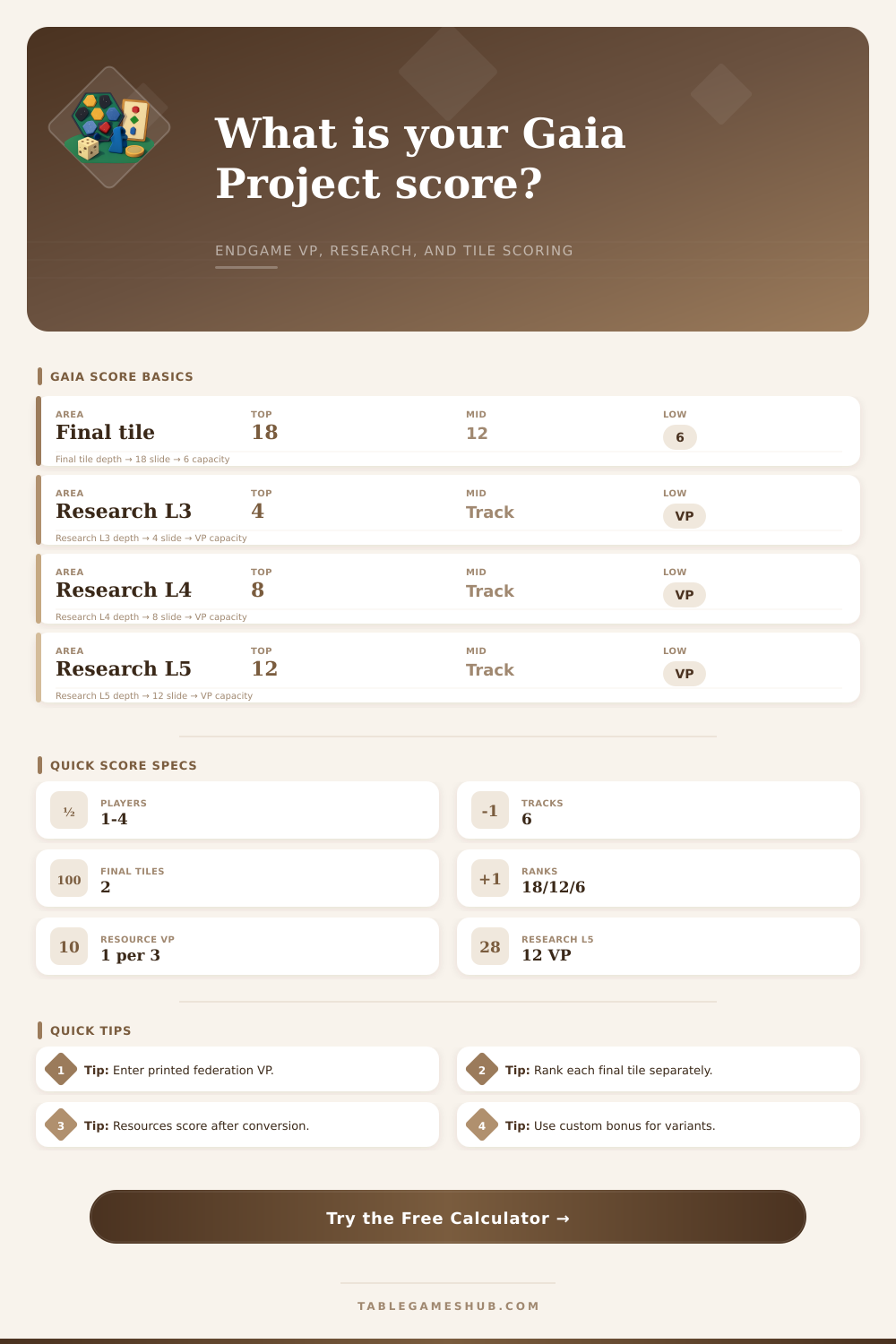
| Level 0 to 2 | 0 VP | Early research improves play but has no end-track VP in this model. | Leave at current level if the marker did not reach level 3. |
| Level 3 | 4 VP | First end-scoring research band. | Useful for broad, multi-track games. |
| Level 4 | 8 VP | Strong track position without reaching the top space. | Common late-game target when level 5 is blocked. |
| Level 5 | 12 VP | Top track position in this score model. | Count level 5 tracks separately for faction notes. |
| Final scoring tile | Input to compare | Common counter | Calculator field |
|---|---|---|---|
| Most Gaia planets | Colonized Gaia planets | Green Gaia planet spaces | Gaia planets colonized |
| Most buildings in one network | Largest connected group | Buildings after satellites link groups | Buildings in largest network |
| Most satellites | Satellites connecting networks | Power tokens placed as satellites | Satellites in largest network |
| Most planet types | Distinct colonized terrain types | Color diversity plus Gaia or transdim calls | Different planet types colonized |
| Most space sectors | Occupied sectors on the map | Sectors with at least one of your structures | Space sectors occupied |
| Rank situation | Award positions | Example VP | Calculator handling |
|---|---|---|---|
| Solo 1st place | 1st only | 18 VP | Rank 1, tied players 1. |
| Two tied for 1st | 1st and 2nd | 15 VP each | (18 + 12) divided by 2, rounded down. |
| Two tied for 2nd | 2nd and 3rd | 9 VP each | (12 + 6) divided by 2, rounded down. |
| Three tied for 2nd | 2nd, 3rd, 4th | 6 VP each | Fourth award is zero, then average and round down. |
| 4th without tie | 4th only | 0 VP | No final tile award beyond the scoring band. |
| Faction profile | Bonus proxy | Uses these inputs | Why it is separate |
|---|---|---|---|
| Terrans or Gleen | Gaia planet tempo | Gaia planets and federation tokens | Highlights how many green worlds became scoring leverage. |
| Ivits or Xenos | Network reach | Satellites, buildings, and federation tokens | Useful when satellite placement defines the endgame map. |
| Nevlas or Firaks | Research engine | Knowledge and high research levels | Rewards track depth and advanced-tech style games. |
| Hadsch Halla or Taklons | Resource reserve | Credits, ore, knowledge, and power | Shows how much unspent economy still converts to points. |
| Custom faction bonus | Manual VP | Custom faction bonus field | Use for expansion variants or table-specific scoring notes. |
Score the two final tiles independently
A player can be first on one end tile and outside the award band on the other. Enter rank and tie count separately so the calculator does not blend the two comparisons.
Audit federation VP before resource conversion
Federation tokens, research tracks, and advanced tech tiles usually swing more VP than leftover counters, so confirm those visible VP values before rounding resources.
When a player receives the final scoring tile for the game of Gaia Project, and begins to calculate the score for that game, the player has accomplished the goal of there efforts to build an economy, claim federations, and advance research tracks for their player’s resources. The determination of a score for the game include several different factors that contribute to the final score for that player. Any error in calculating those various factors can result in a change to the ranking of that player compared to others who are playing the game.
The factors that contribute to a Gaia Project score include the number of federation tokens that a player have earned, the research tracks that a player has advanced to level three or beyond, the number of points that can be earned from the final scoring tiles that are distributed to each player at the end of the game, and the leftover resources from the game that are collected into sets of three of the same types. The calculator can help a Gaia Project player to calculate the final score for the game. The calculator allows a player to input there score in the game, the two final scoring tiles that they earned during the game, and the number of each type of counter that the player accumulated during their efforts.
How to Calculate Your Final Score in Gaia Project
The calculator will calculate the total points for the player during the game, but does not make any decision for that player. Each of the different factions that play in Gaia Project scores their points in different ways, however. Terran players, for example, earn points from their Gaia planets, while Ivits players earn points from their satellite count.
Thus, the calculator can help a player to determine how their counters may impact their total score. Many player make mistakes when calculating their total score from the final scoring tiles. For example, many players believe that their rank earned on one of the final scoring tiles will be reflected in their earned rank on the other final scoring tile.
Additionally, any ties between players for one of the final scoring tiles will split the potential points for that tie, and only award the players the rounded-down value of the points for that tie. For instance, if a player is tied for first place on one of the final scoring tiles, they will not earn the total points for first place, but rather the average of the points for first and second place. It is to this end that the Gaia Project calculator provides the reference table included; it can help a player to review how ties and ranks work for the game.
Additionally, many players will forget to include there leftover resources when calculating their score. Any leftover resources (credits, ore) may earn a player victory points if they can be grouped into sets of three. By knowing these different factors that contribute to ones Gaia Project score, a player can make better decisions during the last round of the game.
For instance, a player may recognize from the calculator that their research tracks are nearing a new level. In this case, the player may choose to devote some of their remaining actions to advancing one of their research tracks. Additionally, if the calculator indicates that a players satellite count is approaching that of another player, they may choose to increase their number of satellites during the last round.
Thus, the calculator can help players to make more informed decisions during the last round of Gaia Project. Through calculating the final score for Gaia Project, a player can compare the success of their strategies to those of other strategies for the game. For instance, the final score for the game can reveal how successful a player was at building their federations compared to another player that may have built their federations to tall structures, yet earned the same number of points.
Thus, the calculator allows players to determine the success of their strategies during the game. While the calculator will not teach a player how to play Gaia Project in future games, the calculator will help a player to understand how they achieve there score in the current game of Gaia Project.