Nucleum Energy Network Calculator
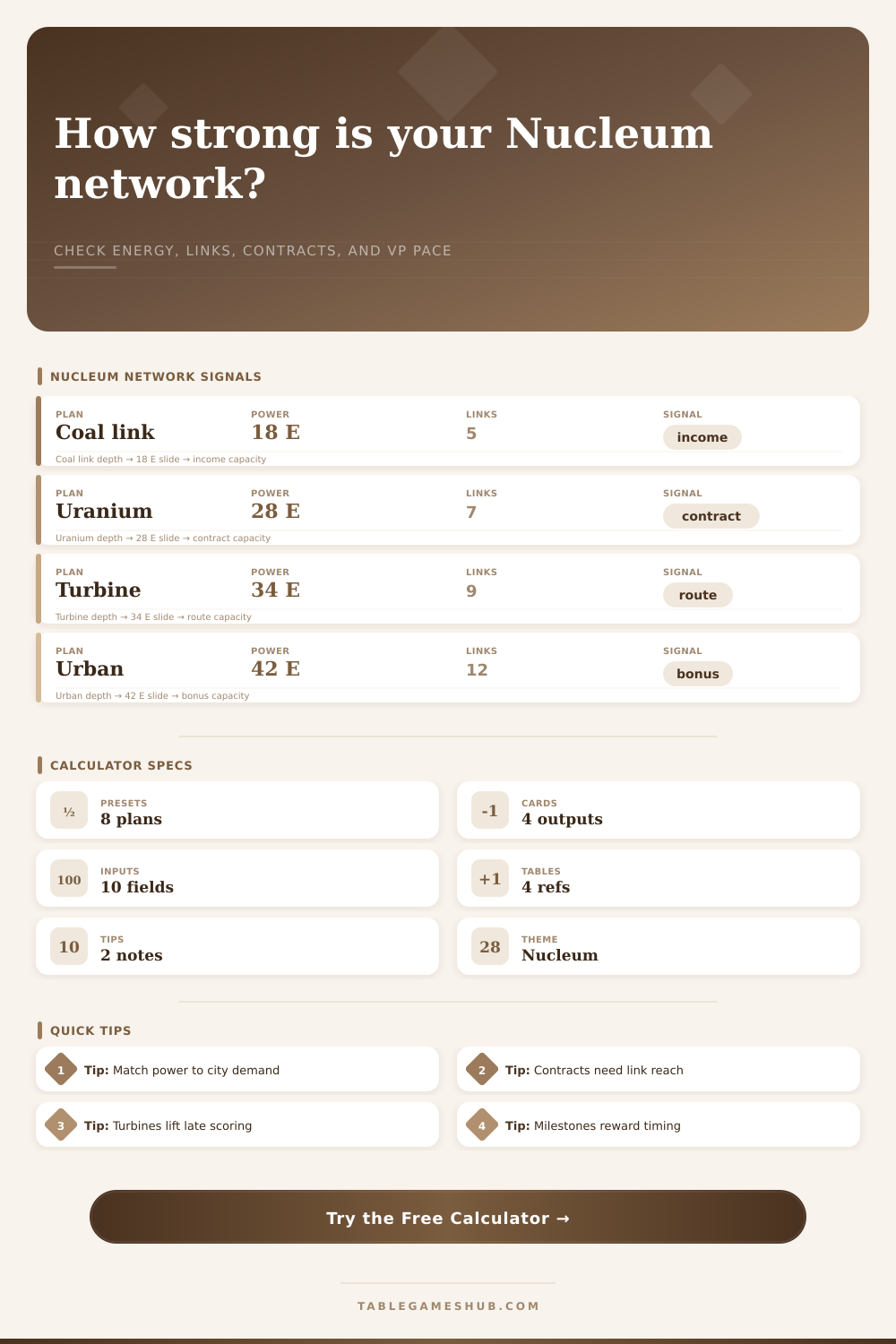
Model a Nucleum power route from energy generated, network links, contracts, coal, uranium, turbines, city demand, income tempo, and victory point milestones.
Use this as a scoring and tempo planner for Nucleum-style network turns. Enter the board state you can actually connect this round, then compare demand coverage with contract and milestone timing.
🗺Network Presets
⚙Energy Network Inputs
Energy Network Breakdown
🔧Network Spec Grid
📘Power Route Reference
| Network Plan | Energy Pattern | Best Payoff | Watch Point |
|---|---|---|---|
| Coal Plant Link | Moderate energy, early links | Income and first contracts | Coal can run short before reach improves |
| Uranium Contract | Small fuel count, large burst | High value contract completion | Demand must be reachable this round |
| Turbine Route | Efficient conversion | Late scoring and dense routes | Underbuilt links waste turbines |
| Urban Network Bonus | Demand heavy cluster | City demand cover and bonus VP | Energy deficit blocks the final city |
📊Fuel And Turbine Multipliers
| Component | Model Value | Network Use | Scoring Signal |
|---|---|---|---|
| Coal unit | 3 energy pressure | Baseline plant activation | Strong when links are cheap |
| Uranium unit | 7 energy pressure | Contract spike and demand cover | Best when routes are already open |
| Turbine | 2 route efficiency | Turns fuel into repeatable output | Improves late game stability |
| Network link | 4 reach points | Connects plants to cities | Needed before contract scoring |
🧮Preset Assumptions
| Preset | Energy | Links | Primary Question |
|---|---|---|---|
| Coal Plant Link | 18 generated | 5 links | Can the first supplied corridor pay back? |
| Uranium Contract | 30 generated | 6 links | Does the contract justify the fuel spike? |
| Milestone Power Sprint | 40 generated | 10 links | Can milestone VP land before rivals score? |
| Late Game Grid | 52 generated | 14 links | Is demand cover stronger than extra links? |
🗂Network Score Guide
| Strength Score | Label | Recommended Focus | Common Cause |
|---|---|---|---|
| 0 to 39 | Fragile | Add links or fuel first | Demand exceeds reachable energy |
| 40 to 59 | Developing | Finish one contract lane | Mixed income and route pressure |
| 60 to 79 | Strong | Push milestones | Good cover with useful turbines |
| 80 plus | Dominant | Convert tempo into VP | High cover, links, and income together |
💡Nucleum Network Tips
Lay out your third power plant and suddenly the board becomes a math problem. The city is on one side and the energy source are on the other, but something is missing in between. Connecting them often costs more than you make. That’s where most Nucleum games take place: Between knowing what to do and having resources to do it.
While other players is moving their tokens, the calculator handles the heavy lifting so you don’t have to do the mental arithmetic. Instead of counting the points, it helps you figure out if your network will hold up long enough for victory points to count.
How to Use the Calculator for Nucleum
The first thing to look at is your fuel mix. In this case, that’s coal versus uranium. Uranium is powerful but volatile. Coal is cheap and reliable. How does the tool weigh them? That depends on number of active links. It may appear that one unit of uranium will massively increase your energy production. However, without two links connecting it to market, that energy remains trapped. You’re paying for something you can’t access.
This is why many people gets tripped up: they concentrate solely on raw energy production and forget about their reach. High value contracts demand certain link counts before they become viable (check out the reference table). Without sufficient reach, that uranium is a paperweight on your board.
In the mid-to-late game, though, turbines becomes valuable because they make all your previously constructed routes more efficient. This makes their initial placement feel weak, as they don’t produce power themselves and instead scale up from whatever infrastructure has been establish. In other words: you must build a base network prior to seeing any return on investment from turbines. The calculator will account for this by updating your network strength score according to how many turbines you’ve connected, in relation to your overall number of links. A low score here suggest you’re probably wasting time building conversion upgrades rather than opening new territory. Turbines are useful, when used propery.
The hard ceiling here is set by city demand: If neighboring cities is already saturated, then there’s no place for your excess energy to flow. So, the tool measures your total energy generation and compares it to how much demand you want to meet. That’s important, because while a faraway, high-demand city may score well on paper, it could of be a Pyrrhic victory as the cost of building the links might outweigh the victory points you get.
Where the choice gets tricky is the income tempo. Each additional link costs you a coin, which means a coin you didn’t use to meet a contract requirement or secure a milestone. The calculator makes this tradeoff clear in terms of what it shows your income gain will be relative to your scoring pace. Nucleum treats milestones as kind of like side-quests, but those typically is what distinguishes a good game from a winner. How do you know how to achieve them? Use this tool to track your progress toward them and see if your current pace means you are playing offense (sprinting) or defense (slowing down). So if you have a strong network strength score, but not so great a milestone outlook, then you’re likely over-invested in efficiency and need to invest more in breadth.
The trick is knowing what you’re measuring. Yes, having the largest power grid will get you there, but the name of the game is providing value to where it’s needed while keeping economy intact. Dial up the presets, experiment with building a coal-heavy start and finishing off with a uranium-powered charge into the finish line. Watch the score change hands, and return to board to try doing this live. However, it requires you to appreciate the relationship between fuel, links, and destination. Get the balance right, and victory points will follow.