Ark Nova Conservation Calculator
Model one Ark Nova conservation push across project thresholds, Association action strength, donation slots, sponsor and final-card CP, appeal movement, and the endgame target number.
Use this for the board game Ark Nova when choosing whether to support a conservation project now, wait for a higher icon level, donate with Association II, or rely on final scoring conservation points.
Conservation result
| Project family | What counts | Typical support levels | Calculator use |
|---|---|---|---|
| Continent base projects | Africa, Americas, Australia, Asia, or Europe icons from cards and partner zoos | 2 icons = 2 CP, 4 icons = 3 CP, 5 icons = 4 CP | Choose Continent and enter matching continent icons. |
| Animal-type base projects | Primates, Reptiles, Predators, Herbivores, or Birds icons from your zoo | 2 icons = 2 CP, 4 icons = 3 CP, 5 icons = 4 CP | Choose Animal-type and enter matching animal-category icons. |
| Species Diversity | Different animal category icons represented in your zoo | 3 types = 2 CP, 4 types = 3 CP, 5 types = 4 CP | Use for a broad zoo with several animal classes instead of one stack. |
| Habitat Diversity | Rock and water habitat requirement icons across played animal cards | 2 habitat icons = 2 CP, 3 = 3 CP, 4 = 4 CP | Use when rock/water requirements are your project engine. |
| Release into the wild | A played animal released from your zoo, with its appeal and icons removed | Size 2 = 2 CP, size 4 = 3 CP, size 5 = 4 CP | Enter the animal size as the ready count and the appeal loss separately. |
| Breeding or research projects | Project-specific species, animal-type, or science/research conditions | Lower/middle/high levels generally award 2/3/4 CP | Use the family that best matches the printed project condition. |
| Conservation point | Track effect | Score value model | Endgame meaning |
|---|---|---|---|
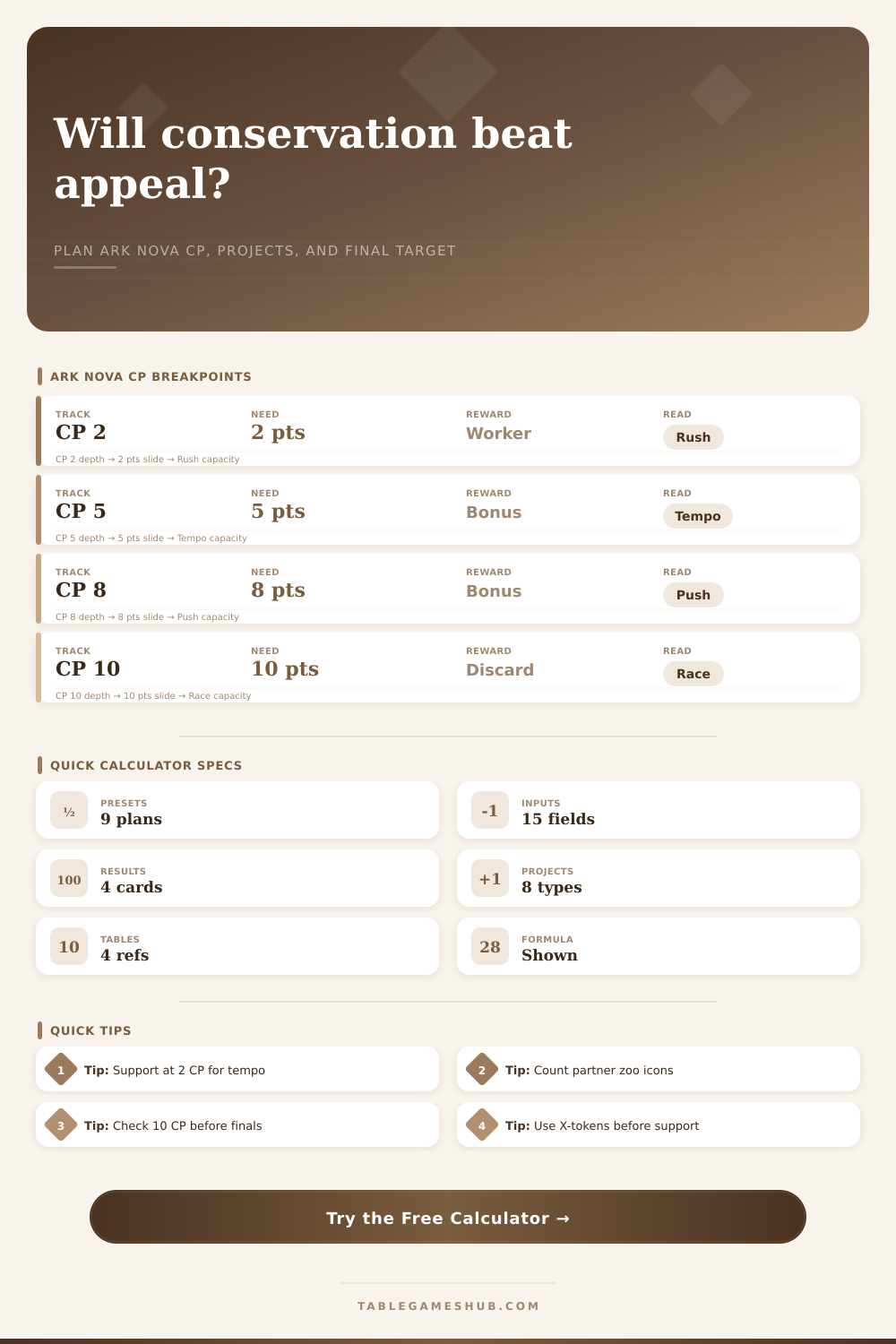
| 2 CP | Choose an action-card upgrade or gain an Association worker | First 10 CP count as about 2 appeal spaces each | Early tempo breakpoint; often worth supporting a low project. |
| 5 CP | Take one of the shared yellow conservation-track bonuses | 5 CP lowers the target by 10 spaces in this model | Useful before the zoo has enough appeal to race. |
| 8 CP | Take another shared yellow conservation-track bonus | 8 CP lowers the target by 16 spaces | Sets up the 10 CP final-card discard checkpoint. |
| 10 CP | If any player reaches 10 CP, all players keep both Final Scoring cards | 10 CP lowers the target by 20 spaces | Major table-wide scoring timing checkpoint. |
| 11+ CP | No special printed checkpoint each point, but endgame pressure rises | Each CP after 10 lowers target by about 3 spaces | Late CP usually closes the final appeal gap faster than appeal alone. |
| Association item | Breakpoint | Constraint | Calculator effect |
|---|---|---|---|
| Support conservation project | Association strength 5 | Must meet a free project condition and have an available player token | Blocks project CP if strength plus X-tokens is below 5. |
| Repeat same Association section | 2 workers this break | Workers return only at break | Raises the worker requirement from 1 to 2. |
| Association II donation | Upgraded Association action | Open donation slots advance from 2 to 12 money | Adds planned donation CP only when Association II is selected. |
| Project from hand | Support immediately | New project may push older project cards rightward and off the board | Counts the project CP as immediate if support is otherwise legal. |
| Break timing | Workers return at break | Break can trigger during other players' turns | Uses turns left to flag whether waiting is likely too slow. |
| Component or system | Quantity | Conservation relevance | Planning note |
|---|---|---|---|
| Zoo cards | 212 total: 128 Animals, 64 Sponsors, 20 Conservation Projects | Animal and Sponsor icons feed project requirements; project cards add new CP options. | Display access improves with reputation and upgraded Cards/Association. |
| Base Conservation Project cards | 12 total; 3 face up in 1-3 players, 4 face up in 4 players | Public project race around continent, animal-type, species, and habitat ladders. | Two-player setup blocks one level on each of the three base projects. |
| Final Scoring cards | 11 total; each player starts with 2 | Each card can add up to 4 CP at final scoring. | If nobody reached 10 CP, each player discards one before scoring. |
| Action cards | 5 per player, strength slots 1 to 5 | Association must reach strength 5 to support conservation. | X-tokens may push the action to the required strength before resolving. |
| Association workers | 4 possible workers per player | Workers pace partner zoos, universities, project support, and donations. | CP 2, reputation 8, project cube bonuses, and third partner zoo can add workers. |
| Appeal and Conservation tracks | Appeal 0-113, Conservation 0-41 | Game ends when markers share or pass the same scoring area. | Final VP equals appeal after scoring minus the target number for your CP area. |
With Ark Nova, you come into the game knowing what you want from the zoo and sure that everything will be fine. Then halfway through you notice that conservation track has changed the game’s dynamic. More then you would expect. So many people run after appeal like it’s all that matters. Don’t pay attention to green shield markers on the other tracks as they climb theirs.
You will realize at final scoring time that your high appeal didn’t matter because you couldn’t meet target number. Conservation isn’t a side quest for points; it’s an engine that decides if you’ll get any points at all when game ends.
How to Win with Conservation Points
You need to think ahead to understand when to make big donations versus spread resources across multiple project. A tool that can help model this interaction at the table is important.
This goes back to the central dilemma, timing. Conservation plays directly into your animal strategy and feels like right thing to do. Doing it will net you conservation points, which in turn will get you more projects from board. But there’s usually a cost to tempo. Conservation projects often requires specific conditions before they is ready, and if you wait long enough to hit those conditions you’ll lose tempo.
This is where the calculator comes in; once you input where you’re at today, it does the work for you. Does it make sense to take a little bit now to get an early bonus? Or would you prefer to hold out and save up points for a huge dump at end-game? Most folks miss this portion because they just look at end result.
There’s a real benefit to hitting these early conservation goals: things like getting an additional worker or leveling up an action card. These will speed up the growth of your zoo and provide you with resources which may be worth more then the raw number of points gained through conservation alone.
The other side of this trade-off comes from donations. Donations cost money, a rare resource, and are performed on Association board using a limited number of workers. So do you spend three coins to gain two points? Could you buy an animal that will increase your appeal directly? That’s a question of where you sit in the game compared to others.
How far off the lead are you? If every other player is racing past you on conservation front, the further behind you go, the harder you’ll have to work come endgame. Conservation has a known impact on your final number: Every single point lowers the bar by a certain amount. And that means that if you don’t pay attention, you can fall far enough behind and end up in a situation where winning or losing becomes very close.
The tool includes some handy reference tables that shows exactly when these milestones affect things. There’s also the matter of which projects to choose. You’ll always have base projects available (though those rely on your zoo or partner zoos having certain icons). Hand projects provides some variety, but they cost more and risk shoving other cards out of play.
Are you going to go for a continent-based strategy? Or a species diversity strategy? Do you wait for the perfect combination of creatures to make a project work? Or do you commit early so that one project makes it easier to complete others? All of this matters here, and there’s no “right” answer.
That’s why the tool allows you to simulate each decision by entering in how many of each icon you already have and how many you expect to gain before game ends. It isn’t only what you have today, but rather what you’ll have when the game reaches its end. For instance, if you’re two turns from the end, does it make sense to wait for a fourth creature to match up with a project, knowing that delay might let your opponents cross ten conservation points first?
One of the key markers in the late game is reaching ten conservation points. Not only do they secure their two final scoring cards, but those cards are frequently worth a large number of points themselves. If you miss out on reaching ten, you end up throwing away half of your available bonus, which is incredibly frustrating. It’s easy to get into a mad dash to reach that milestone, making the late-game feel urgent.
The calculator shows how much the appeal gap shrinks when you reach 10 points, helping you understand if chasing conservation is worth the risk. It turns abstract point totals into tangible victory point gains. You can use it to judge if taking the chance is worthwhile.
The bottom line is Ark Nova punishes those who don’t think several turns ahead. You can’t react to every card draw without losing cohesion. You’ll want to try out an idea and see if it works, while keeping your options open to modify plans as they evolve. Ask yourself: Should I wait until Association two before I donate? Will this low-level project help me get the worker I need right away? These questions vary depending on your board state, but the basic rules applies the same.
Appeal determines how quickly you run; conservation controls the finish line. Without knowing which way the line moves, you could end up running in place and wondering why nobody sees it. The answer lies in that green shield track, so watch it; it determines the winner well before final score is added.