Hearts Score Calculator
Total a Hearts round with hearts captured, queen of spades, optional Omnibus cards, moon shots, previous scores, target gaps, and current standings.
1Preset Score Sheets
Choose a realistic table state, then adjust any score line before calculating.
2Game Settings
3Round Score Lines
Round points are normally hearts taken plus queen of spades, then optional variant cards, manual adjustments, and moon handling.
| Player | Previous score | Hearts taken | Queen? | Jack diamonds? | Ten clubs? | Manual adjust | Shot moon? |
|---|---|---|---|---|---|---|---|
4Component & Score Specs
5Reference Tables
| Scoring item | Classic value | Calculator input | Scoring note |
|---|---|---|---|
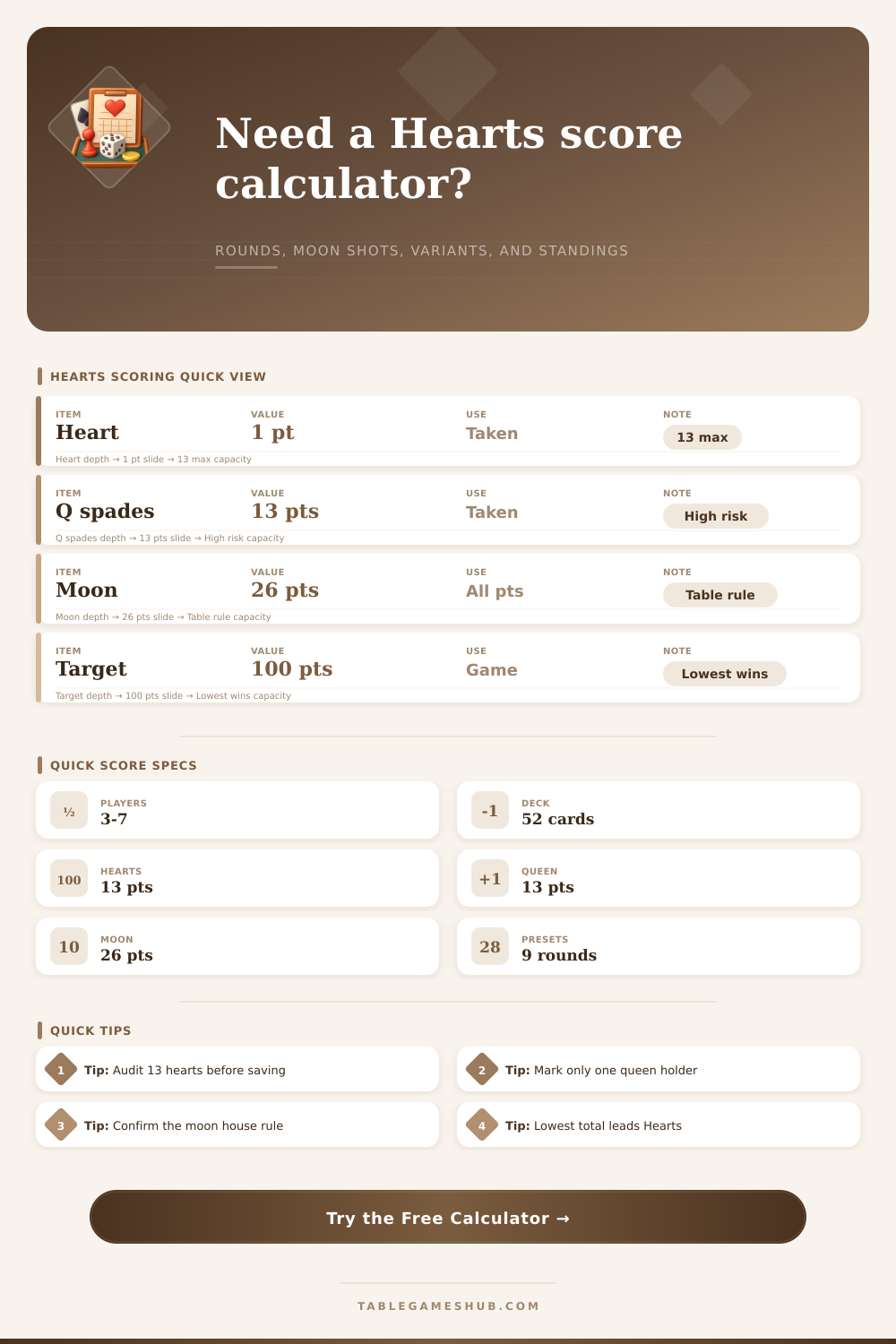
| Each heart captured | 1 point | Hearts taken | There are 13 hearts total in the deck. |
| Queen of spades | 13 points | Queen? | Only one player should hold this card each round. |
| Jack of diamonds | -10 points | Jack diamonds? | Used by Omnibus tables as a bonus card. |
| Ten of clubs | 2x score | Ten clubs? | Some tables double the holder score or all scores. |
| Player count | Cards each | Cards removed | Common handling |
|---|---|---|---|
| 3 players | 17 | 2 of diamonds | Remove one low non-scoring card before dealing. |
| 4 players | 13 | None | Cleanest standard deal and pass cycle. |
| 5 players | 10 | Two low cards | Keep all scoring cards in the deck. |
| 6 players | 8 | Four low cards | Agree on removed cards before the first deal. |
| 7 players | 7 | Three low cards | Short hands make queen timing more volatile. |
| Moon rule | Shooter result | Other players | Best for |
|---|---|---|---|
| Add to others | 0 round points | +26 each | Traditional score sheets where totals only rise. |
| Subtract self | -26 round points | 0 each | Comeback-heavy house games. |
| Best choice | Calculator chooses | Depends | Tables allow the shooter to pick the larger advantage. |
| Variant moon | Custom value | Custom value | Tables using Omnibus or nonstandard point cards. |
| Audit check | Expected count | Warning trigger | Fix before recording |
|---|---|---|---|
| Heart cards | 13 total | More or fewer than 13 | Recount every captured trick pile. |
| Queen holder | 0 or 1 | More than 1 queen | Only the queen of spades scores. |
| Moon shooter | 0 or 1 | Multiple shooters | Only one player can take all scoring cards. |
| Target danger | Table choice | Inside buffer | Confirm whether the game ends immediately. |
6Scorekeeper Tips
Moon audit: A true moon usually means one player has all 13 hearts and the queen of spades. Use the moon checkbox only after that count is confirmed.
Variant cards: Keep jack of diamonds and ten of clubs separate from manual adjustments so the score sheet shows which house rule changed the round.
If you play Hearts (or any other card game), this is a card scoring calculator that will keep track of all your points for you. When someone doesn’t think they caught somebody’s card, it can turn in to an argument. It turns in to a long conversation where everyone else sits there waiting. With this thing you can just throw your cards down and turn them in to a nice clean scoring sheet. Now you don’t have to waste time fighting over math and you can get back to playing.
The scoring for Hearts can get complicated fast. Unlike most games where you want to accumulate points, in Hearts you attempt to score as few point as possible. After entering your Queen penalties and hearts that you’ve captured, the calculator add them up for you. It eliminates the need for manually keeping track of cumulative totals from round after round. When the pressure is on, memory tends to fail. Having something reliable help a lot.
Why You Need This Scoring Tool
Typically, you’d be playing Standard four player Hearts, where each heart card is 1 point and the Queen of Spades is a 13-point bomb. If you want to factor those into your calculations, great: they’re already included as defaults. Real games, however, may have their own set of house rules that change things up a bit. Maybe it’s the Jack of Diamonds that costs an extra -10 points (Omnibus twist). Or maybe if you hold the Ten of Clubs, your score double. Those tweaks would certainly change the risk of each hand. There has to be a better way than having to rewrite your notes, right? What happens when house rules come into effect?
The shoot-the-moon mechanic provides ample drama. A player who takes all twenty-six penalty points on their turn typically reset the board (or penalizes other players). By switching through various moon shot options, the calculator will deduct those points from shooter’s score and/or add them to the victim(s). It works well with whatever style you have at home.
When an opponent attempts a comeback after falling behind by forty points, consistency matter. Another problem is tracking which players are near the losing side of target score. In our game, it’s generally around one hundred, so everyone would prefer to be under that number. The tool will highlight whichever player is closest to danger zone. For example, if you have two or three player near that limit, it will show you visually who should play defensively during the next round.
Additionally, when you input your results, it will verify that the number of Queens and hearts match the mathematically possible outcome. That way if you think you took out thirteen hearts, but you only see twelve, the system alert you to an error. It’s a safeguard against those quiet errors that can derail endgames.
If you play with a few or with many, then the distribution of cards is altered. Fewer players means longer hands with greater volatility. To make sure that each hand is fair for all players, the calculator remove non-scoring cards according to the number of players. That’s not just an arithmetic exercise, it’s also a matter of integrity in the game. Because the basic fifty-two-card deck doesn’t divide evenly into every size of groups, adjustments must of been made. The numbers are transparent and build trust with your players. A clear score sheet will eliminate many disputes. If there’s a question as to whether a player passed on a good hand or made a bogus bluff, you might still have room for argument, but you won’t be able to argue a proper total.
If someone says “I know I didn’t take that heart,” point at the screen. The math doesn’t lie. When it remains fun rather than an arithmetic debate, your buddies will thank you.