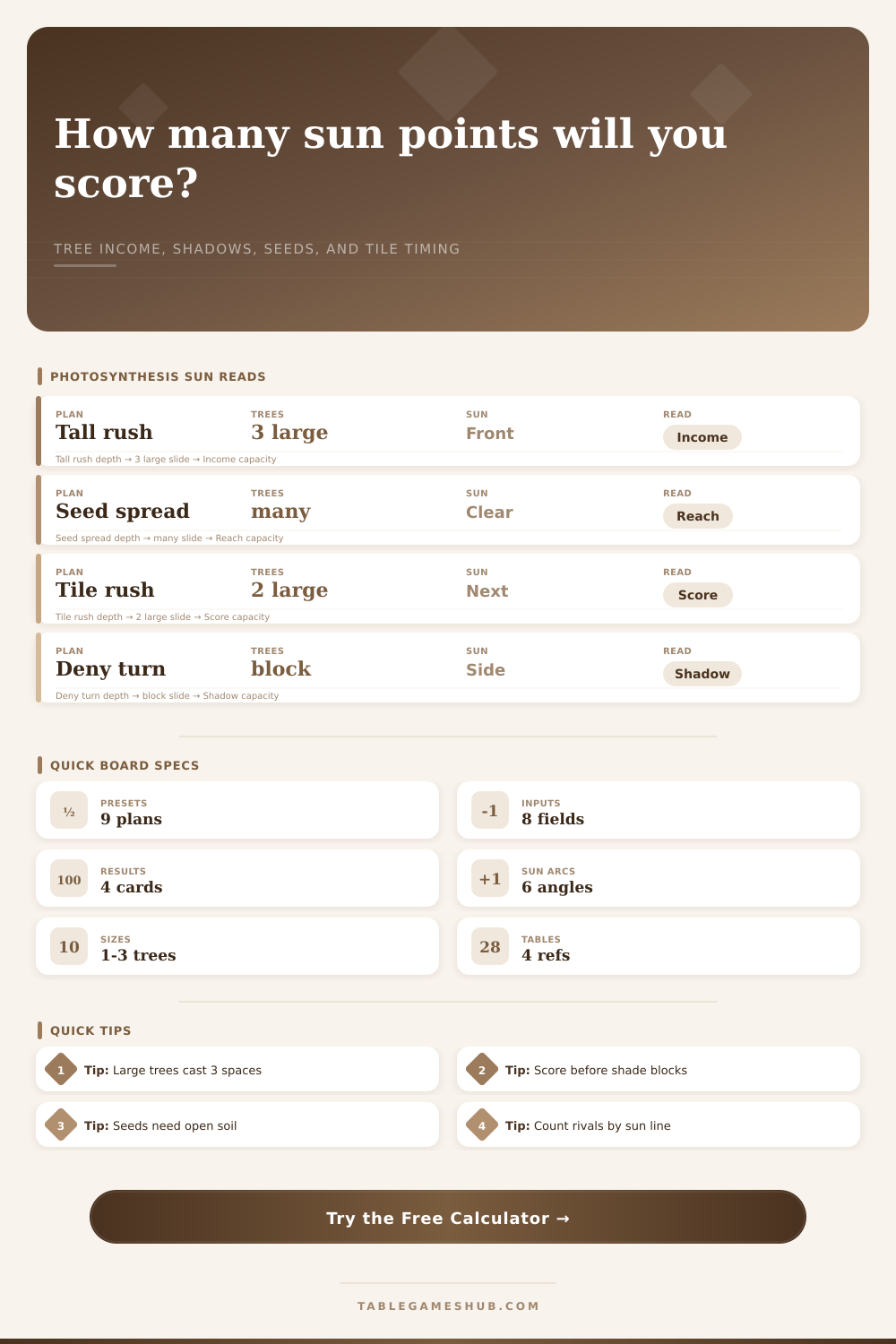
Photosynthesis Sun Point Calculator
Estimate a Photosynthesis turn from tree counts, current sun direction, shadow blockers, soil ring pressure, growth costs, seed reach, scoring tile value, and remaining rotations.
Use this for the board game Photosynthesis. It models each sun phase as income from unshaded trees, then converts that income into growth, seeding, scoring-tile, and rotation-denial pressure.
Photosynthesis sun point result
| Tree size | Sun income | Shadow length | Calculator use |
|---|---|---|---|
| Small tree | 1 sun point | 1 space | Efficient early seed spread, but easy to block. |
| Medium tree | 2 sun points | 2 spaces | Best midgame income bridge toward large tree scoring. |
| Large tree | 3 sun points | 3 spaces | Largest income and scoring access, plus strong denial shadow. |
| Scored tree | Tile VP instead | Removed | Converts board position into points but reduces future income. |
| Sun direction | Income factor | Best watch card | Board read |
|---|---|---|---|
| Front light | 1.05 | Net Sun Income | Clean lane where your canopy is mostly exposed. |
| Side flank | 0.96 | Shadow Loss | Mixed shade; rival and friendly trees both matter. |
| Rear light | 0.92 | Action Readiness | Back trees can score if prior growth was timed well. |
| Low angle | 0.86 | Shadow Loss | Long line increases blocker pressure from large trees. |
| Ideal angle | 1.16 | Scoring Pressure | Strongest timing for rushing a high-value tile. |
| Position plan | Seed reach | Tile value cue | Calculator read |
|---|---|---|---|
| Outer ring recovery | 1 space | Lower VP | Good when income is weak and open soil matters more than peak points. |
| Middle ring build | 1 to 2 spaces | Normal VP | Balanced route for medium-to-large growth without overpaying tempo. |
| Inner ring race | 2 spaces | High VP | Worth growing fast if blockers do not cut off the next sun angle. |
| Center space fight | 3 spaces | Highest VP | Strongest score ceiling, but rotation denial matters immediately. |
| Preset | Main pressure | Result card | Decision signal |
|---|---|---|---|
| Large Tree Shadow | Denial line | Shadow Loss | If loss is high, grow out of the lane or score before the next angle. |
| Seed Spread | Open soil | Scoring Pressure | If seed value beats action cost, claim the ring before rivals fill it. |
| Scoring Tile Rush | Tile timing | Action Readiness | Readiness above 100% means the large tree can convert now. |
| Rotation Denial | Future shade | Shadow Loss | Accept lower income only if your large tree blocks more rival value. |
| Crowded Forest | Traffic | Net Sun Income | Thin low-value trees when shade makes future income inefficient. |
Trees need space and time to photosynthesize. On a round board, you’ll plant little plastic tree and hope they do not fall into your neighbor’s shadow. It is frustrating when the other player covers your canopy just before score time.
Knowing where to point the sun helps: it lets you translate fuzzy gut instinct into numerical fact. Enter the directions that the sun is shining and how many trees is planted; then the calculator does the rest for you. No more guesswork about whether a play was brilliant or boneheaded.
How the Calculator Helps You Play Better
Photosynthesis revolves around this central conflict: Short vs. Long. Saplings produce a single sun point, whereas big tree output a total of 3 sun points. Saplings also has the benefit of being impossible to fully block, and that’s why they’re good for earning money quickly. But they won’t net you any high-scoring tiles. On the other hand, big trees create both denial and wealth, but at a steep price. You’ll need to invest heavily in them.
When should you stop growing little trees and start spending on upgrades? Missed opportunity is your enemy. If you’re slow to draw, your opponent will clog the inner ring with large trees. Then those trees’ shadows will prevent you from generating income until it’s time to score.
How does this balance translate? Enter the number of each size tree you have growing. You have three big ones, a couple of medium-sized one, and one little one. Plug in those numbers and see what your gross canopy income is. Then use the sun marker angle to calculate losses.
Where’s the sun coming from? If there’s some front light, you’ll get clean access to all your trees. If there’s low-angle sun, the resulting long shadows allow rivals to block your view. The table of references show how income efficiency drops off as you flank the sides with less-than-ideal angles.
Why care? This will tell you whether you should save points for a seed action or spend them on growing taller.
One other factor that is easily overlooked until it is too late is seed reach. In order to grow seeds, there must be empty soil slots, and they don’t go farther than the height of their parent tree. The rings furthest from the trunk provide a lot of room, but not much value. As you approach the trunk, the tiles’ value rise, but so do your opponents’ attempts to block you from moving! To represent this, the calculator asks how many ring deep your intended move goes, and how far away from the parent tree that you want to place the seed. This lets you determine whether you’re better off staying on the outside, or pushing further inward despite the cost in income.
If your attempt fails, you’ve wasted one turn. When time is limited, every turn matter. The sun marker spins, increasing pressure. Trees are converted to VP from the stack. Each big tree is a point of victory and take away income in future rounds. This is when folks tend to go wrong. They get greedy for VP and rush to score the first big tree, forgetting that three sun points a turn accumulates fast. Scoring if there aren’t many spins left makes sense. Keeping the canopy alive longer may gain more overall points if there are several more turns left. The tool tries to measure how much pressure is applied by comparing the tile’s value and expected income against the cost of the action.
Photosynthesis also has a key strategy called rotation denial. Scoring your own trees isn’t necessarily the only way to win. Sometimes it makes more sense to plant a tree that blocks an opponent’s sun exposure. That transforms their potential income into zero, while costing you no chips. There are presets on the calculator for rotation denial situations. These let you see whether or not a particular placement will shut down a rival’s lane. It quantifies how much sun loss they’ll experience. This helps you determine if blocking is worth the tradeoff of missing out on points from your own growth.
In Photosynthesis, every move involves a trade off between shade and light. Harvest the sun, but deny it to someone else. That’s an abstract tension, but the tool makes those numbers concrete. It tells you whether your canopy is robust enough that you’ll grow something, or weak enough that you’re vulnerable to getting shaded out. And it tells you when it’s time to cash in and get some victory points.
When you view each round as a calculated investment, you begin to play the board rather than just react to it. Yes, the sun keeps on turning regardless of what you do. But with more data, you could of made sure your trees are prepared when it does.