Race for the Galaxy Gathering Storm Calculator
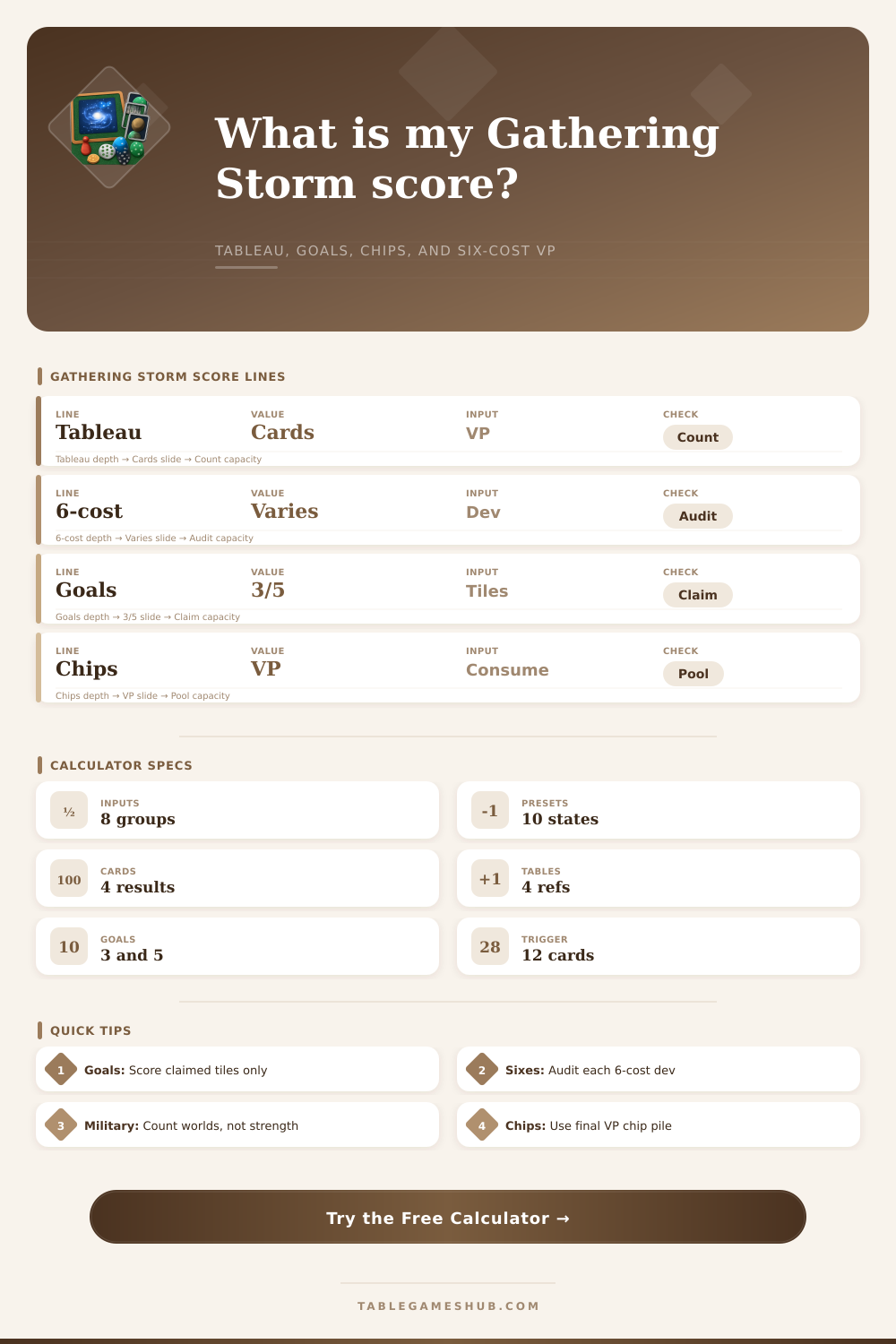
Total a Gathering Storm finish with tableau card VP, 6-cost development scoring, military worlds, consume VP chips, start world context, First and Most goals, hand size, and the 12-card or empty-chip endgame trigger.
| Score line | What to count | Modeled value | Calculator field |
|---|---|---|---|
| Printed world VP | All world VP symbols in tableau, excluding variable six scoring | Entered directly | World VP |
| Printed development VP | Non-six development VP symbols and fixed development points | Entered directly | Dev VP |
| 6-cost developments | Each 6-cost development scored from its own text | Entered final total | Sixes and Six VP |
| VP chips | Final chip pile from consume powers and awards already taken | 1 VP per chip | VP chips |
| Gathering Storm goals | Claimed First goals and held Most goals | 3 VP and 5 VP | First goals, Most goals |
| Start world | Common scoring path | Calculator signal | Audit note |
|---|---|---|---|
| Old Earth | Explore support into consume or development tempo | VP chips plus tableau density | Hand size can be high without adding score. |
| Epsilon Eridani | Alien windfall worlds and Alien six-cost payoffs | Alien Tech focus and windfall worlds | Check whether Alien worlds are printed VP or six VP inputs. |
| Alpha Centauri | Blue windfall production into consume chips | VP chips and production focus | Consume chips often carry more than printed tableau VP. |
| New Sparta | Military settling, Rebel worlds, and Imperium scoring | Military worlds and strength | Strength is not VP; score the worlds and six text. |
| Lost Earth Colony | Genes, novelty, and mixed development scoring | Pan-Galactic or custom six focus | Separate fixed dev VP from the variable six total. |
| Separatist Colony | Rebel and military tableau sprint | Military worlds, goals, 12-card trigger | Goal timing can decide the final margin. |
| Goal family | Typical value | When to enter | Score audit cue |
|---|---|---|---|
| First goal | 3 VP | When that player claimed the tile during play | Usually already represented as chips or awards; avoid double counting. |
| Most goal | 5 VP | When the player holds the goal at game end | If tied, use the table's actual awarded value in goal count or chips. |
| Tableau-size goal | 3 or 5 VP | When worlds, developments, or card families satisfy the tile | Compare against the final tableau card counts. |
| Consume or chip goal | 3 or 5 VP | When consume powers or VP chip counts satisfy the tile | Confirm chips are not counted once as goal and again as chip VP. |
| Benchmark | Common read | What moves it | Calculator output |
|---|---|---|---|
| 12 tableau cards | Natural endgame trigger | Fast Settle and Develop selection | Endgame Read and Tableau cards |
| VP pool empty | Consume-heavy table ending | Produce and Consume x2 cycles | Consume VP chips |
| High six value | Variable development finish | Correct card family alignment | 6-cost dev VP and Score shape |
| Military rush | World-heavy score with fewer hand cards | Military strength and Rebel support | Military worlds and printed world VP |
| Goal swing | Gathering Storm-specific margin | First claims and Most checks | Goal VP and breakdown rows |
It is rare for a game of Gathering Storm for Race for the Galaxy to end clearly. More often than not, it comes down to a mess of cards on the table. You’ve played your 12th card and fired off the end game, and now your brain hurt trying to count all the points from developments and worlds strewn across the board.
This thing cranks the numbers for you. It takes account of the printed value, spent chips, awarded goals, and scoring effects based off six costs. No need to crunch numbers at the table while everyone’s debating.
Why You Need a Score Calculator
Scoring right is harder then spotting the points on the cards. But where many people get lost is they either miss some hidden value in variable developments, or they accidently double count. Six-cost development don’t have fixed values until the very end, which is something many players overlook. For example, Imperial Research Center might appear as zero points on the board, but if you have the most research symbols at the end, it is actualy worth ten victory points. That means the tool keep your static totals separate from the variable ones so you don’t double count something or completely forget about it.
In a close race, one wrongly calculated card can swing who wins. Finally, the worlds you start with also affect your breakdown. Those who started with New Sparta will tend to invest in Military power. They think that the raw number of worlds under their control will automatically become VP. That is rarely true, unless those worlds are specifically needed for certain goal tiles or turn into rebel worlds. This is where the calculator can help you audit, splitting out the raw military strength and counting up the worlds you control. Old Earth players may feel like their chips give them a strong lead, and Alpha Centauri lists might have impressive economies but be light on end game trigger points. Knowing what drove your run tells you if it was an efficient strategy or just luck that kept you livig this far.
It adds complication for advanced gamers because some of the goals in Gathering Storm trip you up. The trick is to watch for “first goals,” which earn three points when claimed, and “Most goals,” which earn five points at the end of the game. Overlap occurs here; if you claim a First goal which called for eating up some chips, those chips may be in your stack. Do you tally them as representing the value of the goal tile? Or do they represent chip count? That will determine the validity of your win (or protest against someone else’s). There’s a chart on the page explaining this, how not to double-count scoring by taking two different shots at the same achievement. It is a little bit of admin work, but it makes all the difference between a contested defeat or a credible win.
The tool tracks Victory Points and Hand Size. Instead of measuring points, Hand Size measures context. It feels bad to hold cards you want to play but cannot, rather than just losing points. But seeing how many cards you had in hand will help explain why your tableau may appear less dense than your opponents even if you scored more points. You can get away with having twelve massive, high-value cards and win comfortabley against someone with twenty cheap, low-impact ones. Volume never wins out over efficiency.
To highlight this ratio, the calculator will show you Victory Points per Card which shows just how efficiently your engine ran. And that’s what the game is about; building up momentum and managing it till pull time. And at the end of the game the math tell the story.
There is nowhere to hide; nothing in this game is hidden any longer. Whether you were running a military rush with Rebels or a consume-heavy production loop, everything matters now. Everything matters. Every goal claimed, every chip spent, and every six-cost development must line up. You separate the variables from the constants, check triggers, and see how well your plan measured up or if you simply got lucky. Your memory of the previous round may fool you but the numbers won’t.
You should of checked them earlier.