Catan Cities and Knights Calculator
Total a Cities & Knights position with settlements, cities, metropolis points, defender cards, commodity progress levels, knight strength, barbarian outcome, and target victory points.
Current Cities & Knights score
| Score source | Points counted | Typical limit | Calculator handling |
|---|---|---|---|
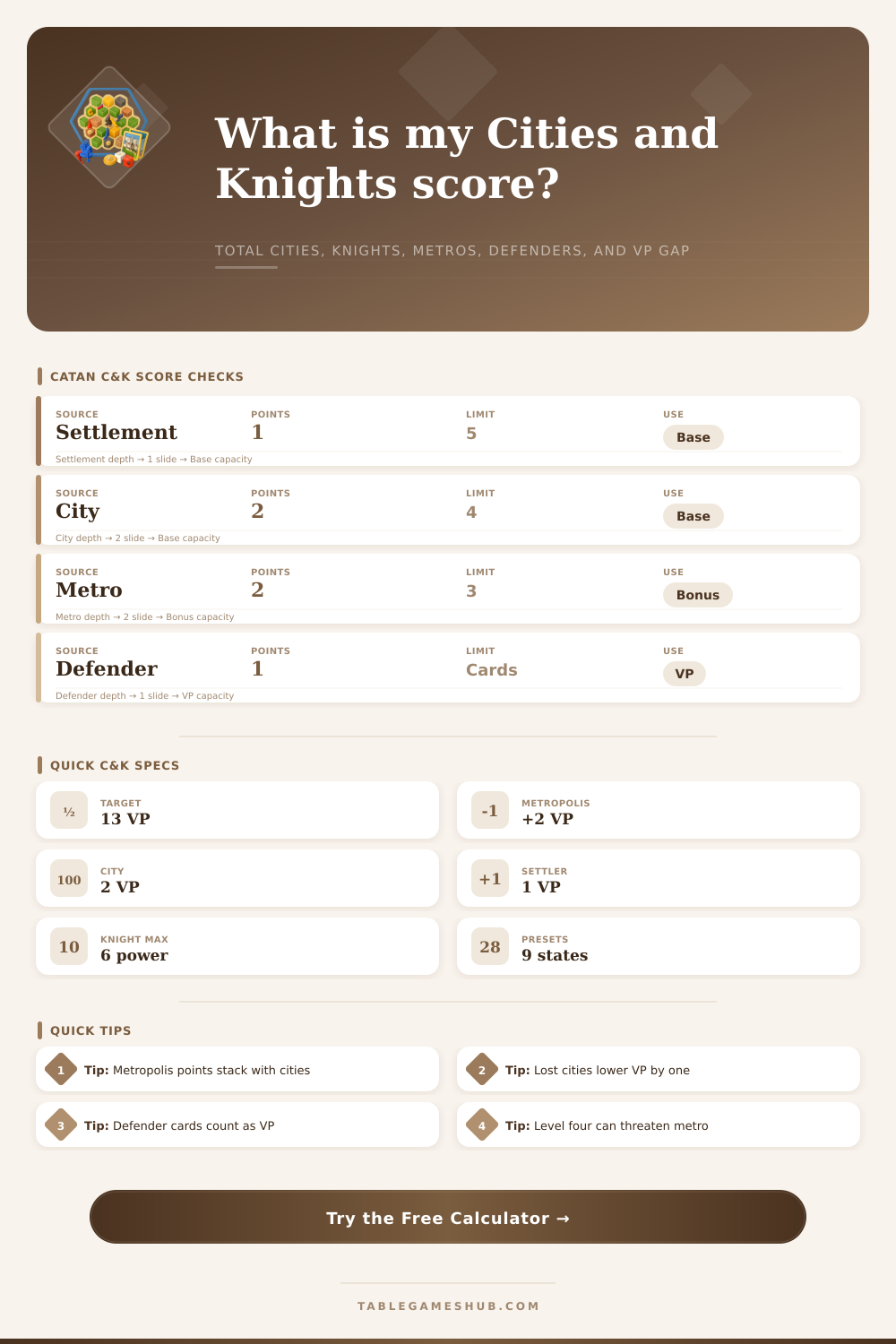
| Settlement | 1 VP each | Usually up to 5 pieces | Added directly from the settlement input. |
| City | 2 VP each | Usually up to 4 city pieces | Added directly from cities still standing. |
| Metropolis | +2 VP each | One each for science, trade, politics | Stacks on top of the city already worth 2 VP. |
| Defender of Catan | 1 VP per card | Varies by invasion results | Added as victory point cards already held. |
| Branch | Commodity | Metropolis gate | Calculator signal |
|---|---|---|---|
| Science | Paper | Level 4 can threaten science metropolis | Counts as a live metropolis threat at level 4 or 5. |
| Trade | Cloth | Level 4 can threaten trade metropolis | Counts as a live metropolis threat at level 4 or 5. |
| Politics | Coin | Level 4 can threaten politics metropolis | Counts as a live metropolis threat at level 4 or 5. |
| Balanced climb | Mixed commodities | Multiple level 4 branches compete | Marks the position as a metropolis race. |
| Barbarian state | Knight check | Possible VP swing | Use in score sheet |
|---|---|---|---|
| No invasion resolved | Compare active strength to cities | 0 VP immediate swing | Use the read as a pressure warning only. |
| Catan defended, you lead | Strongest eligible defender | Potential +1 defender VP | Add the card only after it is awarded. |
| Catan defended, another leads | Enough table strength, no card | 0 VP for your sheet | Score stays unchanged, but cities remain safe. |
| Barbarians won | Weakest eligible defense is exposed | Often -1 VP from city downgrade | Calculator estimates the at-risk city loss. |
| Position profile | Typical score shape | Strongest lever | Watch item |
|---|---|---|---|
| Opening City Pair | Two cities, low defender count | Commodity level climb | Do not leave both cities undefended. |
| Trade Metropolis Race | City base plus cloth pressure | Level 4 trade branch | Confirm the marker is actually held. |
| Final Push to 13 | Metropolis and defender cards matter | Small VP card or city build | Target gap can be only one point. |
| City Lost Check | Barbarian loss can erase progress | Activate knights before scoring | Downgrade changes city points to settlement points. |
The game ends quietly when you tap a victory card that you earned several turns ago. Resource shortage isn’t usually much of a threat in Cities and Knights. It’s an arithmetic problem: how many points do I need to devote to my defense? How many does that cost me if I want to win? Because the goal is building an empire amidst threats like marauding barbarian hordes at your doorstep, every point you spend on defense is a point you cannot spend on winning. Enter your board state into calculator; it’ll crunch the numbers for you and spare you the trouble of keeping count in those late-game rounds where each victory point seems precious.
Take a look around. Your physical footprint matters first. A settlement rewards you with a single point and doesn’t ask for much work in return. Double that with cities, but know that resources and upkeep is required if you want them to evolve. Was it destroyed during an invasion? That city falls back into a settlement, resulting in an immediate loss of points from your total. It’s why so many folks get wide-eyed at their commodities track. Seeing the numbers climb makes them think they’ve got things won, but realy those points are barely secured.
How to Win at Cities and Knights
But then we have the metropolis race. Here’s where things get interesting, and also go beyond simple city building towards strategy. Sure, I’d like a city. But I would really like one of the metropolis markers. By reaching level 4 on the politics/trade/science board, you claim one of those for yourself. What does that give you? It gives you an additional two points on top of what you currently have on the board. On page, there’s a helpful reference table that explains this all very well. These bonuses is cumulative, too, so it’s a serious benefit that puts players with leads in certain commodities ahead by forcing others to respond to them rather than just responding to their own board placement. So if I’m leading in cloth, now they have to fear disruption to trade, as well as how much paper they can produce.
The abstract moves to specific details about defense. How good is your knight strength against barbarian raiders? Does he protect those cities, or do they fall? The calculator knows how many knights you have up and what has happened lately to invaders. Have you protected Catan? Congratulations! You probably got a Defender card for a point. And this can be the difference between being in the game and falling out of it. It is a small deal, but it is huge if all players is bunched on twelve. How well do your knights compare to the cities you’re protecting? That ratio of knight power to cities at risk determines how hard the tool think you’ll be pressured. If that ratio isn’t great, the result will tell you that your score is at risk.
Long term strategy is driven by commodity levels So early on in the game you can go up all three of these boards at an even pace. Eventually, specialization are required. So when do you push for that next level? Or do you buy victory point cards and shift your focus? You’ll pick from the list of profiles for where you currently stands (trade monopoly vs science push, etc.). That way you can see just how far away you are from triggering that metropolis. You can also figure out if it’s worth spending resources to push for one more level, or if it is time to switch over to picking up some cards. This is something the interface makes easy as well, telling you precisely what you’re short of reaching your desired score.
People get hung up on the resources. Points trump resources. Points are real, resources are potential. Sure, you might be able to stockpile ore and grain like crazy, but without the defender cards or cities to back them up, you’ll never win. The calculator makes you turn your head from your hand to the scoreboard. It removes all the noise and tells you straight up what you should of do next. Do I need another city? Or will a city marker be enough for victory?
Play around with the presets. What if you have a solid trade lead and two cities? How does that compare to an enemy with three cities but no commodities? Run it through the tool, and it’ll spit out the answer. It converts those vague intuitions into hard facts, which is invaluable when betrayal occurs from turn to turn and alliances break down.
Before you make that last move, you want to know where you stand. In the end, Cities and Knights is all about acquiring points and mitigating risk. Points acquired are clearly shown in calculator, which shows you a picture of where you stand and where you should be. And though it doesn’t play out for you, it paints a clear picture of how to proceed. Did you defend well enough when those barbarians came? Will you earn those final points? Use these markers as a reference, monitor your knight strength, and follow the math until the next step take you ever closer to that famous thirteen.