Domino Train Length Calculator
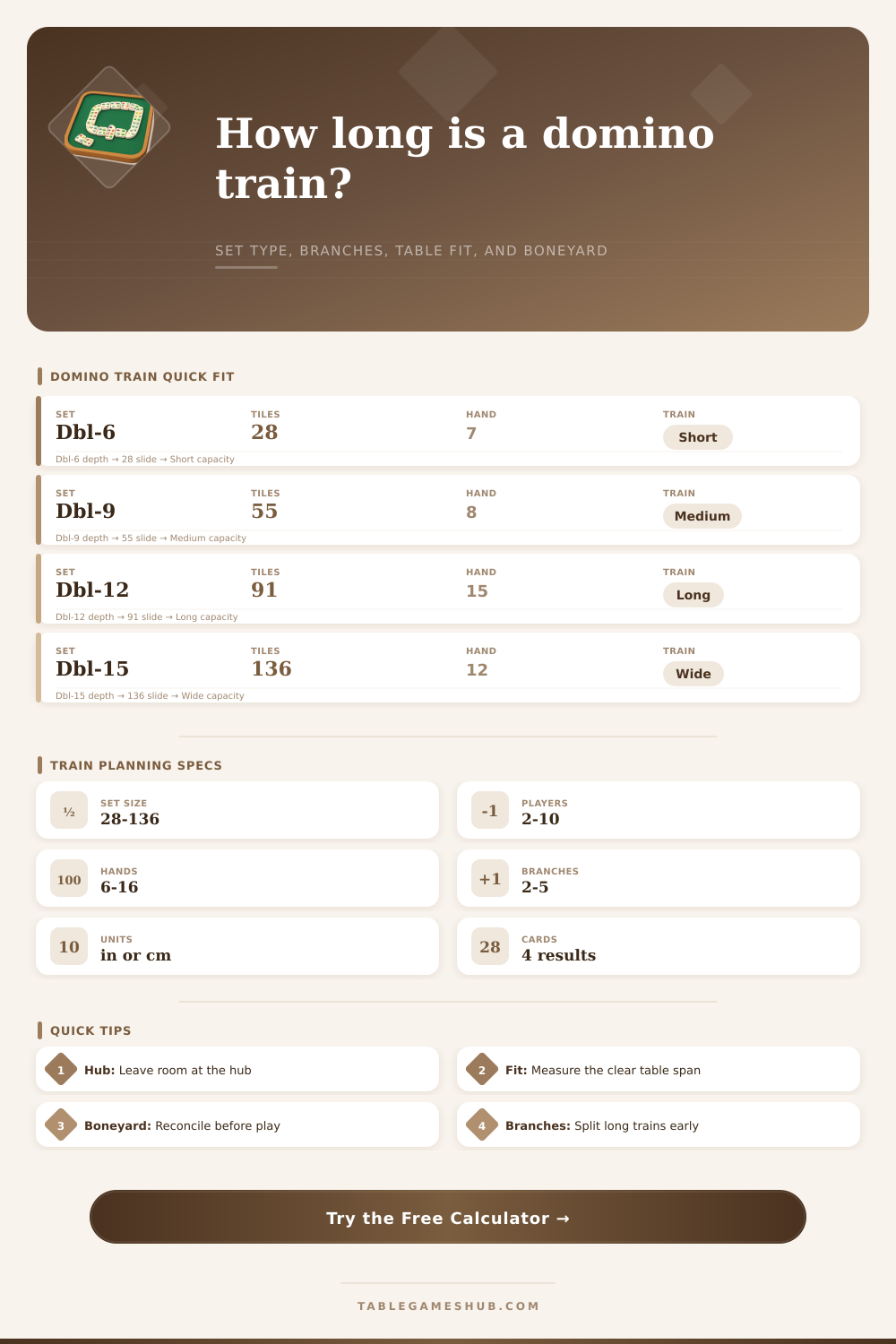
Estimate Mexican Train and branch-style domino layouts by set type, starting double, player count, public and private trains, boneyard size, and available table length.
Adjust the branches and boneyard to match the table state before measuring the final span.
Set and starting-double reference
| Set type | Total tiles | Common hand size | Train planning note |
|---|---|---|---|
| Double-six train table | 28 tiles | 7 tiles per player | Best for short two-way or four-player teaching layouts. |
| Double-nine train table | 55 tiles | 8 to 10 tiles per player | Works well for 4 to 6 players with one public train. |
| Double-twelve Mexican Train | 91 tiles | 12 to 15 tiles per player | The usual set for long private trains and a public train. |
| Double-fifteen club train | 136 tiles | 10 to 12 tiles per player | Needs early branch splitting on standard dining tables. |
| Double-eighteen large set | 190 tiles | 10 to 16 tiles per player | Use a cross hub or multiple public lanes for fit. |
Current deal and boneyard table
| Zone | Tiles | Share of set | Length effect |
|---|---|---|---|
| Player hands | 96 tiles | 105.5% | Potential train tiles after play |
Branch fit table
| Branch model | Lanes per branch | Tiles per longest lane | Required table span |
|---|---|---|---|
| Four-arm cross hub | 3 lanes | 9 tiles | 48 in |
Table length planning guide
| Clear table length | Imperial size | Metric size | Typical domino train use |
|---|---|---|---|
| Compact card table | 36 to 48 in | 91 to 122 cm | Double-six or short double-nine trains. |
| Small dining table | 60 to 72 in | 152 to 183 cm | Double-nine with 4 to 6 players. |
| Full dining table | 84 to 96 in | 213 to 244 cm | Double-twelve with a public train. |
| Club or tournament table | 108 to 144 in | 274 to 366 cm | Double-fifteen or 8 to 10 player layouts. |
There’s that scene where all the friends assemble at the dinner table, a box of fresh double-twelve dominoes sitting beside some snacks. They’re excited to have a friendly game of something that gets strategic and cutthroat so everyone pulls their hand out enthusiastically. And the game starts, and pieces click into each other and branches sprout outward from the middle. The train grow until it reaches across the score pads and onto water glasses. By the tenth round, there’s not enough table to play on; one player cradles their tiles in midair because there’s nowhere to put them down.
Until then, you don’t realy realize how much it eats up space. To prevent this, all it takes is some planning ahead. Before anyone touches a single tile, you should of known how much space a certain number of tiles will cover. No tape measure, no protractor, no nothing required while playing the game, just know how many tiles you’re trying to fit, and how much table surface area they require.
Plan Your Domino Table Space
Since a normal domino train is basically a bunch of lanes leading away from a central point, knowing how wide each lane needs to be requires knowing inches. Plugging in the table’s dimensions, along with set type, into the page’s calculator does that math for you. This lets you avoid guessing at conversions and math that typicaly ruin casual game nights.
So what’s your set? Double-sixes fit on the table easily, but if it’s a double-twelve or bigger, that set will spread out quickly. Each move increases how long the visible train gets. With double-fifteen, say, and eight players each holding a dozen, then you’ve just put almost eighty percent of whole set into players’ hands. And there goes not much more room to plan for in terms of arranging tiles.
It may look like there aren’t many open lanes in the boneyard, but remember that those are face-down tiles. They don’t take up any table space until somebody draws them to block. This might extend a lane that was already at its limit.
What about layout? That’s where the hub configuration makes all the difference: it defines the size and shape of the playing space. With a two-way straight station, you need as much table length as possible (to support the trains), while only needing a small amount of width (so the train stays long and narrow). By contrast, a four-arm cross hub cuts down each branch considerably, meaning more people can fit on the same square footage.
Breadth vs. Depth. Do you have a wider table that isn’t very deep? Consider a wider hub or perhaps a fan. Pick the geometry that fits your furnitures; don’t let your furniture dictate your geometry!
Also keep in mind that some people convert units. Players often think in inches (pitch), while their table may be measured in feet. Each tile is about two inches long if you lay it out end to end without much spacing between them. Multiply that by thirty (the number of tiles on each branch) and you’re up to almost three feet of playing space per arm. With four arms coming off the centre, and a six-foot table, you run into physical limits quickly.
Without knowing how much space you’ve got, or what scale to design your layout for, you risk wasting time before finding your plan doesn’t fit. The converter makes this easy: it works equally well with imperial and metric and keeps the right measurement in mind at all times.
Don’t ignore the public train. The public lane grows with the game regardless of any private branches in Mexican Train rules. It’s a kind of safety valve for players who gets blocked, but it eats up precious real estate in the center. You must have breathing room at the hub to place your markers and your hands. You also need space for the mad scramble of initial placements.
Leave no room there for negotiation. Measure the open span from end to end across the direction of the train and don’t mind those outer edges where drinks reside. All that matters is that center.
The flow is everything in dominoes. Nobody wants their opponent leaning on them and fishing out a tile from underneath. And nobody wants to collapse when a branch hits the edge of the table. Hours can be wasted if you don’t do some pre-game calculation.
Clear the area. Check the span. Let those tiles fall where they may. Sometimes the best strategy is to have enough room to make that strategy work.