Japanese Mahjong Yaku Calculator
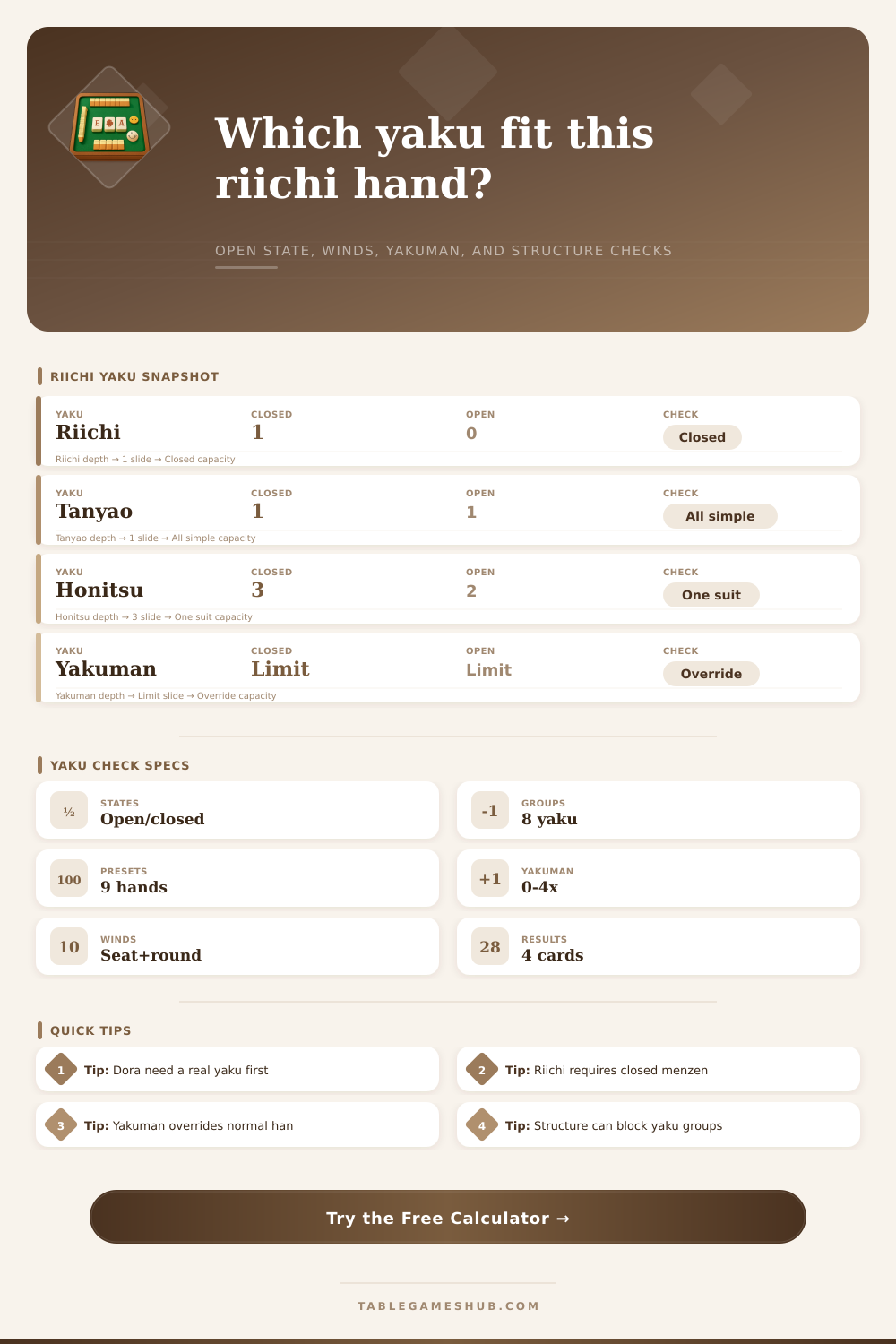
Check riichi yaku groups against open or closed state, riichi eligibility, seat and round winds, yakuman count, dora notes, win method, and hand structure conflicts.
| Yaku group | Closed value | Open value | Calculator check |
|---|---|---|---|
| Tanyao / Pinfu basics | 1 to 2 han | 1 han if tanyao only | Closed pinfu parts fail when open |
| Sequence group | 1 to 3 han | 0 to 2 han | Pairs and triplet shapes can conflict |
| Triplet and quad group | 2 to 4 han | 2 to 4 han | Sequence requirements are unlikely |
| Value honor group | 1 to 4 han | 1 to 4 han | Seat and round wind are highlighted |
| Flush group | 3 or 6 han | 2 or 5 han | Open hand loses one han |
| Structure check | Usually fits | Common conflict | Best use |
|---|---|---|---|
| Standard four melds plus pair | Basic, sequence, honor, flush | Seven-pairs-only claims | Most ordinary riichi hands |
| Seven pairs shape | Pair, flush, terminal | Toitoi, pinfu, normal sequence sets | Chiitoitsu tanki checks |
| All triplets / quads shape | Triplet, honor, terminal | Pinfu and sequence yaku | Toitoi and yakuhai stacks |
| One-suit flush shape | Flush plus sequences or triplets | Mixed-suit sequence yaku | Honitsu and chinitsu review |
| Thirteen orphans shape | Yakuman | Normal yaku groups | Kokushi musou only |
| Yakuman family | Typical state | Structure clue | Normal yaku treatment |
|---|---|---|---|
| Kokushi musou | Closed | Thirteen orphans | Normal groups ignored |
| Suuankou | Closed | Four concealed triplets | Yakuman count overrides han |
| Daisangen | Open or closed | Three dragon triplets | Honor group becomes limit hand |
| Tsuisou / Chinroutou | Open or closed | All honors or terminals | Terminal-honor structure matters |
| Chuuren poutou | Closed | Pure one suit | Flush normal han ignored |
| Bonus or context | Yaku? | Needs closed? | Calculator note |
|---|---|---|---|
| Riichi | Yes | Yes | Open state removes it |
| Menzen tsumo | Yes | Yes | Added from closed tsumo |
| Seat or round wind triplet | Yes | No | Counts through honor group |
| Dora, ura dora, aka dora | No | Ura needs riichi | Bonus han after yaku exists |
| Open calls | No | No | Can reduce or block yaku |
You have twelve tiles in your hand and another is on its way to table. Everyone’s holding their breath waiting for last tile to make the winning shape. Half the skill of playing Japanese riichi mahjong are knowing when you’ve got a winning hand. The other half is knowing whether or not it will score any points. Regardless of how well you arrange the tiles, a hand without yaku isn’t worth anything.
This is what distinguishes casual player from the strategists who understand depth of the game. This forces you to consider both scoring and structure at once, within the flow of play where risk and reward must be weighed against each other. Where it gets tricky are bridging the gap between the tile shapes and their point system’s own rules. What if you have an otherwise beautiful run but can’t find three triplet (or any other acknowledged pattern)? That beauty won’t mean diddly-squat based off a mathematical standpoint.
How the Mahjong Score Calculator Works
Enter our calculator, which check chosen sets of yaku groups against your current hand status. By entering both round and seat wind, you’ll be able to test if there are still viable patterns that could score even after declaring open and/or riichi. You’ll also know how to factor in tsumo bonuses, toggling the win type accordingly. It’s a simulator that eliminates guesswork from complicated hands where more than one possible pattern may apply, or compete.
While you can see what points each hand earns, the calculator doesn’t reveal whether that’s because of a yaku scoring pattern, so how does it know which yaku count? To determine this, it needs to understand its yaku hierarchy: some patterns applies only to closed hands (so any pon or chi immediately makes those inapplicable). For instance, riichi is probably the best-known one; it provides a single point for declaring that you’re ready before you draw your winning tile. Other patterns concern simplicity, such as tanyao which rewards hands made entireley of numbered tiles (no terminals or honors).
The calculator evaluates these criteria as soon as possible. It marks the hand invalid if it contains a valid open state that would stop it from being scored as a closed-hand yaku. This avoids the all-too-common error of thinking that a hand composed of four sets and a pair must be complete.
The yaku are also subject to massive structure. Certain traditional hands follows the usual rules of melds, while others has their own special shape (e.g., 13 orphans or seven pairs). These have their own restrictions; for example, no sequence bonus points, no pinfu. But a seven pair has its own set point amount. Then there’s something called 13 orphans that just trumps everything else. This is a yakuman hand. You can choose those shapes and try them out as well to see how they fit into the groups of yaku you’ve selected. Where do they conflict? For example, if you’re going to get pinfu, then you don’t get any seven pairs, that’s just mathematicaly impossible.
There is another twist: context matter with wind tiles as well. In other words, simply having three easts may not count toward your score. They might be worth something if you hold them from the east seat or if it’s the east round. Otherwise, the tiles are basically dead weight when it comes to scoring, unless they can help create some kind of larger pattern of honors or terminals. To figure out whether your inputted hand includes relevant rounds and seats, the calculator will check your selected seat and round winds against your hand inputs. It also accounts for dora notes (i.e., bonus tiles don’t come into play until you already form at least one valid yaku). That way, you won’t fall into the trap of chasing bonus points while playing a hand that ultimatey doesn’t have enough legitimate scoring potential.
It’s not something you learn overnight, but once you get the hang of it, you find yourself spotting patterns almost without thinking about it. You begin to naturaly know what sorts of tiles goes together and what dead-end combos you could of avoided picking up altogether. The tables of reference I’ve included outline typical point values for both opened and closed states so you have an idea of how much you might be walking away with. From there, you can better strategize: will you play defensively? Will you risk everything on a potentially profitable hand? In the end, mahjong rewards accurate calculations. Knowing where yaku fall into your system means the dicey nature of luck shifts toward strategy, and then when you finally win, you’ll know exactly why you’re getting paid well.