The Castles of Mad King Ludwig Calculator
Score rooms, room sizes, completion rewards, corridor and stairs bonuses, bonus cards, King's Favors, negative halls, and final money in one table-ready audit.
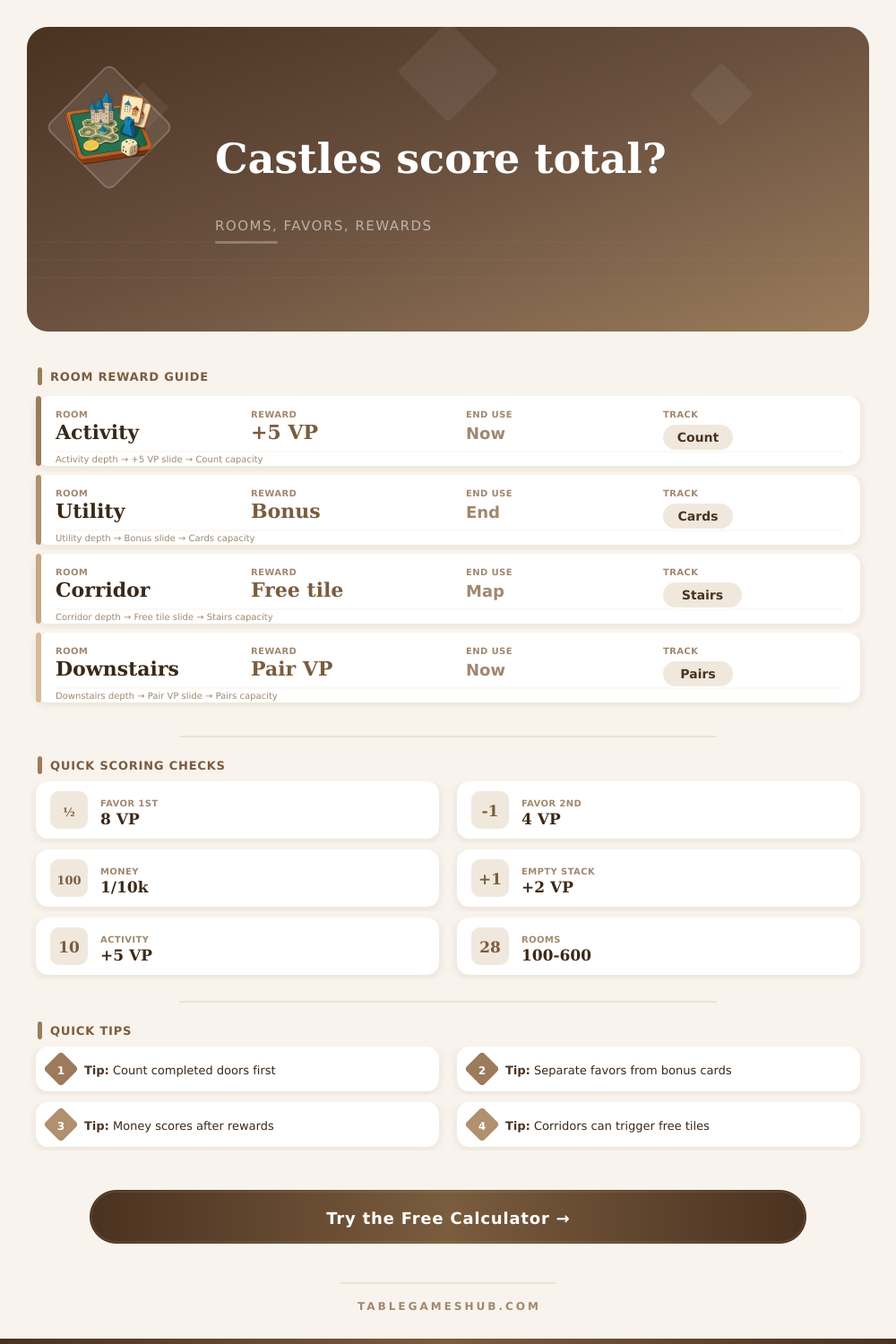
| Room type | Completion reward | Calculator field | Scoring note |
|---|---|---|---|
| Living | Re-score the completed room | Living rooms + re-score value | Best when the room has strong center icons. |
| Activity | Gain +5 VP | Completed Activity rooms | Enter adjacency penalties separately. |
| Sleeping | Search and rearrange a room stack | Sleeping tempo value | Use a small VP estimate unless it produced a known score swing. |
| Outdoor | Gain money | Outdoor rooms + marks per room | Money converts to VP during final scoring. |
| Utility | Draw 2 Bonus cards and keep 1 | Utility rooms + average kept value | Useful for projecting private bonus card value. |
| Food | Take an immediate extra turn | Food rooms + extra turn value | Estimate the VP from the extra placement or pass. |
| Corridor, hallway, stairs | Place a free hallway or stairs | Corridor count + free tile value | Counts as corridor-type progress for relevant objectives. |
| Downstairs | Every 2 completed re-score a room | Downstairs rooms + re-score value | Pairs are rounded down. |
| Scoring item | Rule modeled | Input to use | Output |
|---|---|---|---|
| Depleted room stacks | Each room from an empty supply stack scores +2 VP | Depleted size fields | Stack bonus VP |
| King's Favors | Rank awards are 8, 4, 2, and 1 VP | Favor placement counts | Favor subtotal |
| Bonus cards | Private objectives score at game end | Bonus card points | Bonus subtotal |
| Money | Every 10,000 marks scores 1 VP | Money plus Outdoor rewards | Money VP |
| Activity penalties | Some Activity rooms lose points for adjacent room types | Activity penalty field | Placement adjustment |
| Negative halls or corrections | Use for hall penalties, blocked-door audit, or manual fixes | Negative halls field | Score correction |
For example, you drop a big six-hundred-square-foot tile down and realize your castle is architecturally terrible. Your doorways don’t line up. Because you didn’t realize how much it mattered to avoid placing corridors in the wrong spots, those negative hall cost you points every time you pass them. The calculator does the math for you, turning a jumble of rooms into a single number: victory points.
So there’s no more worry about doing arithmetic at game’s end; instead, you can debate whether your fancy grand hall was worth the structural instability it created. And here’s where it gets weird: Size beats out efficient use of space in the game; which is something that initially trips up new players. There’s satisfaction in pulling down little stacks; you’re getting somewhere! But those little room barely register when the final score rolls around. Your map doesn’t fill up as much when you have three hundred rooms compared to five-hundred, and the tool will help you visualize that.
Why You Need This Score Calculator
Depleting a stack is a binary reward: Whether or not you’ve pulled all the tiles from a near-empty deck is irrelevant; only whether or not you’ve emptied it entirely matters. And knowing this shifts your strategy for those last few cards in your hand. Bonus for completing a room adds more complexity that requires close attention.
If you have a utility bonus card in your hand, it gives instant points immediately upon being played. However, if placed as the center icon in a living room, it can trigger a re-scoring event that swings your total wildly. Similarly, activity rooms provides immediate points with an adjacency mismatch penalty. The calculator breaks out these changing factors from its static base score, and lets you drill down into the value of each mechanic.
For example, how many extra turns did those food rooms generate? How much did steady utility bonus card income contribute? Understanding this difference helps you better identify what happened in the last round when your opponent overtook you. In close matches like this, King’s Favors are often the difference, but all too often they aren’t factored into your strategy until it’s already too late.
Public objectives give you a huge point boost if you rank high enough on them, and that may be worth more than small amount of castle you built. You can plug both first and second places, and it shows how much less valuable the favor points get after that initial spot. Going from first to second will cost you half the value of those points. That’s a brutal hit for a good game that went slightly off-course. It also shows why you must keep tabs on the public tracks alongside your own setup.
Castles of Mad King Ludwig’s other underrated engine is money. In the heat of battle, it feels like all those marks you earn by placing tiles into Outdoor rooms are just annoying busywork; you don’t see the payoff until the end. But one victory point is worth 10,000 marks, and that points pile up slowly as everybody scrambles to place the next tile. And the Cash Calculator will total up both your outdoor rewards and bank balance so you can see whether saving money made sense based off the current state of the game.
Sometimes a profitable-but-dull castle is better than an aesthetically-pleasing-but-useless one. Aggressive expansion needs negative halls as a counter-balance. Before making a big investment in a tile, you need to consider connectivity; every door that’s out of place brings down your possible score. The tool lets you remove these explicitly (and make sure you don’t lose them in mental math mistakes). One minor missing door doesn’t seem like much when the rest of the room “looks good on paper,” but those little costs adds up fast when you’re building an entire kingdom.
Also included are reference tables that act as a handy tick list to help you remember the most common scoring situations. These tables will jog your memory about where staircases should go and when corridors counts as a bonus too. Having these details in front of you will save you from accidentally forgetting a free hallway bonus or counting an effect twice in a single room, like the living room. Getting it right at the table matters every bit as much as playing strategically.
The game is about mastering this balance between short-term score and long-term scoring potential. Maybe you adore that dramatic gargoyle at the edge of your kingdom? But it’s not going to score many points. This calculator is an objective mirror to your decisions; it will tell you if your tastes match the winning conditions.
If you’re frustrated with your kingdom design, turn it into math. Turn your feelings into numbers. Let it be reflected in numbers next time you struggle to place that last room. Your ego won’t win the game; let the numbers lead your ambitions instead. A mad king has to know how to count his treasures before he takes the crown.