Zilch Dice Score Calculator
Score a six-dice Zilch or Farkle roll, compare common house variants, estimate the next-roll farkle risk, and decide whether the turn is ready to bank.
Current Zilch Decision
| Combination | Dice used | Classic score | Notes |
|---|---|---|---|
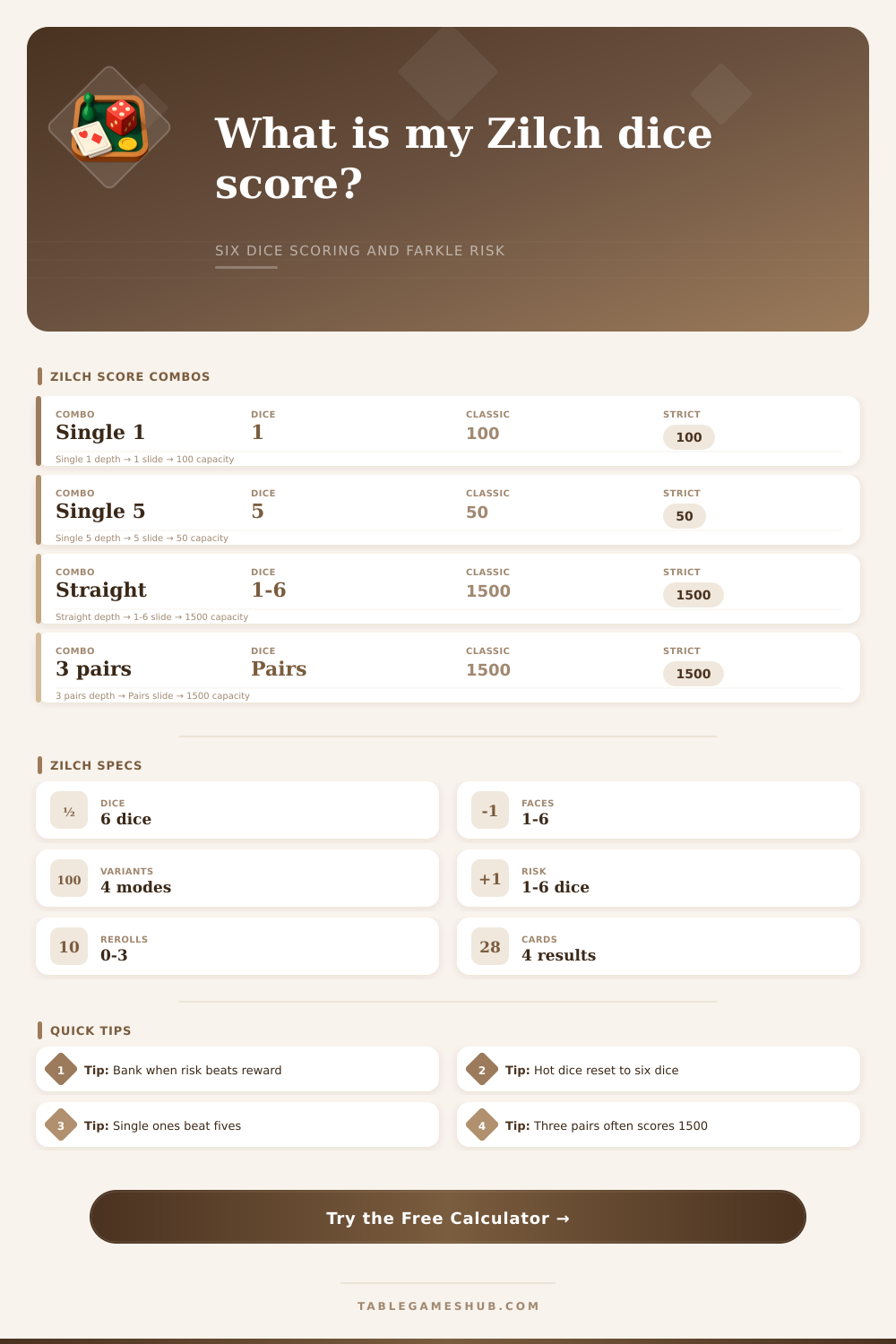
| Single one | 1 die | 100 | Scores outside triples. |
| Single five | 1 die | 50 | Scores outside triples. |
| Triple ones | 3 dice | 1000 | Some tables use 300. |
| Triple 2-6 | 3 dice | Face x 100 | Triple sixes score 600. |
| Four of a kind | 4 dice | 1000 | Friendly mode ladders higher. |
| Five of a kind | 5 dice | 2000 | Uses all matching dice. |
| Six of a kind | 6 dice | 3000 | Hot dice if enabled. |
| Special | Pattern | Score | Dice used |
|---|---|---|---|
| Straight | 1-2-3-4-5-6 | 1500 | 6 |
| Three pairs | 2-2-3-3-6-6 | 1500 | 6 |
| Two triplets | 3-3-3 and 5-5-5 | 2500 | 6 |
| Four plus pair | 4-4-4-4 and 2-2 | 1500 | 6 |
| Six single scorers | 1s and 5s only | Per die | 6 |
| Variant | Triple 1s | 4/5/6 kind | Specials |
|---|---|---|---|
| Classic Farkle | 1000 | 1000/2000/3000 | Most six-dice sets |
| Zilch table | 1000 | Base x 2/3/4 | Three pairs and straight |
| Friendly table | 1000 | 1000/2000/3000 | Two triplets included |
| Strict table | 1000 | 1000/2000/3000 | No leftover singles after specials |
| Dice rolled | Farkle outcomes | Total outcomes | Risk |
|---|---|---|---|
| 1 die | 4 | 6 | 66.7% |
| 2 dice | 16 | 36 | 44.4% |
| 3 dice | 60 | 216 | 27.8% |
| 4 dice | 204 | 1296 | 15.7% |
| 5 dice | 600 | 7776 | 7.7% |
| 6 dice | 1440 | 46656 | 3.1% |
In a Zilch game you learn to panic with six dice remaining and only needing one more point to win. They rattle around the table. They comes to rest in a formation that nets you nothing. In that instant intuition lets you down, probability takes its place. Time to bank points? Or time to go for glory? That’s what makes the difference between scoring a zero and a good run.
And once you input your roll into the calculator, it figures out whether or not it’s worth taking a chance on a straight. In the end, Zilch comes down to whether you prefer to risk losing points immediately or if you’re willing to take your chances now for a possible future reward.
How to Manage Risk in Zilch
A single die carries a 67% chance of landing on a non-scoring face. For most people that’s too high a price for such a modest benefit. Add more dice, and the risk compounds exponentialy fast. Three dice? Odds is good, right? No! Nearly 28% of the time, all three will be a fail. When you’re ahead, every little bit counts. This tiny percentage stacks up quick and eats away at your victory.
House rules are different and knowing which version you’re playing are essential to understanding value. In classic farkle, you get a thousand points for triple ones. Other tables might do ladders. It’s covered in the reference table so you can align them with your own group’s house rules. Playing with hot dice also matters. With this mechanic, you retain all six dice after a full scoring roll. That alters strategy as there’s no more penalty for clearing the board. You have less incentive to bank up if you feel you have comfortable lead without that rule.
Emotional attachment to a large number will often cause a bank to go wrong. A player clings to three hundred because she desires five hundred and doesn’t care that it could be erased entirely. That happens 44% of the time when you roll two dice. Farkle risk provides the visualization: see how much you have at stake compared to your current score. What are you risking? Not only do you need to think about what you’ve got, but also what you might lose. Usually, if it’s attainable, then math should tell you to bank up.
Greed is the biggest obstacle in a game of high stakes rolls. The makeup of your dice left to roll is something else to take into account. Are they all ones? Are they fives? Those will score something every time, so that’s safer. But are they all ones? If so, then what happens when you need a bigger jump? What about two and three? That’s where the tool comes in. It looks at the best legal scoring set for your variant to determine whether it is worth continuing.
Smart players want points; most players want drama. Once you’ve stopped trying to guess what each outcome will be, the learning curve becomes flat. You don’t throw dice; they’re already thrown. You only control when you choose to stop rolling them. When you realize a 1500-point straight is statistically unlikely, you can savor the experience instead of fretting about its rarity. Likewise, if you understand that three pairs are likely, and don’t depend on them, but plan for them, the game reward your patience and punishes your impulses.
The bottom line: As much as Zilch is an exercise in arithmetic, it’s also an exercise in emotional regulation. Even if the dice are randomly generated, you don’t have to respond at random. By taking emotion out of the equation and using the tool to assess risk level, you begin to play the percentages rather than hope for a miracle. That change makes a chaotic party game into a strategic contest. Whoever blinks last (without going bust), wins. And your decisions should of never be random.