Twenty Five Card Game Calculator
Score a Twenty-Five hand, compare house variants, estimate finish pressure, and turn trump strength into a practical game-race forecast.
score = tricks won × trick value
For the common per-trick race, every captured trick moves the score by five unless your table edits the value.
0-2 = 0, 3-4 = base, 5 = jink
The house profile handles tables that score a made hand only after three tricks and treat all five as a larger jink.
needed = max(0, target - current)
The calculator converts the needed points into a required trick or threshold result for the selected profile.
P = sum C(n,k)p^k(1-p)^(n-k)
A binomial estimate uses sure tricks, top trumps, table size, and trump color pressure to estimate reaching the needed hand result.
Twenty-Five uses a standard pack with one suit turned as trump after the deal.
Each player or team works from five cards, creating five tricks per deal.
The standard race ends when a player or team reaches twenty-five points.
The five of trumps, jack of trumps, and ace of hearts are central to hand strength.
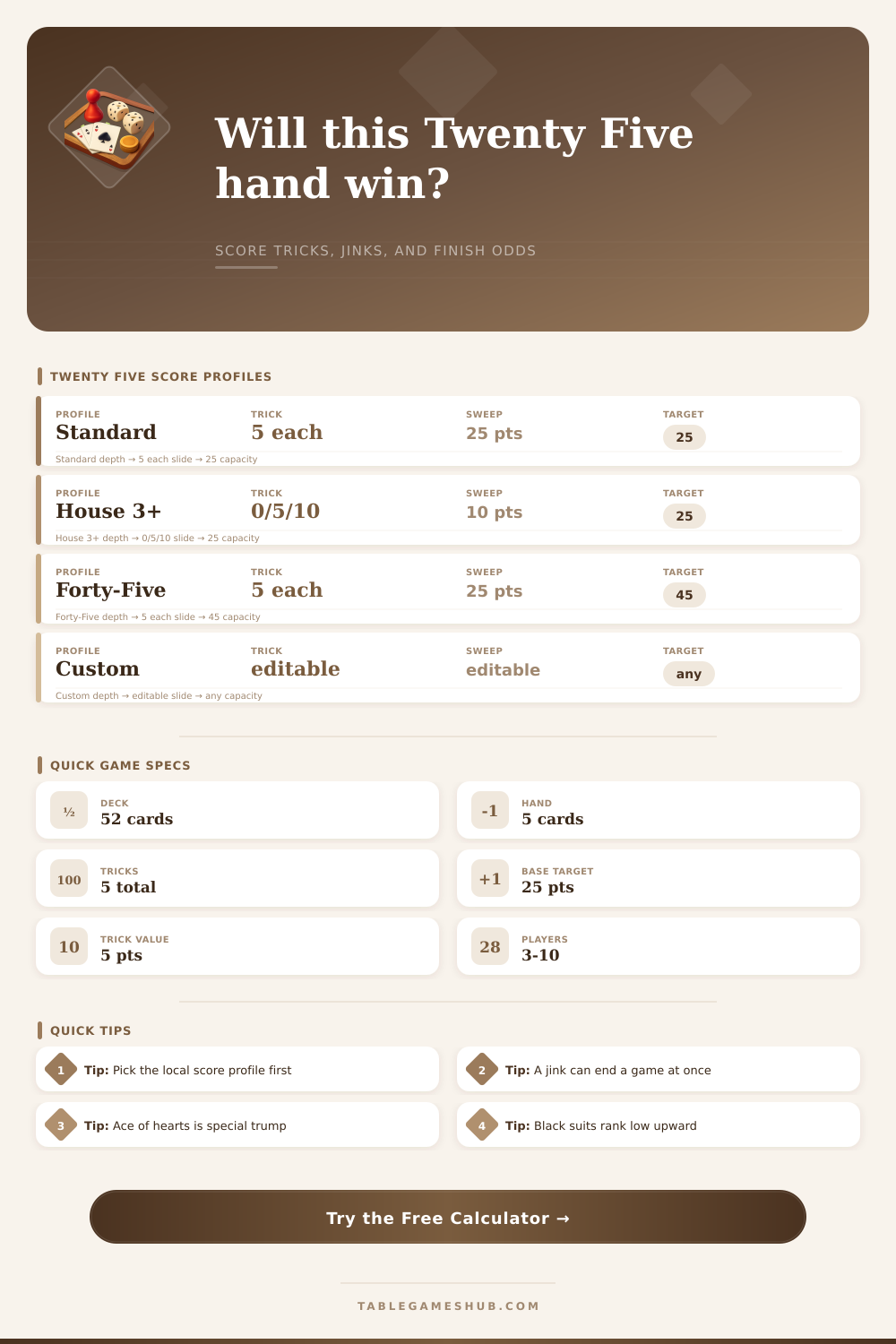
| Profile | 0-2 tricks | 3-4 tricks | 5 tricks |
|---|---|---|---|
| Standard 25 | 0-10 points | 15-20 points | 25 points |
| House 3+ | 0 points | 5 points | 10 points |
| Forty-Five | 0-10 points | 15-20 points | 25 points |
| Custom | Editable | Editable | Editable |
| Trump suit | Highest group | Red tail | Black tail |
|---|---|---|---|
| Hearts | 5, J, A, K, Q | 10 down to 2 | Not used |
| Diamonds | 5, J, A hearts, A, K, Q | 10 down to 2 | Not used |
| Clubs | 5, J, A hearts, A, K, Q | Not used | 2 up to 10 |
| Spades | 5, J, A hearts, A, K, Q | Not used | 2 up to 10 |
| Needed | Standard ask | House ask | Pressure |
|---|---|---|---|
| 1-5 points | Win 1 trick | Win 3 tricks | Immediate |
| 6-10 points | Win 2 tricks | Jink all 5 | High |
| 11-15 points | Win 3 tricks | Multiple hands | Building |
| 16+ points | 4+ tricks | Multiple hands | Long race |
| Band | Inputs that cause it | Typical use | Watch |
|---|---|---|---|
| Control | 3+ top trumps | Push for sweep | Lead timing |
| Solid | 2 sure tricks | Secure score | Rival near 25 |
| Thin | 1 sure trick | Protect position | Trump drain |
| Chase | 0 sure tricks | Hope for steals | Overcounting |
Turned up the five of trumps. The room is quiet. Someone sighs because they hold it; someone grins because their partner does. Of all the moments in the whole 25-card game, this one, more than anything else, defines a session.
Luck plays its part in the game, but only until you realize that managing score thresholds and trick counting is what really sets the good player apart from the hope-for-better-cards-next-deal player. Once you know how strong your hand is, what you’ve got, and where you stand, plugging into the calculator above will do the rest of math for you. No need to puzzle over probability tables and coefficients,. Just get down to playing.
How to Win at 25 Cards
Before any shuffling is done, most table have some level of agreement about their scoring but when they don’t reach consensus, it’s usually around edge cases; which we’ll discuss next. There are people who score each trick as five points and it gets to be a nice gradual slog to 25 points. Other people will have a house rule that says you must win three tricks to get something on the board and it makes earlier hands feel frustratingly low-stakes.
Why does this matter? Because if your table has per-trick scoring, then taking two tricks counts as progress. It’s not nothing! But if it’s a threshold game, those two tricks is effectively zero. So you either have to go all-in or fold up to give someone else a chance. That changes how risky every deal are significantly. The table on the page explains this clearly, so you can see how different profiles shift risk profile of every deal.
The real currency is Trump strength. Unlike hearts or bridge, where ranks is determined by suit (with reds descending from queen, blacks ascending from two), each suit has its own ranking (the black suits ascend from two, the red ones descend from queen). This all makes sense once you understand it means you can sometimes be better off with a low spade than you would of with a middling heart. And then you need to count carefully through your high-ranking trumps.
The three key cards matter: the ace of hearts, the jack and the five of trumps. Three of these will get you control; zero will leave you chasing. To turn abstract ideas into real odds, the tool asks you what you expect your future performance to be and how many you are sure of taking now. It doesn’t tell you what cards to play. But it tells you when to play safe and when doing so is simply a slow path to defeat.
It’s here where we add another wrinkle: the idea of the jink. In many versions, any player with a strong hand faces a binary decision: Do I take the safe three-trick play and bank fifteen points, or do I go for broke? Do I risk it all for a possible sweep to win the match out-and-out? The game is over as soon as you do that. It’s a high-variance play, which can feel reckless if you haven’t done the math to figure out what the alternate would look like.
Play for the jink when you’re close enough to twenty-five so that you know you need to go for it. Play for the jink when you’re well behind and have no other option. These factors is taken into account by the calculator, which calculates the odds of how you will finish given your starting hand and how fast your competitors are likely to catch up. And it presents you with a percentage to match.
This is where people tend to fall into traps with sure tricks. You think, “I got this, I’ve got a Jack.” Then forget that some other person has the Ace. Or maybe they have the Five. Be conservative in what you count as your sure tricks. Use a lower estimate and leave the rest up to the probability engine. If the odds are good, even one certain trick will give you a much stronger hand than you expected. And if they drop drastically, then you’re probably better off not risking your lead. Rather than predict exactly what will happen, it’s about managing your expectations.
The game is set up so that players who know which battles to fight and which ones to settle for incremental gains gets rewarded. All that said, twenty-five is ultimately a race; individual hands aren’t so much separate parts but links in a chain. Each point you earn counts against everybody else’s score. You don’t only want to win tricks, after all, you want to be the first one across the finish line. This makes it every bit as important to follow the other players’ scores and guess how fast they’re progressing as it is to study your hand.
By adding up your existing lead or deficit, together with your predicted rate of progress, the tool plots out where things stand in the race. And, if nothing else, it transforms an otherwise frenzied social card game into a little less random chaos. Of course, you’ll still need to play well. But now, at least, you’ll understand which hill is worth dying on.
When the next high card comes from the pack, the room will fall silent once more. But this time around, you’ll already know what it says about your odds.