Ingenious Score Calculator
Total a candidate Ingenious tile placement from its five scoring rays on each symbol, update all six color tracks, flag immediate bonus plays, and compare the final weakest-color ranking against another player or partnership.
1Named Ingenious Presets
Load a board state, then adjust the ray counts, color tracks, bonus mode, and comparison scores for the table in front of you.
2Game Mode and Tile Placement
Symbol A Five Rays
Symbol B Five Rays
3Your Six Color Tracks Before the Tile
4Comparison Player or Partnership
Enter the current leader, your opponent, or the other partnership. Final rank compares the sorted score tracks from lowest to highest.
5Formula Cards
Tile-Ray Formula
tile color = ray1 + ray2 + ray3 + ray4 + ray5
For each symbol on the placed tile, count same-color symbols in the five outward lines. The newly placed symbol itself is not included.
Track Cap Formula
new score = min(cap, old score + tile color)
Standard score boards stop at 18. Double-length partnership or solitaire boards can be checked with the 36 cap option.
Bonus Play Formula
bonus = track crosses 18 or 36
In standard and partnership games, a newly reached final space creates an immediate bonus tile. Solitaire mode suppresses bonus plays.
Final Rank Formula
rank = compare sorted scores from low to high
The weakest color is the final score. If tied, compare the next weakest color, then continue until one side leads.
6Component and Spec Grid
7Ingenious Reference Tables
| Placed tile | Five rays on side A | Five rays on side B | Calculator result |
|---|---|---|---|
| Red plus blue | 1 + 0 + 2 + 0 + 1 | 0 + 2 + 0 + 1 + 0 | Red gains 4; blue gains 3. |
| Green plus green | 3 + 1 + 0 + 2 + 0 | 0 + 2 + 1 + 0 + 2 | Green gains 11 because both symbols are green. |
| Yellow plus orange | 0 + 0 + 4 + 1 + 2 | 2 + 2 + 0 + 0 + 1 | Yellow gains 7; orange gains 5. |
| Purple plus red | 0 + 1 + 0 + 0 + 0 | 4 + 3 + 2 + 0 + 1 | Purple gains 1; red gains 10. |
| Your sorted tracks | Other sorted tracks | Winner | Why |
|---|---|---|---|
| 9, 11, 12, 13, 15, 18 | 8, 14, 14, 14, 16, 18 | You | Your weakest color is 9, beating 8. |
| 10, 10, 12, 15, 16, 18 | 10, 11, 11, 13, 14, 18 | Other | Weakest color ties at 10; next weakest is 10 versus 11. |
| 12, 12, 12, 13, 13, 15 | 12, 12, 12, 13, 13, 15 | Exact tie | All six sorted track values match. |
| 18, 18, 18, 18, 18, 18 | Any lower set | You | All six tracks at 18 is an immediate win check. |
| Mode | Active cap | Bonus play check | Calculator note |
|---|---|---|---|
| Standard game | 18 per color | Yes, when a color newly reaches 18 | Use for normal 2, 3, or 4 player games. |
| Partnership game | 36 with double board | Yes, at the first and second final spaces | Opposite players share one double-length score board. |
| Solitaire game | 36 with double board | No free bonus plays | Still applies track caps and weakest-track scoring. |
| Immediate win | 18 or selected cap | Not needed after all tracks cap | All six tracks reaching the cap ends the comparison. |
| Item | Count or range | Scoring role | Calculator field |
|---|---|---|---|
| Score board tracks | Six colors | Each color is advanced separately and later sorted for rank. | Your six color tracks |
| Placed tile symbols | Two hexes | Each symbol scores its own five outward rays. | Symbol A and Symbol B colors |
| Tile rack | Six tiles | Rack may be swapped if it lacks the current lowest color set. | Lowest rack coverage |
| Board spaces | Vary by player count | Open tile spaces indicate how close final scoring may be. | Open connected tile spaces |
| Tile bag | 120 starting tiles | Remaining tiles affect how many future refills are likely. | Tiles left in bag |
8Scoring Tip Boxes
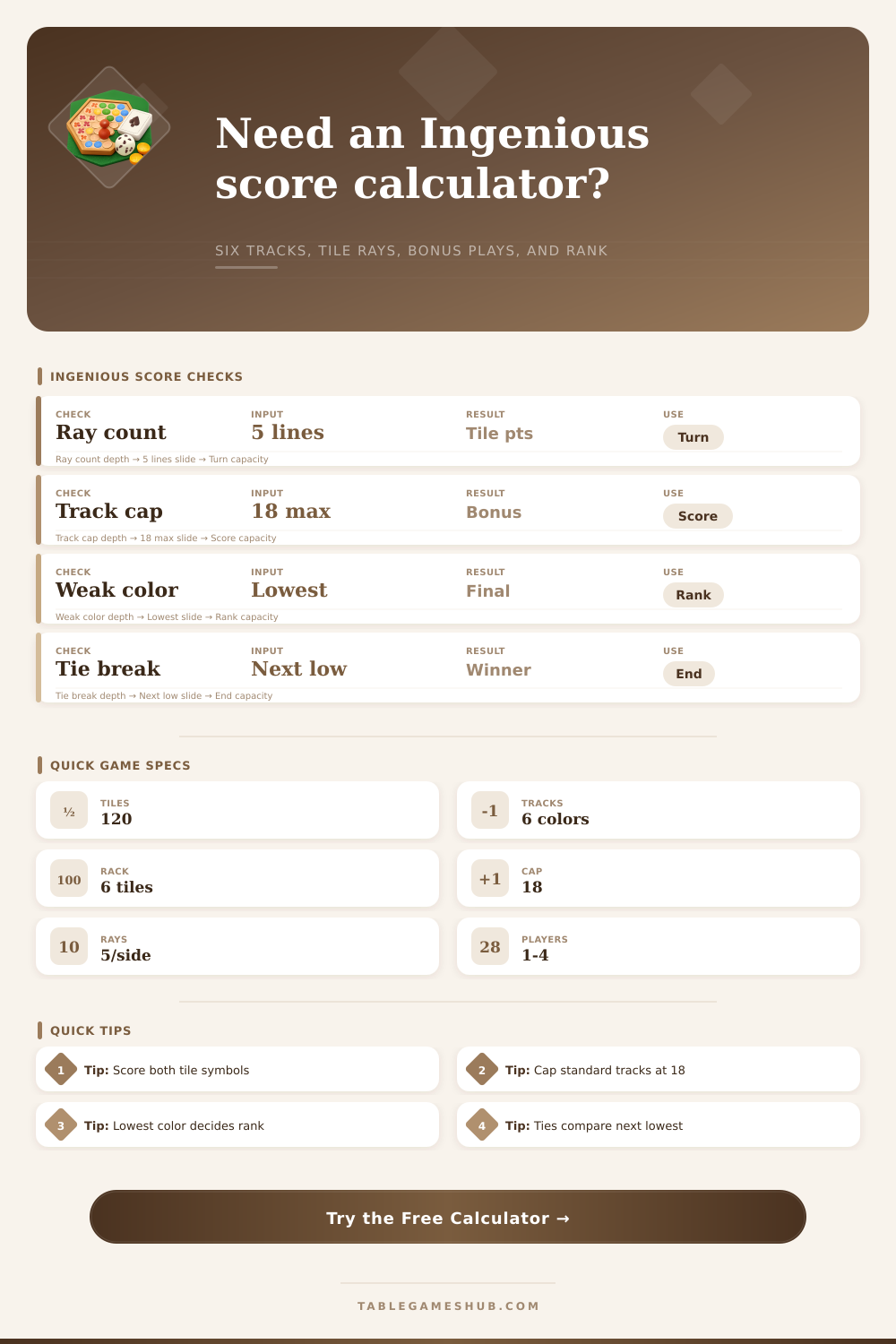
Ray count check: Count away from each placed symbol in its five available lines, stopping at an empty space or a different color. Do not count the tile symbol you just placed.
Rank check: After the board is full, sort every player or partnership from lowest color to highest. The first higher value in that sorted list wins the comparison.
Mathematical Trap: From across the table, Ingenious looks like child’s play: “Place a tile, get points. Place a tile, get points.” It sounds easy enough, but beneath that honeycomb of hex tiles lie a clever math trap. Yes, you feel good about placing a tile for points. But while you’re doing that, your opponent is racking up a lead in colors you overlooked.
That’s because the scoring system don’t award the player with the most points. Instead, it awards the player who keeps the greatest balance, which means your last-place color track will ultimately determine where you finish. This lesson take most players one competitive game to learn.
Why Balance Matters More Than Points
Its simple mechanic is this: When you place a tile, it has five rays going out from either side. Count along those rays the number of matching symbol until you reach a different symbol or an empty space. Don’t count yourself as a new symbol. Newcomers get tripped up here when they instinctively count their new symbol into the mix. Luckily, the calculator will do that math for you with its ray counting, leaving you free to focus on strategy instead of arithmetic mistakes.
Input your score on tracks in play and what you think might gain you points. How will that change your position? Each color track caps out at eighteen points. Once you reach that point, you’re able to draw an additional card then refill your hand from there. It’s a strong positive reinforcement for more aggressive players, who can chain bonuses to create a strong cycle. But you don’t want to push any one color so hard that it neglect other colors.
When it comes time to score, your cards is sorted by color in descending order and ranked compared to your opponent’s lowest color first. In this example, let’s say I fill up three eighteen-point tracks but my lowest color was only worth ten while my opponent has a minimum of twelve. No matter what, I’m screwed.
That’s where people fail to grasp it, they’ll go after big numbers instead of building their floor. For instance, consider a move which scores seven yellow points and does not touch green at all. That’s a mathematically identical move to any other if it didn’t affect your worst score, which is green. That’s why the calculator shows what the new weakest score would become with every hypothetical placement.
The stakes are even greater in solitaire or partnership modes where tracks can stretch up to thirty-six points. You have more room to fall behind your opponent, allowing them to jump ahead of you on a secondary track during the tiebreaker. Ingenious is a tough game when it comes to tiebreakers. In case of a two-way tie for lowest color, the next highest color are compared, followed by the next, etc. A one-point gap at that level could be the difference between victory or defeat.
There’s no getting away with ignoring colors that aren’t currently slowing you down, you need to keep a base across each of the six color groups. To show how rapidy an advantage can be lost if you don’t stay balanced, the tool came with some sample tiebreaker tables to look at.
A large part of strategy is predicting what tiles will become available in the future, as well as the state of the board itself. In the early game, players wants to target easy-to-see, high-scoring rays. In the mid-game, it becomes important to block your opponent from getting their bonus or to prevent them from finishing their track too soon. Late game turns into a dash to complete six colors before the tile supply are depleted. Suddenly, you may have to take low-point tiles. This is because they hold a color you actualy must have to avoid getting left behind.
You can also use it to see how close you think you’ll end up to another player, which lets you know if you want to play it safe or go for bonus points. For example, if you’re ahead of someone else on their worst color, you can press for bonus points on better ones. If you’re behind, then every single point matters. It’s not all about brute force, the game favors accuracy and patience.
To master Ingenious, you have to get out of the mentality that it’s about accumulating points. It’s not. It’s about equalizing them. It’s not about building up a mountain. It’s about filling a valley. Each tile you play is an act to level the playing field… Both figuratively and literally.
Once you learn to protect your weakest point scores while avoiding the urge to chase after most powerful ray, the game completely transforms itself. Suddenly, instead of searching for ways to take advantage off the board, you’re looking at each square as an area to shore up before someone else does. The calculator will help you figure out how to make those plays, but the strategy is to trust moves based on their impact on the overall balance rather than the burst. And that change in thinking makes all the difference between being a casual player versus consistently winning.
The tiles won’t lie about where they think you’re weak. You should of not either when making plans.