Success Counting Dice Calculator
Calculate dice-pool chances for target successes, expected hits, reroll value, exploding dice, and botch risk from one shared set of table-ready inputs.
1Real Dice Pool Presets
Pick a familiar success-counting pattern, then adjust the pool size, threshold, rerolls, and target before calculating.
2Dice Pool Inputs
3Dice Component and Probability Specs
4Success Chance Reference
| Die and threshold | Faces that count | Single-die chance | Expected hits per die |
|---|---|---|---|
| d6 at 4+ | 4, 5, 6 | 50.00% | 0.500 |
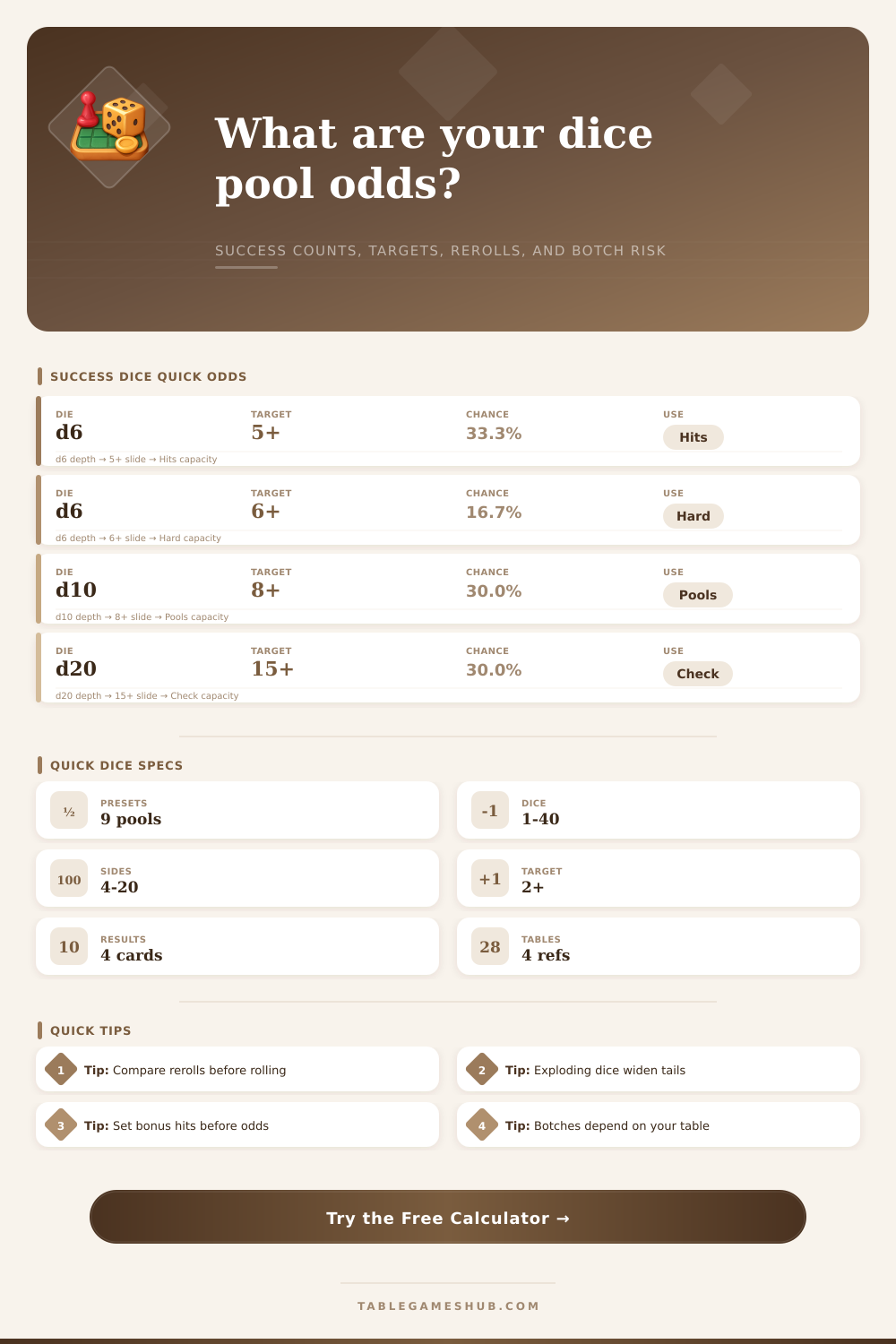
| d6 at 5+ | 5, 6 | 33.33% | 0.333 |
| d6 at 6+ | 6 only | 16.67% | 0.167 |
| d8 at 6+ | 6, 7, 8 | 37.50% | 0.375 |
| d10 at 7+ | 7, 8, 9, 10 | 40.00% | 0.400 |
| d10 at 8+ | 8, 9, 10 | 30.00% | 0.300 |
| d12 at 8+ | 8 through 12 | 41.67% | 0.417 |
| d20 at 15+ | 15 through 20 | 30.00% | 0.300 |
| Pool pattern | Target | Chance to pass | Expected successes |
|---|---|---|---|
| 4d6, success on 5+ | At least 2 | 40.74% | 1.33 |
| 6d6, success on 5+ | At least 2 | 64.88% | 2.00 |
| 8d6, success on 5+ | At least 3 | 53.17% | 2.67 |
| 10d6, success on 5+ | At least 3 | 70.07% | 3.33 |
| 6d10, success on 8+ | At least 2 | 57.95% | 1.80 |
| 8d10, success on 8+ | At least 3 | 44.80% | 2.40 |
| Rule option | Calculator treatment | Formula idea | When it changes most |
|---|---|---|---|
| No rerolls | Each die is one independent trial | P(hit) = hit faces / sides | Baseline comparison |
| Reroll 1s once | A natural 1 gets one extra independent roll | P + P(1) x P | Low thresholds and many dice |
| Reroll failures once | Every failed die gets one extra roll | P + (1 - P) x P | High difficulty pools |
| Exploding max face | A max result adds another die roll | Distribution is extended by recursion | Targets above expected hits |
| Preset scenario | Dice profile | Target use | Good calculator check |
|---|---|---|---|
| Shadowrun-style pool | d6, 5+ hits | Multiple hits versus threshold | Compare penalty dice before rolling |
| Year Zero push | d6, 6+ hits | One or more successes | Use failure reroll once for a push |
| Storyteller-style pool | d10, 8+ hits | Difficulty by success count | Check expected hits and botch risk together |
| Exploding sixes | d6, max face explodes | High target tail odds | Watch margin chance, not only average hits |
5Dice Probability Tips
Tip: Set bonus successes before judging the pool. Automatic hits reduce the target, which can change a hard roll into a routine one.
Tip: Exploding dice rarely move the average a lot, but they strongly affect the chance of reaching high success margins.
There’s a certain type of fear that grips you as you rifle through your dice bag on the edge of an anxious moment. Your character has poured everything into this one shot. It feels important and now you’re putting it all up to fate. To let random chance shape your story. But most people throw their dice and hope the dice gods smiles down upon them.
Knowing the probabilities can change things entirely. It turns your gameplay from a desperate lurch toward hope into an educated strategy session. We’ve got a calculator that’ll do the math for you here, but that’s not the magic. The magic is knowing what those numbers represent.
Understanding Dice Math
Traditional pass/fail checks aren’t success counting systems. It’s not “Does this one die succeed?” but rather “How many of these dice in my pool of them succeeds?” This completely redefines the probability geometry. It doesn’t just mean you’re more likely to succeed. With a bigger pool, there’s also less variance.
If you’ve got eight ten sided dice and each needs to be at least an 8 then yes, your odds on a per-die basis are 30%. But average number of successes is going to be two point four. Sounds pretty good, right? Until you notice that you fail if only one of those succeed in most systems. The problem isn’t so much what the average is, as how frequently you fail below the average.
But it’s also here that tools which guess the chance of passing on a given target prove their worth. Rather than saying “here’s your average roll,” they say “here’s how likely you are to cross the finish line.” So if the tool says there’s a forty percent chance you’re gonna pass, but you need three successes in this scene, you know you’re likely to fail two times out of every five attempts.
Knowing that gives you something to negotiate with the gamemaster before you even make the die rolls. Should you ask for help? Do you want extra prep time? Are you willing to accept an easier challenge? This converts a binary gamble into a reasoned choice.
The other complication (which I can’t really get my head around) is reroll rules and exploding dice. Ones seems like no big deal since you don’t roll many. But if you’re rolling lots and lots, those ones adds up. Then there’s exploding dice which stretch the tail of the probability distribution quite long. Sure it doesn’t help your average much, but it does greatly raise the odds of an outlier result. You’ll get the occasional huge success…or maybe you’ll go down in flames thanks to the botch rule.
On the page, there’s a reference table that shows what happens when you combine single die probabilities into what you get in a pool. So when you see that a d6 at 4+ is half the time, that anchors your expectations about bigger pools.
You also tend not to think about Botch Risks, until they blow up in your face. If you’ve got some 1s exposed and roll 0 on your dice, your system is screwed. But if your pool is huge and your threshold is high, that risk actualy goes up. In that case, it is never going to happen. Or is it a tiny pool and a very easy thing to do? It won’t matter, because you’ll probably get something off anyway. Unless you’ve got a huge pool against something really hard. Then those ones start racking up fast. Roll out Botch Probability first and then you don’t screw yourself by driving your car well only to blow it up. You should of checked the math first.
The strongest modifier you can add to any success counting game is a bonus success. Depending on the system, that’s as good as adding multiple dice to your pool or lowering the difficulty. In either case, it shifts the whole distribution curve in direction of success. It’s nearly always better to use a resource to buy a bonus hit if you have that choice available. That marginal gain is steep; each additional success directly decreases the number of dice needed from the volatile dice pool.
At the end of the day, though, tabletop games are about narrative tension, but understanding the math helps you manage the risk. It’s about tension in a story. When you remove the fear of the unknown by figuring out the odds, however, it changes everything. You shift from fearing the roll to controlling the risk. Knowing your numbers allows you to tell a better story. This can mean pushing a character past their limits or making sure they make a safe passage on a routine task.
Randomness will remain part of the dice, but your interaction with those dice doesn’t have to be. Actualy, it won’t dissapear.