Barrage Score Calculator
Calculate Barrage points from dam networks, water production, energy track progress, contracts, objectives, machinery, and final bonuses.
| Structure | Calculator Treatment | Scoring Role | Planning Note |
|---|---|---|---|
| Level 1 Dam | 2 VP each | Early basin control | Pairs well with cheap conduits |
| Level 2 Dam | 4 VP each | Midgame water storage | Often supports repeated production |
| Level 3 Dam | 7 VP each | High-value headwater anchor | Best when connected to strong routes |
| Conduit | 2 VP plus power bonus | Converts drops into energy | Power value drives production output |
| Powerhouse | 3 VP each | Completes production chain | Cluster near dependable basins |
| Water Route Type | Typical Drops | Average Power | Energy Range |
|---|---|---|---|
| Small valley route | 3-5 drops | 1.5-2.5 | 5-12 energy |
| Balanced mountain route | 6-10 drops | 2.5-3.5 | 15-35 energy |
| High headwater route | 8-14 drops | 3.5-4.5 | 30-63 energy |
| Late surge chain | 12-20 drops | 4-5 | 48-100 energy |
| Score Band | Final VP | Network Shape | Likely Missing Piece |
|---|---|---|---|
| Developing | 0-79 | Few linked structures | More production or contracts |
| Competitive | 80-119 | Working dam and conduit chain | Endgame objective points |
| Strong | 120-159 | Reliable production engine | Contract conversion ceiling |
| Dominant | 160+ | High-energy contract engine | Only tie-break refinement |
| Contract Focus | Energy Need | VP Pattern | Calculator Input |
|---|---|---|---|
| Small contracts | Low to medium | Fast VP bursts | Contract count high, VP modest |
| External work | Flexible | Resource conversion | Efficiency and machinery matter |
| National contracts | Medium to high | Large printed VP | Contract VP high, count lower |
| Objective scoring | Board dependent | Endgame swing | Objective VP and elevation bonus |
Scoring a game of Barrage can be quite complex due to a variety of points that can be earned in the game. Points can be earned for the structures that are build, the water that pass through the dams, the number of contracts that is completed, and the endgame bonuses that the players earn. The various ways that points can be earned for each of these categories leads to difficulties for the majority of Barrage players in correctly calculating there score for the game.
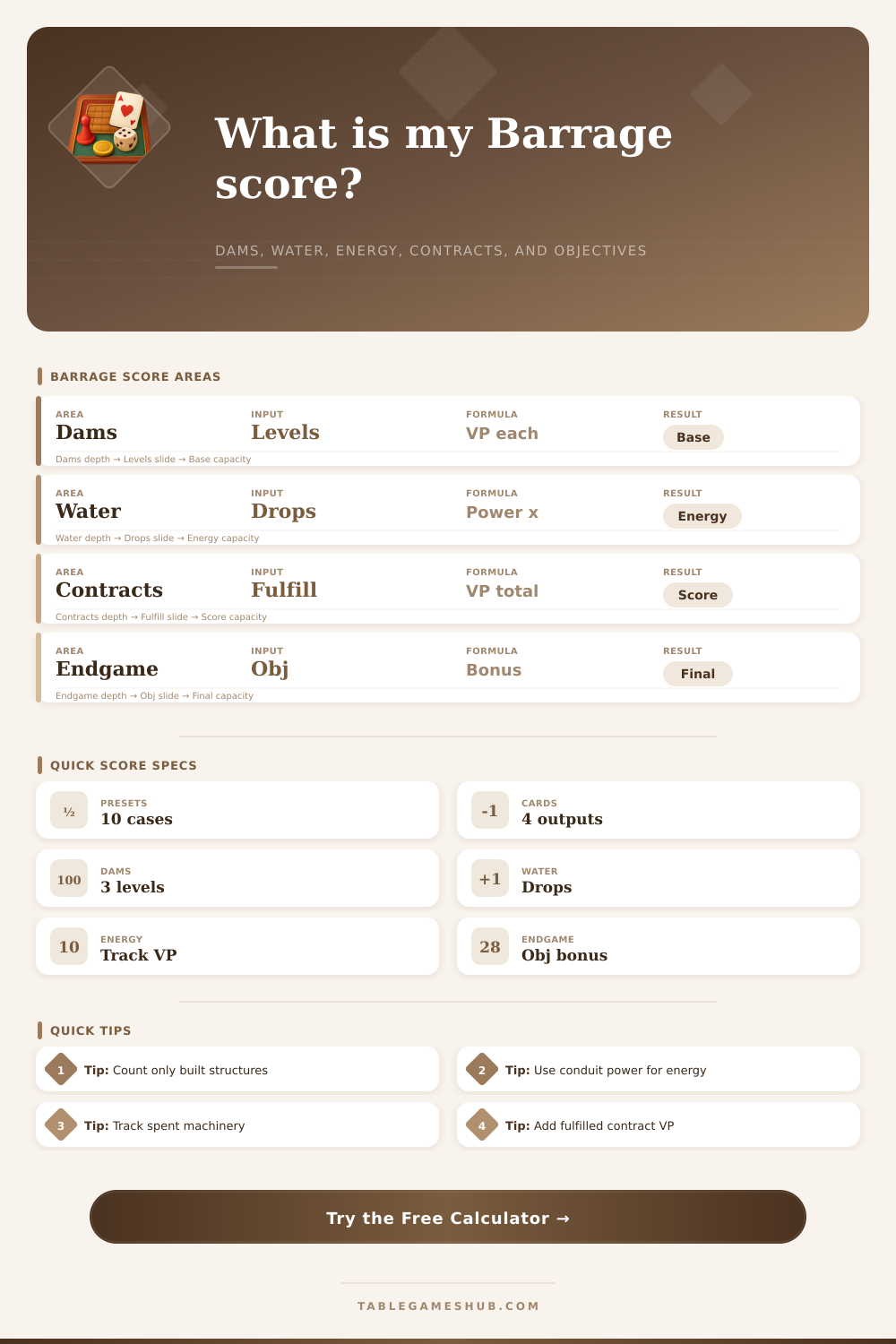
To avoid these difficulties, arguments, and potential mistake in calculating there score, players turn to the scoring tool for the game. The scoring tool calculate victory points for Barrage players in four main stage. The first of these categories is the value of the structures that the players built.
How to Score a Game of Barrage
Different types of dams provides different amount of victory points for the players when completed. For instance, low dams may provide fewer victory points than tall dams, but provide for the movement of water to the next level of the dam system. The scoring tool can calculate the value of each type of dam once the Barrage player enter the number of each type of dam that were constructed in the game.
The second of the scoring tools calculations is of the energy that the system created. Energy is only created if the water that pass through a dam is both transported to a powerhouse, and contained within a conduit that is owned by the Barrage player. Energy is not earned for water that is contained behind a dam, or that dissapears off of the map.
Victory points can be earned based off the number of drops of water that the Barrage player routed, and the average power of the conduits through which the water passed. The scoring tool utilize a selector to select an efficiency percentage for victory points earned through the movement of water in the game. The third of the scoring tool’s calculations for victory points is the value of the contracts that are completed for the game.
Players may earn victory points for the completion of the printed contracts that are create for Barrage players, as well as for the endgame objectives. Some endgame objectives provide victory points for the Barrage player for having high volume of contracts that were successfully created, but others may award victory points based upon the number of specific type of contracts that are created. The scoring tool can calculate the victory points earned from the printed contracts and those that the Barrage player created, as well as calculate victory points for the Barrage players endgame objectives.
The fourth of the scoring categories include machinery that the Barrage player returns at the end of the game. For instance, if a Barrage player did not return any machinery during the game, this could indicate that the player spent their last round of the game building structures rather than converting the structures that they had built. The scoring tool can calculate the return of machinery during the game, but it rarely has any impact upon the outcome of the game.
Another benefit of using the scoring tool is the inclusion of reference tables that explain the victory points that can be earned during the game. One table explain the number of victory points that can be earned for each type of dam that the Barrage player constructs. Another reference table calculates the energy that can be created based upon the routes of the water that Barrage players route in their game.
A third table calculates the victory points for different range of endgame scores, which can help the Barrage player to understand if their score will be competitive in comparison to others during the game. The Barrage scoring tool does not, however, account for any possible shifting alliance between the Barrage players. For instance, while a Barrage player may have constructed a route that another Barrage player claimed during the game, that player could potentially destroy such a route and prevent the water from reaching a powerhouse.
Additionally, shared external contracts may vanish during the game. However, the scoring tool allow Barrage players to determine their victory points for the game. Furthermore, Barrage players can use those calculated victory points to decide if they wish to protect there established routes, or to construct additional contracts that may lead to an improvement of there total victory points during the game.