Brass Lancashire Score Calculator
Score canal and rail links, flipped cotton, coal, iron, port, and shipyard tiles, income track position, loans, cash tie value, and era totals.
| Scoring point | Canal era | Rail era | Final game |
|---|---|---|---|
| Canal links | Score built canals | Usually cleared | Include prior era if recording full game |
| Rail links | Not active yet | Score built rails | Add rail VP to full score |
| Industry tiles | Only flipped canal-era tiles | Only flipped rail-era tiles | Add all flipped VP entered |
| Cash | Record separately | Record separately | Breaks tied victory point totals |
| Link entry | What to count | Score field | Common check |
|---|---|---|---|
| Canal links built | Your canal tiles | Canal link VP total | Do not count opponent links |
| Rail links built | Your rail tiles | Rail link VP total | Use rail-era network only |
| Connection points | Printed/adjacent VP | Total VP fields | Count from both connected spaces |
| Era split | Canal vs rail | Scoring moment | Canal and rail are separated |
| Category | Included when | Input used | Score role |
|---|---|---|---|
| Cotton mills | Tile is flipped | Cotton mill VP | Large industry base |
| Coal mines | Coal is consumed | Coal mine VP | Industry plus income |
| Iron works | Iron is consumed | Iron works VP | Industry plus income |
| Ports and shipyards | Tile is flipped | Port and shipyard VP | Specialized end score |
| Score aid mode | Best use | Main output | Distinct detail |
|---|---|---|---|
| Canal checkpoint | Mid-game scoring | Canal VP plus flipped tiles | Rail inputs held apart |
| Rail checkpoint | Second era scoring | Rail VP plus rail industries | Canal score can be excluded |
| Final score sheet | End of game | Total VP and cash tie | Loan pressure noted |
| Tie audit | Close scores | Cash and income context | Victory points stay primary |
In order to calculate the score of a game of Brass Lancashire, players must calculate the total number of points that was earned from link and industries. Scoring a game of Brass Lancashire can be difficult for players, however, because there are so many different types of points of which a player must collect. Players must earn points from links and points from industries, and the two total must be combined to determine the final game total.
Thus, a score calculator can help to calculate the total score for the player. Score calculators are useful for players because they prevent the player from having to remember all of the game score for that player. When using a score calculator, players must distinguish between canal links and rail links.
How to Calculate Your Brass Lancashire Score
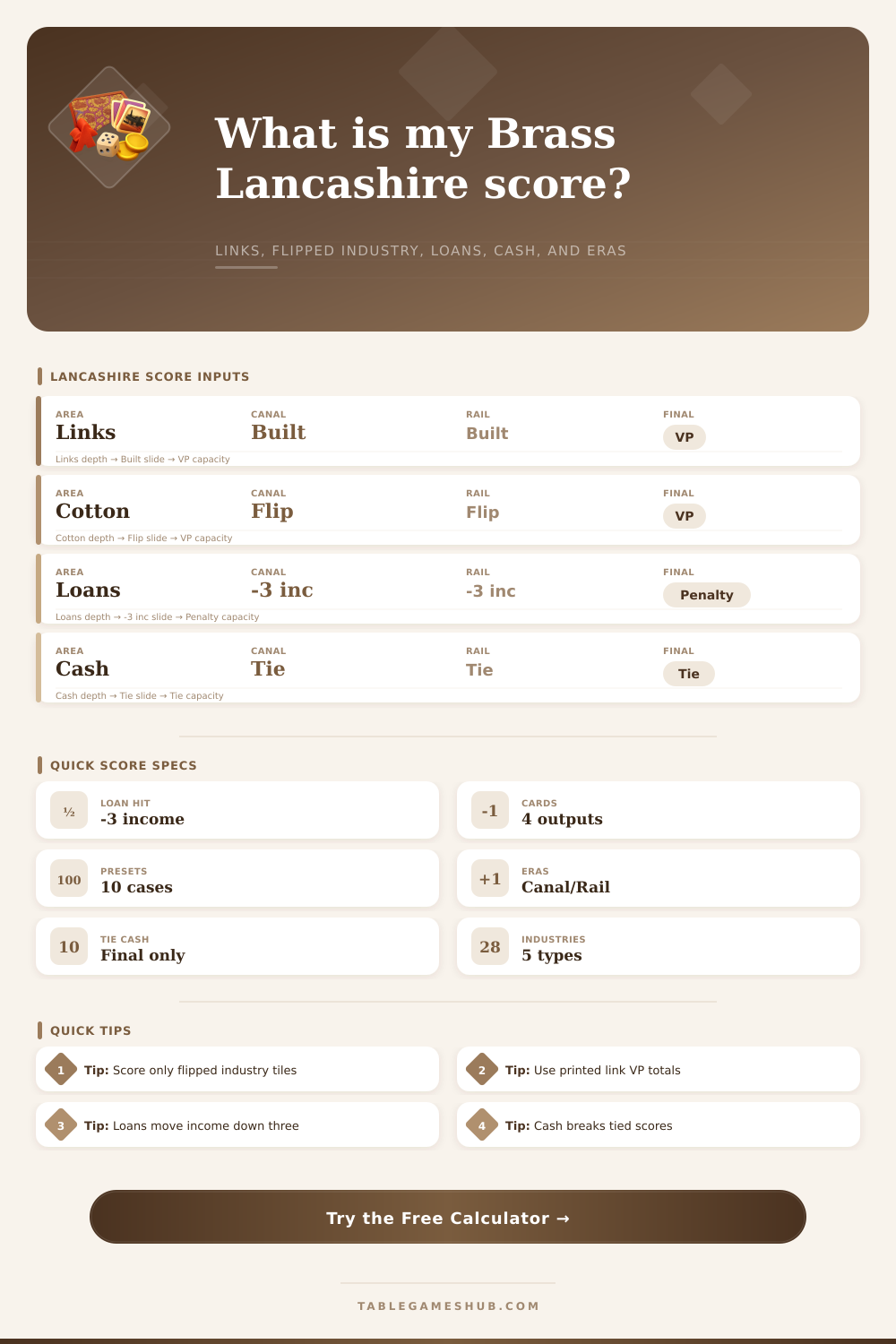
Canal links and rail links is different from one another in that canal links are only earned during the first building era of the game, while rail links are only earned during the second building era of the game. Thus, the player must calculate each type of link separately from one another. Additionally, only industries that have been “flipped” will yield points for that player.
Thus, any industry that have not been flipped during the game must not be included in the total score of that player. These separate values can be entered into a score calculator to calculate the total score for the player. Another element of the game that players must account for in calculating the score of the game is the number of loans that the player took during the game.
Each loan that the player took reduced the player’s income track by three space during the game. Thus, the player can enter the number of loans that were taken into the score calculator for the game to automatically calculate the penalty for that player’s loans. Additionally, another value that can be entered into the score calculator is the amount of cash that the player still possesses at the end of the game.
While cash does not contribute to a player’s victory point total, it can be used as a tiebreaker should two players have the same victory point total. Within the score calculator tool for Brass Lancashire are reference tables that explain the meaning of each of the different inputs for the score calculator. These reference tables indicate that canal and rail links are different from each other.
Additionally, the reference tables also indicate that only industries that have been flipped will contribute to a player’s total victory point score. Furthermore, the reference tables also indicate that the cash value for a player is only to be used as a tiebreaking score for the player. These reference tables ensure that the values that are entered into the score calculator are correct and that the total score that is calculated will be the more accurate representation of the score for that player.
As with any new tool, players can make mistakes when calculating their score for Brass Lancashire without using the score calculator. Players can, for instance, mistakenly include the value of an industry that has not been flipped. Additionally, players can mistakenly forget to account for the penalty that their loans have on their income track.
Additionally, players can even make mistakes in the counting of their canal and rail links. Yet, once they begin to use a score calculator, players will no longer make these types of error. The score calculator does not make any decisions for the player during the game.
For instance, the score calculator will not calculate whether or not a player made a good decision to take loans during the game. Additionally, the score calculator will not calculate whether or not a player made a good decision in obtaining rail links during the game. Thus, all that the score calculator does is calculate the numbers that the player inputs into the calculator.
Thus, the score calculator makes the tallying of the score for that player reliable and accurately. Finally, one of the main use of calculating a score for the game of Brass Lancashire is to allow for those players to compare their score with each other. For instance, one player may have earned more points from industries than another player.
Or, another player may have obtained more links than the first player. Thus, the score calculator allows for each player to compare their scores to each other. By using a consistent scoring method with a score calculator, there is less friction in comparing scores for each player.
Thus, the consistency of the scoring method helps the players to understand their game result more easy.