Tzolkin Score Calculator
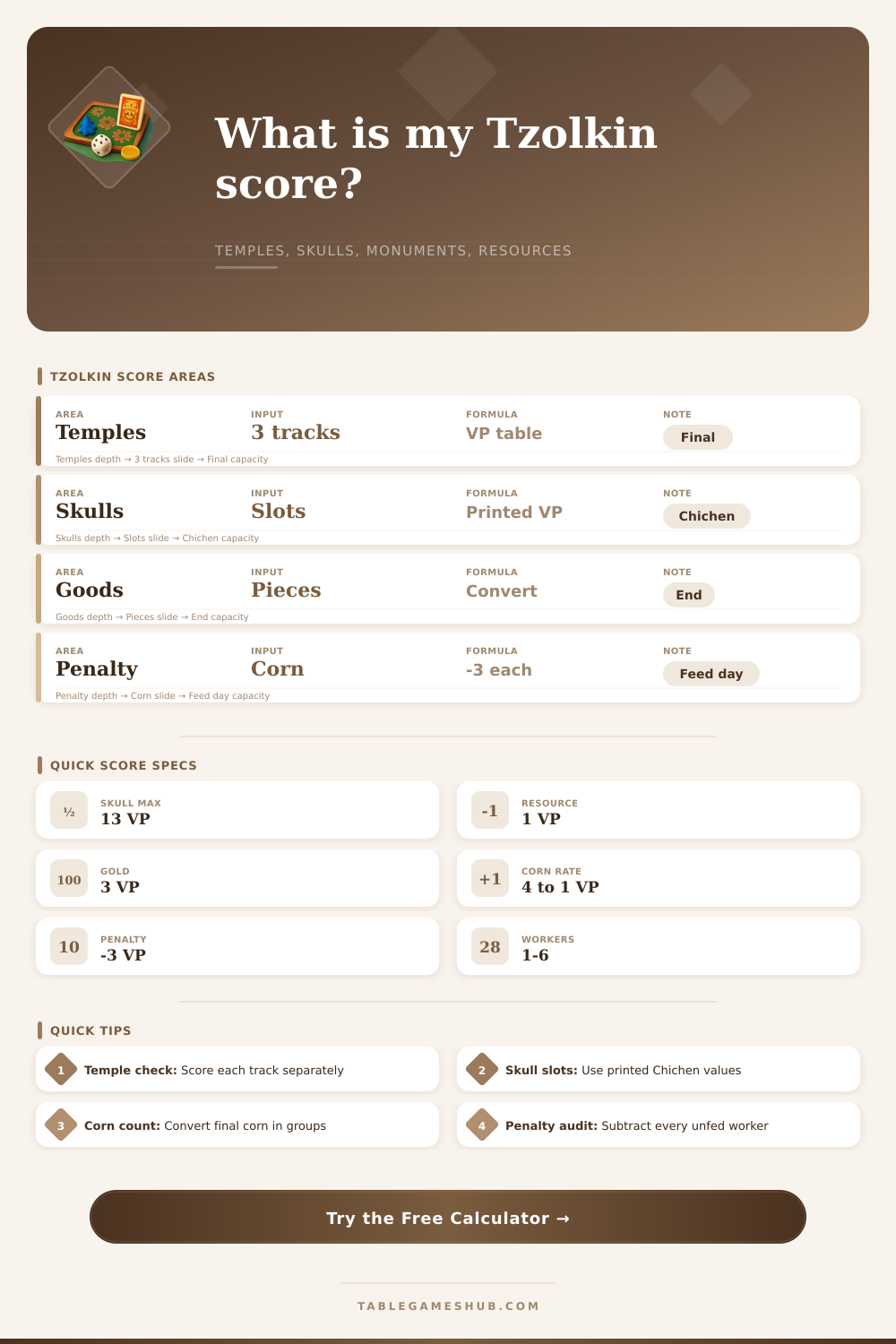
Total final-era points from temples, Chichen Itza crystal skulls, monuments, buildings, goods conversion, corn, workers, and feeding-day penalties.
Enter the score already on your marker, then add end-game scoring areas. The calculator separates printed VP, final conversions, and penalties so a tight Tzolk'in finish can be checked cleanly.
| Temple Position | Final VP | Calculator Input | Scoring Note |
|---|---|---|---|
| Bottom or first step | 0 | 0 or 1 | No final temple bonus |
| Second step | 1 | 2 | Small final scoring bump |
| Third step | 3 | 3 | Often reached by incidental worship |
| Fourth step | 6 | 4 | Strong target before the last era |
| Fifth step | 10 | 5 | Major final scoring area |
| Top step | 15 | 6 | Best single temple finish |
| Chichen Itza Slot | Printed VP | Temple Effect | Calculator Method |
|---|---|---|---|
| Early lower slots | 4 to 7 | Temple movement varies | Add printed VP to skull input |
| Middle slots | 8 to 10 | Often includes temple climb | Score temple final position separately |
| High slot | 11 | Strong direct score | Include only once when occupied |
| Top skull slot | 13 | Highest printed skull VP | Add 13 if your skull is there |
| Final Item | Conversion | Rounding | Calculator Field |
|---|---|---|---|
| Gold | 3 VP each | Whole tokens | Gold Tokens Remaining |
| Wood and stone | 1 VP each | Whole tokens | Other Resources Remaining |
| Corn | 1 VP per 4 corn | Floor full groups | Corn Remaining |
| Unfed worker | -3 VP each | Whole workers | Unfed Workers |
| Source | Typical Range | Volatility | Audit Reminder |
|---|---|---|---|
| Temples | 6 to 35 VP | Medium | Check all three final positions |
| Crystal skulls | 4 to 40 VP | High | Use occupied Chichen values only |
| Monuments | 10 to 70 VP | High | Apply card conditions exactly |
| Buildings | 5 to 30 VP | Medium | Count printed VP before conversions |
| Goods | 3 to 25 VP | Low | Separate gold from other resources |
| Feeding penalty | 0 to -18 VP | High | Subtract after final feeding audit |
In order to score the final era in the game Tzolk’in, a player must keep score in five different areas of the game: the points from the temples, the points from the skulls, the points from the monuments, the points from the buildings, and the points from the leftover corn. Each of these scoring area can make it difficult for a player to accurately score; there is the potential to either miss a scoring area or score one twice. Thus, in order to arrive at an accurat score for the final round of the game, a player must consider each scoring area individually.
The calculator for the game Tzolk’in allow for a player to input the position of the markers for each of the scoring areas and the final number of points for each scoring area. The calculator prints the values for each of the items that score points for players, as well as the rules regarding the conversion of resources into points. These two separate scores is beneficial for players in that it is possible for a player to accidental score one of these items twice, or to forget the rule that corn scores in groups of four.
How to Calculate the Final Score in Tzolk’in
Thus, by printing these two scores separately, the calculator calculates the total score that will be the accurate score for that game. Each of the temples in the game Tzolk’in awards the player points according to the position of there markers on the temple tracks. Each track awards points for movement of the markers, but the final step for each track awards more points than any of the other steps for that track.
Furthermore, each of the three temples score independently of each other; players that advance their markers on all three temples score more points in the final round of the game than those who score on only one of the temples. Thus, the calculator allows each player to test out different outcome of their temple scoring, as well as to help each player to determine whether to spend their actions on a temple instead of a monument. Each of the crystal skulls score a player points according to the slot in which that skull is occupying.
Each higher slot scores more points for the player than a lower slot, but requires more advancement of the temple markers to reach. Thus, a skull that is occupying a middle slot scores fewer points than a skull in a higher slot, but may score as many points as a skull in a higher slot if the placement of the skull also advances the temple markers. The calculator for the skull scoring only prints the points for the slot in which the skull is occupying, leaving scoring from the temples to be calculated separately.
Monuments and buildings can both provide the scoring sources, but the way that they work in the game is slightly different. Monuments usually have conditions associated with them that require specific types of resources or having specific types of temple positions. In contrast, buildings provide smaller points but with no conditions attached to those building points.
Thus, there is a decision to be made between whether the points from a conditional monument are better than the reliable points from a building. However, converting goods into points is a much more straightforward process. The rates at which the goods are converted into points are as follows: gold is converted at a more higher rate than wood or stone, and corn is only converted to points after the final feeding round of the game.
During the feeding round, players can experience a penalty to their score if they do not feed each of their worker. Each unfed worker will result in the subtraction of a certain amount of points from the player’s total score. Thus, a player could have leftover corn, but still lose points due to having workers that are not fed.
The monument and building score calculator apply this feeding round penalty after the step in which players convert goods to points. The building score calculator will help to eliminate any mistakes in the arithmetic that may occur when the players are tired. An error is likely to occur when counting the temples or the gold tokens, and such an error can have a major impact upon the final score and the winner of the game.
Thus, by using the score calculator, all of the players will have the same total score, eliminating any room for argument. The ability to accurately calculate the value of each type of resource allow the players to make better decisions during the last few rounds of the game. For instance, it is possible to determine if the risk of not feeding a worker is worth the potential gain of corn, or if it is better to hold onto the gold tokens.
Thus, players that understand the value of each resource will take advantage of the calendar and the feeding round of workers, for there score will be the result of the two successfully completing their cycles during the game.