🀄 Taiwanese Mahjong Score Calculator
Total tai from hand sources, dealer position, self-draw or discard win, flowers, concealed sets, bonus patterns, caps, and per-seat point exchange.
| Line | Value | Formula | Note |
|---|
| Tai source | Typical tai | Calculator input | Scoring note |
|---|---|---|---|
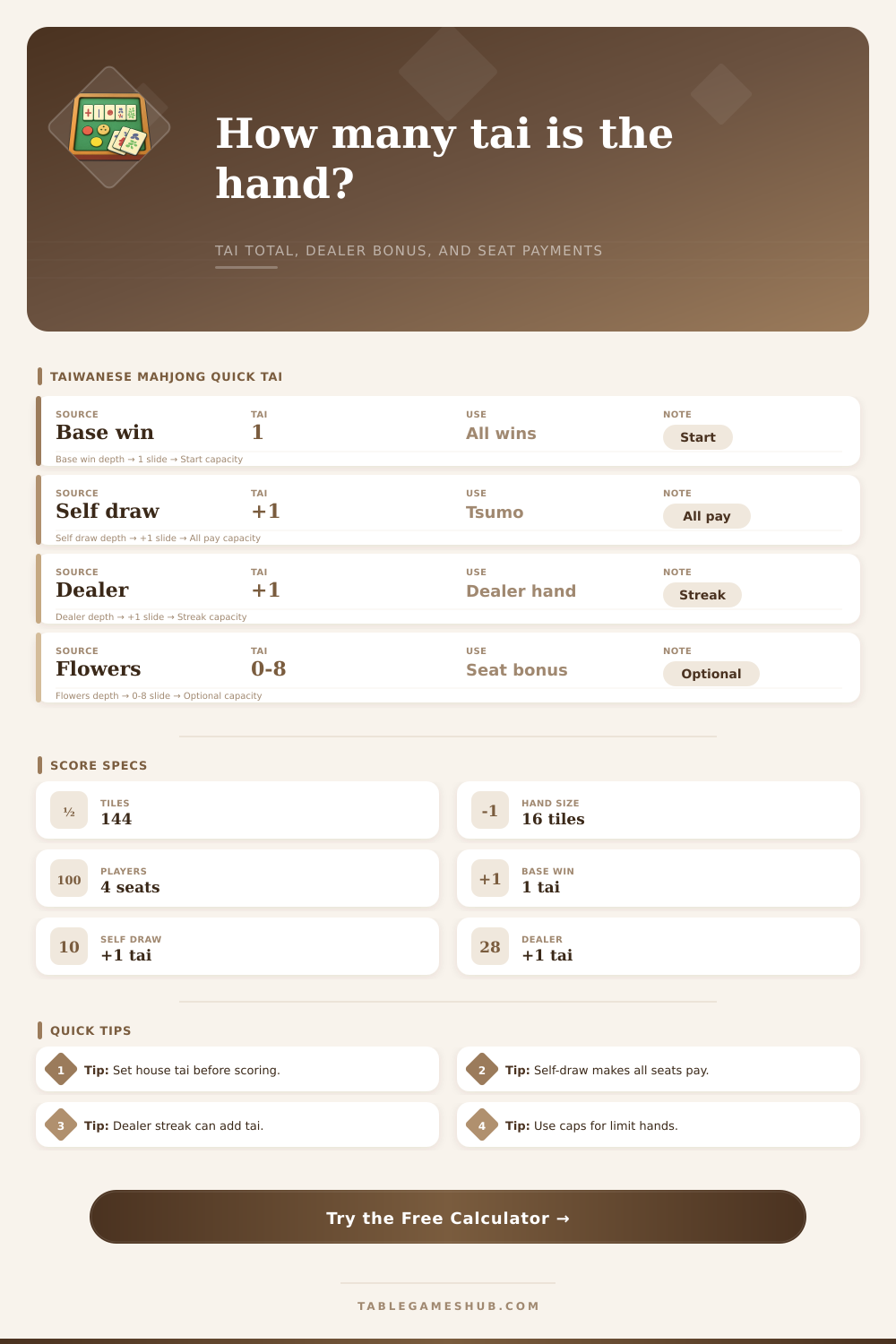
| Base legal win | 1 tai | Base winning tai | Use the table minimum for any completed winning hand. |
| Self-draw | +1 tai | Self-draw adds 1 tai | When enabled, all non-winners pay the winner. |
| Dealer hand | +1 tai or more | Dealer win or loss adds 1 tai | Applied when the winner or payer is the dealer. |
| Flowers and seasons | 0 to 8 tai | Flower scoring mode | Each, matching-seat, complete-set, or disabled scoring. |
| Concealed sets | 0 to 10 tai | Concealed pungs or kongs | Multiplied by the selected tai per concealed set. |
| Win method | Payers | Added tai | Point exchange |
|---|---|---|---|
| Self-draw | All non-winners | Optional +1 | Every active losing seat pays the calculated amount. |
| Discard win | Discarder only | None by default | Main payer is the player who released the winning tile. |
| Discard all-pay variant | All non-winners | None by default | Each loser pays, with the discarder flagged as main payer. |
| Robbing a kong | Kong giver | +1 in this tool | Uses the discard payer path with a robbed-kong bonus. |
| After a kong | All non-winners | +1 in this tool | Uses self-draw payer flow plus the kong-afterdraw bonus. |
| Bonus pattern | Tool tai | Pattern type | Cap advice |
|---|---|---|---|
| All sequences / pinfu style | 1 | Low pattern | Usually combines with flowers and method tai. |
| All pungs | 4 | Meld pattern | Often pairs with concealed-set tai. |
| Seven pairs | 8 | Special hand | Check table rules because Taiwanese sets can vary. |
| Pure one suit | 16 | Suit pattern | Commonly high enough to test the limit cap. |
| Big three dragons | 24 | Limit-style pattern | Use cap tai if your table treats it as a limit hand. |
| Heavenly or earthly hand | 32 | Limit-style pattern | Usually scored by special table agreement. |
| Seat case | Dealer effect | Who pays | Calculator handling |
|---|---|---|---|
| Dealer wins by self-draw | Dealer tai added to every payer line | All non-dealers | Winner total rises by all payer amounts. |
| Non-dealer self-draw | Dealer payer line can add tai | Dealer and other losers | Dealer loss is shown separately in seat exchange. |
| Dealer discards | Dealer payer line can add tai | Dealer only unless all-pay is on | Discarder row receives main-payer label. |
| Non-dealer discards to dealer | Winner dealer tai added | Discarder or all losers | Dealer winner bonus is applied before payment. |
| Inactive North in 3-seat play | No payment | East, South, West only | North row is marked inactive in the exchange grid. |
Separate tai from point exchange
First total the tai, then convert to game points and apply the payer model. This prevents self-draw, discard, and dealer cases from being mixed together.
Keep the house sheet visible
Taiwanese Mahjong tables often tune flowers, dealer streaks, and limit hands. Match those settings before reading the seat exchange grid.
Taiwanese Mahjong scoring requires a person to understand many of the games rules. For example, a person must understand how to calculate the points of a winning hand, as well as understand the house rules that may apply to that calculation of points. In order to score any wins in Taiwanese Mahjong, a player must have at least one tai within their winning hand.
Tai can be earned by any number of means, however, including owning flowers, having concealed pungs, and being the dealer. Flowers are special tiles that provide a player with tai; the number of tai earned from flowers is based off luck or the alignment of each player’s seat in the game. Concealed pungs is sets of three tiles that a player keeps hidden from there opponents, and concealed pungs provide the player with additional tai.
How to Score Points in Taiwanese Mahjong
Additionally, if a player is the dealer, they earns extra tai if they win several rounds in a row. Each of these scoring elements have a value that the group of players that are playing determines. For instance, a player can value a dealer winning several rounds in a row at one tai, two tai, or even five tai.
The method in which a player wins can impact the number of points distributed to each player. For instance, if a player wins with a self-draw, their points are distributed to each of the other players at the table. If a player wins with a discard, however, the player that discarded the tile to them distributes there points.
Different groups has different rules regarding discards, though, so a hand calculator can help players to determine the value of each of these rules, since they can impact the total points distributed to players during a game. In addition to these different winning methods, the dealer position can also impact the points that are distributed to the winners of a round of Mahjong. For example, winning as the dealer may award a player an extra tai, but losing as the dealer can cost that player extra points relative to a player that did not deal.
In addition, if the dealer wins several games in a row, they earn a dealer streak, which can award them additional tai beyond the extra tai that is awarded to dealers. In addition to the winning methods, dealer positions, and the dealer streak, there are also rules regarding flowers, special tiles that provide extra tai to the owner. The rules for flowers can vary between groups of players; some may award tai for every flower that a winner holds, while others may only award tai for flowers that match the seat of the winner that won the hand.
Others may award tai for having all four flowers, while others may award tai for each individual flower. All players must agree upon these rules prior to the start of a game, or else arguments may arise as to the value of the flowers that the winning player held. Other than flowers, additional tai can be earned by having specific patterns of the players tiles.
For instance, having a pure one-suit hand can award a player many tai for their winning hand, as can having a seven-pair winning hand, which is a relatively rare winning hand. Each of these winning hands has a value for tai that the group of players determines, which the hand calculator will record. Three-seat play is a variation of Taiwanese Mahjong.
In three-seat play, one of the players is removed from the game; therefore, there are fewer players whose points are to distributed to the winner. Thus, if a player wins with a self-draw in three-seat play, their points are distributed to only the two other remaining players at the table. The hand calculator automatically adjusts for these different numbers of player.
In addition to distributing points to the players who lost during a round of Mahjong, the players must agree upon a value for each tai in terms of money or chips. For example, a group may decide that one tai is worth ten points, but another group may decide that one tai is worth fifteen points. Additionally, the players must also agree upon the base number of points that each player should earn for each round of Mahjong played; without this number of base points, there may be no transfer of points between players if the number of tai earned by the winner of a round is relatively low.
Another rule that can be applied to games of Taiwanese Mahjong is the implementation of limit caps. A limit cap is the maximum number of points that a single player can win during a single round of Mahjong. By placing a limit upon the number of points that a player can win, the other players are protected from losing all of there chips during a single round of play.
The players can establish a limit cap prior to beginning to play, such as by establishing a limit of twenty-four or thirty-two tai per round. Overall, one of the main uses of a hand calculator is to make the rules of the game visible to each of the players. By entering the number of flowers won by the hand, the winning methods, the number of dealer streaks won by the dealer, and the patterns won by the winner, the calculator can reveal the total points of that game.
If the players have different values or rules for any of these elements, such as concealed kongs, the calculator will reveal the total points that would of been earned with each of those rules. Thus, the calculator can help the players to avoid arguments over the rules of the game; clarity regarding the scoring of a round of Taiwanese Mahjong is the primary benefit of the use of such a calculator. Therefore, the use of the calculator will help the players to begin the next round of Mahjong without any arguments among the players.