Manille Score Calculator
Total Manille card points, the margin above halfway, no-trump doubles, table taps, carryover tied deals, sweep rules, and match target pressure from one scoring entry.
Card point values
| Rank | Nickname | Value | Suit total |
|---|---|---|---|
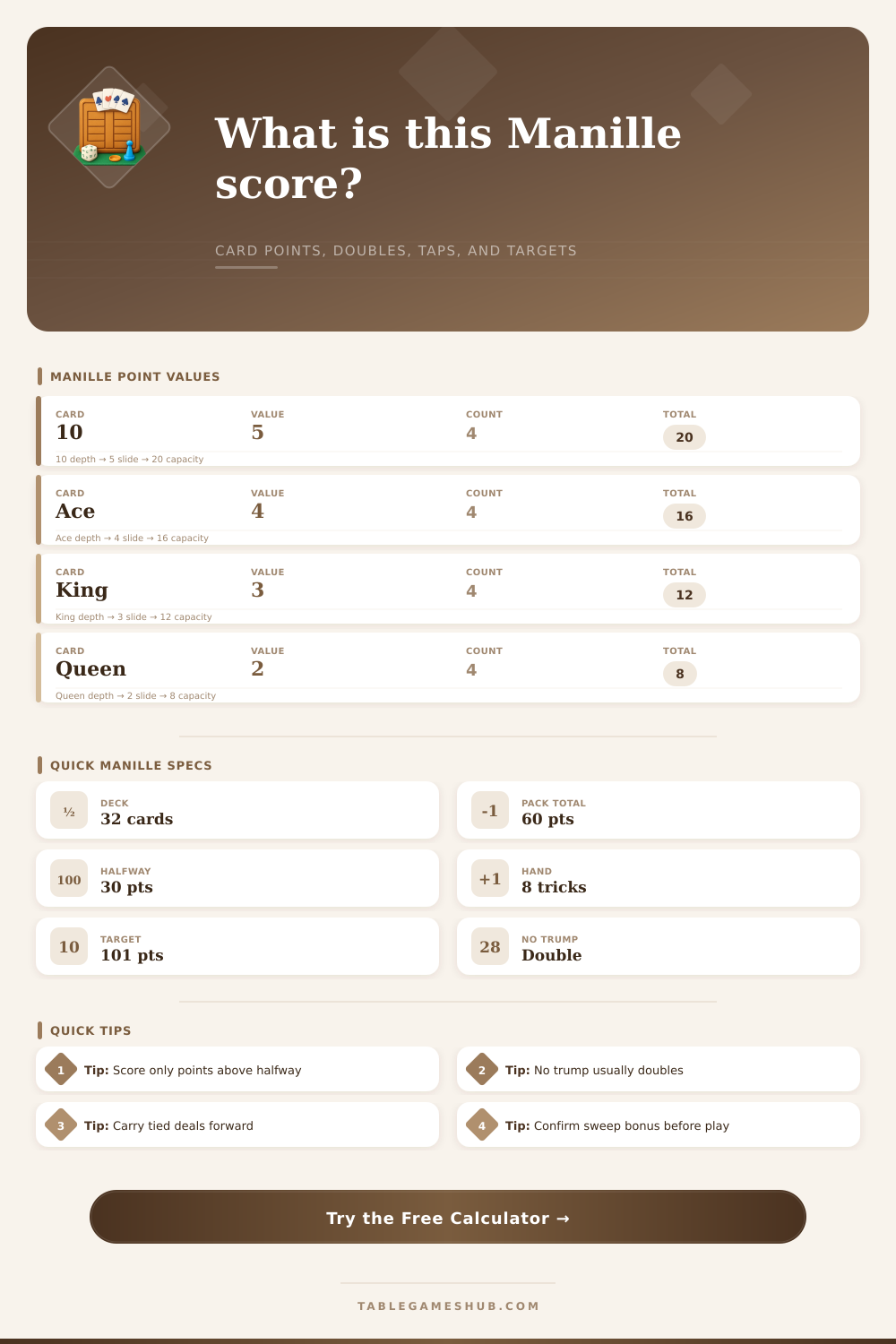
| 10 | Manille | 5 | 20 in pack |
| Ace | Manillon | 4 | 16 in pack |
| King | Face card | 3 | 12 in pack |
| Queen | Face card | 2 | 8 in pack |
| Jack | Low counter | 1 | 4 in pack |
| 9, 8, 7 | Plain cards | 0 | 0 in pack |
Score profiles
| Profile | Total | Halfway | Use |
|---|---|---|---|
| Classic Manille | 60 | 30 | Standard four-player scoring |
| Flemish Manillen | 60 | 30 | Tap and no-trump tables |
| Strict table | 60 | 30 | Penalty-award audit |
| 72 variant | 72 | 36 | Card points plus trick points |
Multiplier checks
| Setting | Multiplier | Applied after | Example |
|---|---|---|---|
| Normal trump | x1 | Margin | 36 scores 6 |
| No trump | x2 | Margin | 38 scores 16 |
| Tap | x2 | Trump mode | 34 tapped scores 8 |
| Double tap | x4 | Trump mode | 40 no trump scores 80 |
| Carryover tie | x2 each | Other multipliers | One tie doubles next score |
Preset score cases
| Case | Card pts | Modifier | Result |
|---|---|---|---|
| Classic 36-24 | 36 | x1 | +6 |
| Close 34-26 | 34 | x1 | +4 |
| No trump 38 | 38 | x2 | +16 |
| Tapped steal | 34 | x2 | +8 |
| All tricks | 60 | house | +60 or +30 |
Playing Manille is a precise game that takes patience; a few miscalculated points can mean the difference between winning and losing. You must win more trick than your opponent. You also has to capture the right amount of points in each trick. Finally, you must score them to match current scoring conditions to come out ahead.
It’s easy for one team to feel like they’re leading by a lot until they miss a tap, forget about a multiplier, and suddenely they aren’t feeling quite as confident anymore. Keeping up with all of this throughout a quick match is already hard enough without having to do any math in your head too.
How to Count Your Score Correctly
There are only thirty-two cards in the deck with a grand total of sixty points. All cards except the ace, jack, queen, king and ten don’t count for anything. Aces is four points; kings are three points; queens are two points and jacks is one point. Since the points stay the same from game to game the maximum number of points in each hand can be easily calculated once you know how many points there is per card.
Once you figure out how many points you have over thirty, you just multiply by a number and let the calculator do the work. This means you don’t have to change your math depending on whether someone called blind or no trump. For example, several players is tempted to try for more tricks regardless of what cards they get, since low point cards don’t contribute any score.
That’s a losing strategy, however, as winning tricks without scoring points doesn’t help at all. One side might win more tricks, but the other side could still have more valuable cards that add up to 10 points. This highlights how value (or weight) of the cards you take is more important then simply taking more or less trick.
You must also know that points scored after the halfway mark, that is, after thirty points. Are what will increase your score. So if your team has thirty-five, then only five points is scored. Knowing this avoids over-estimating your score.
The ultimate danger to the score is multipliers: they have the potential to completely alter the deal. Taps can multiplies the deal by 4. They can even multiply it by 8 if there were multiple challenges. Meanwhile, no trumps and a blind call will double the difference. Neglecting this doesn’t just result in rounding mistakes; it results in big point miscalculations.
Once you enter the trump mode and tap information into the calculator, it shows you the compounded effect of each deal instead of just a raw number of cards. That way you avoid making all-too-common error of scoring 6 for something that should of been scored as 48. While some use a variation of this (seventy-two points instead of sixty) with each trick adding to the overall total, most stick with the traditional scoring where only the first sixty are used.
It is important to know if you are playing the long or short version, which you can see in the reference table: the long version halves at thirty-six instead of thirty. Consistency is key here, everyone must play by the same rules; mixing systems will invalidate the game. Most games ends at one hundred and one points so they are easy to play over many deals without taking too long.
Finally, there are illegal trump leads and renege penalties to account for in the total score. These will factor into the overall count, too. Typically, thirty points go to the wronged party, and this could swing a tight match right back around to their side in an instant. By marking them off first (prior to any multiplier calculations), the system ensures they get counted according to rules and not the players’ attitudes. And it’s harder for anyone to argue about a score if it’s been made fair during heated moments.
Beyond good cardplay, Manille depends equally on keeping careful records. Without a strong system, there’s no guarantee of winning the game, or even preventing an argument once the cards have been played. Whether you’re playing for honor or money, getting those numbers correct will ensure that ability (not miscalculations). Counts in determining the winner.
Instead of doing mental multiplication during the heat of competition, use the calculator to reduce margins and multipliers down to one clear number. This leaves you free to concentrate on the signals from your partner. What might be a point of contention becomes a silent confirmation… And then it’s back to the cards where the action realy happens.