GURPS Success Probability Calculator
Exact 3d6 roll-under odds for effective skill, modifiers, critical success and failure bands, margins, and quick contest comparisons.
| Effective Skill | Success Odds | Critical Success | Critical Failure | Ordinary Failure |
|---|
| Roll | Band | Current Status | Reason |
|---|
| Contest Result | Probability | Roll Pairs | Meaning |
|---|
| Modifier | Effective Skill | Success Odds | Critical Failure | Change vs Current |
|---|
| Reference | GURPS Value | 3d6 Odds | Use At Table |
|---|---|---|---|
| Routine trained check | Skill 12 | 74.1% | Competent but uncertain |
| Professional check | Skill 14 | 90.7% | Reliable under pressure |
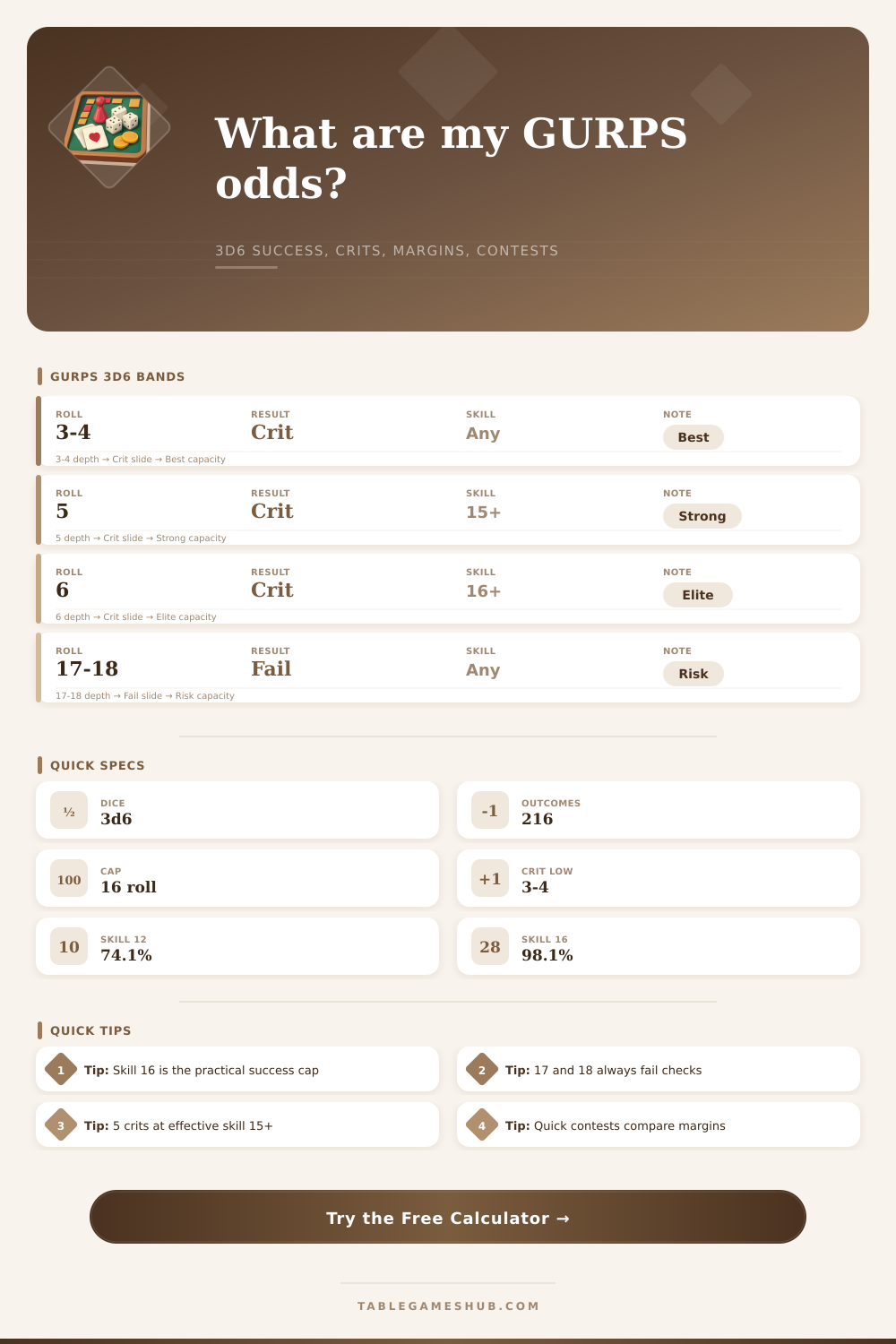
| Practical cap | Skill 16 | 98.1% | 17 and 18 still fail |
| Low default | Skill 8 | 25.9% | Untrained attempt |
| Harsh penalty | -5 | Varies | Darkness or severe range |
| Strong bonus | +4 | Varies | Extra time or aid |
GURPS use dice to determine the outcome of actions, and gives reward to those who use probability to there advantage. The dice within GURPS are not mysterious; the system provide rules for determining when a roll is an ordinary success, critical success, or critical failure. By understanding these categories, players can more easy plan there actions to take advantage of these outcomes.
The effective skill for an action is the value of a skill level after all relevant modifiers have been applied. These modifier may be for the difficulty of the task, the quality of the equipment, lighting, posture, and many other factors. A calculator included with GURPS handle the mathematical calculations of these modifiers, saving the players from have to keep track of these values during the game.
How GURPS Dice Rolls Work
While each individual modifier may have little impact upon the outcome of an action, a single modifier can have an impact when combined with other modifiers. Players easily remember critical success and failure values for GURPS; a roll of 3 or 4 is always a critical success, and a player who has an effective skill value of 15 or higher may also unlock additional critical success number. A roll of 18 is always a critical failure, and a roll of 17 becomes a critical failure if the players effective skill is 15 or lower.
These critical failure and success roll are an aspect of the system that players feel. For instance, a character with an effective skill of 16 will still fail on a roll of 18. An additional layer of decision making for the players are the margins for an action.
The margin for an action is the difference between the player’s effective skill and the actual roll of the dice. A large margin may provide some benefit to the player during an action, or allow another action to be taken. A calculator included with GURPS allow the player to set a target margin, which displays the mathematical odds of achieving such a margin.
This can be especially helpful in deciding whether to spend a point of Luck. Quick contests occur when two players roll the dice for an action. The player with the higher margin for the dice roll win the quick contest.
Since all players roll the same number of dice, the player with the higher effective skill will always have an advantage in these situations. The software includes a list of the outcomes for each contest, the number of times ties will occur, and the number of times the underdog will win the contest. This information can be useful in situations like a guard of average skill attempting to spot an intruder.
Many groups treat an effective skill level of 16 as a ceiling for player characters; any level beyond 16 provide diminishing returns for the characters. The reason for this is that the increased skill level provides both more critical success numbers and a buffer against situational penalty. For instance, a character with an effective skill of 18 will succeed on a roll in the -4 darkness penalty, but a character with an effective skill of 12 will fail with the same darkness penalty.
The calculator included with GURPS allow players to see these benefits before the game begins. Some of the mistake that players often make with GURPS include forgetting that any roll of 17 or 18 will always result in failure, regardless of a character’s skill level. Furthermore, many players believe that a high base skill will protect the player from any situational penalties.
A third common mistake is to incorrectly read a single roll of the dice, rather than understanding the distribution of all possible dice roll. With three six-sided dice, the most common roll are 10 and 11. Higher effective skills mean more critical successes and a lower chance of failure.
The reference tables that come with the software allow players to understand how many success will occur at each level of skill. The tables also show how different modifier change the number of successes that can be rolled. An understanding of these tables will allow the players to understand when an action is likely to succeed, when it is risky, and when the action should be taken only with backup plans.
These tables are part of the calculator included with GURPS. Using the calculator included with GURPS before the game begins allow the players to prepare for the game. The player may use this time to adjust the difficulty of the game or to grant bonus to specific characters in advance.
Furthermore, the player can also use the calculator to create dangerous situation in the game; for instance, if the player knows that an effective skill of 8 will result in success only about a quarter of the time, the player can determine how often an untrained character will struggle in that task. Understanding the probabilities of GURPS does not eliminate the uncertainty of the game, but it does allow the players to understand the game’s uncertainty. A player who understands these probabilities can make decisions about which situation to place their characters into.
Thus, while the dice will still make the decision for each individual action in the game, the player can also make a decision of when to roll the dice.