🃏 Card Sleeve Size Calculator
Choose sleeve width, height, clearance, double-sleeve thickness, stack depth, and box fit for tabletop card collections.
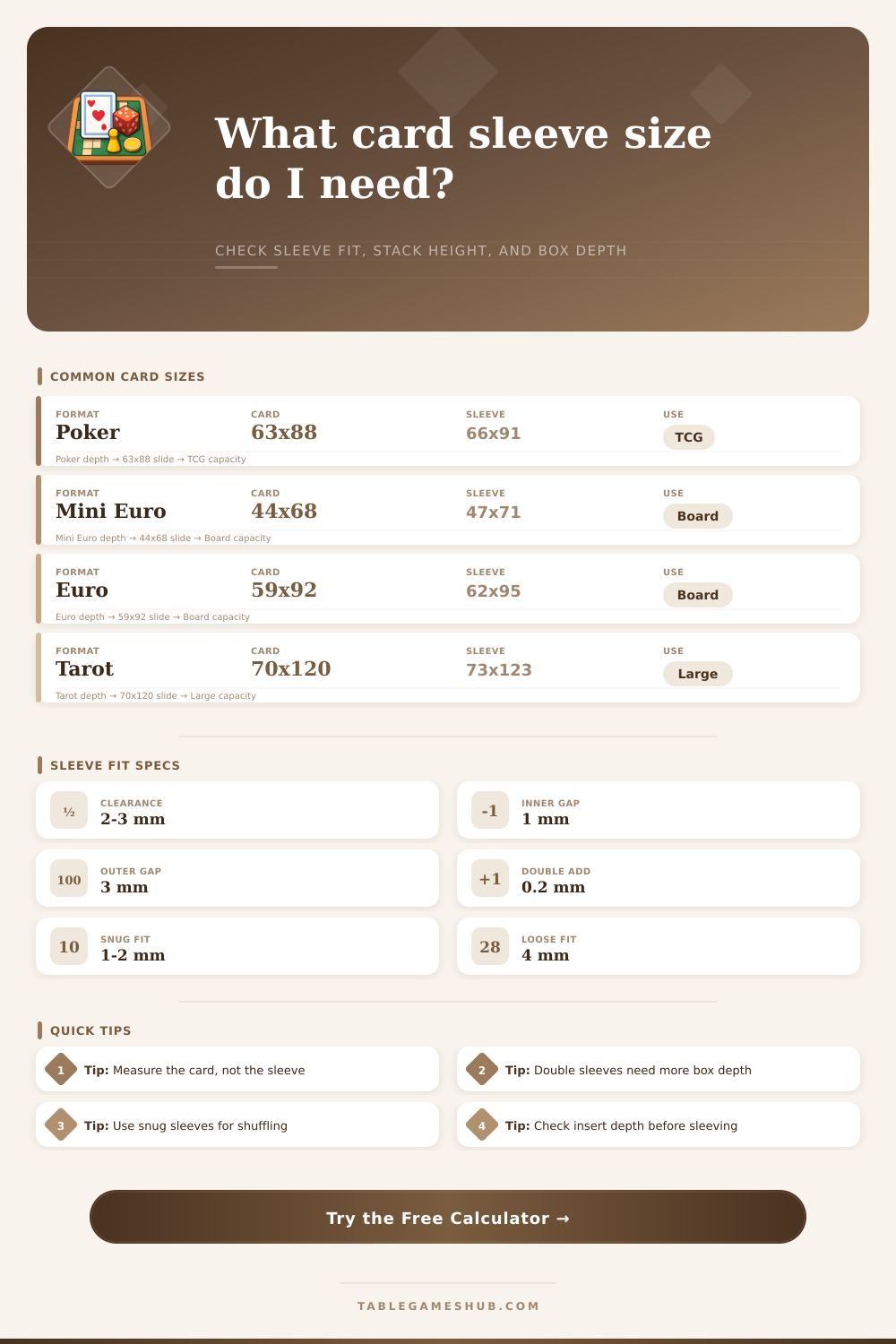
| Format | Card size | Typical sleeve | Common use |
|---|---|---|---|
| Poker / TCG | 63 x 88 mm | 66 x 91 mm | MTG, Pokemon, poker decks |
| Bridge | 57 x 89 mm | 60 x 92 mm | Bridge and narrow card games |
| Japanese | 59 x 86 mm | 62 x 89 mm | Yu-Gi-Oh style small TCG cards |
| Mini American | 41 x 63 mm | 44 x 66 mm | Small board game cards |
| Standard American | 56 x 87 mm | 59 x 90 mm | Many adventure and deck games |
| Mini Euro | 44 x 68 mm | 47 x 71 mm | Compact Euro game cards |
| Standard Euro | 59 x 92 mm | 62 x 95 mm | Large board game cards |
| Tarot / Oversize | 70 x 120 mm | 73 x 123 mm | Tarot, Dixit-style cards |
| Fit style | Total extra width | Total extra height | Best use |
|---|---|---|---|
| Inner sleeve | 0.5 to 1.5 mm | 0.5 to 1.5 mm | Double sleeve base layer |
| Snug outer | 1.5 to 2.5 mm | 2 to 3 mm | Frequent shuffling |
| Standard outer | 2.5 to 3.5 mm | 3 to 4 mm | Board game storage |
| Loose premium | 3.5 to 5 mm | 4 to 6 mm | Thicker sleeves and easy loading |
| Sleeve setup | Layers per card face | Stack add per card | Storage note |
|---|---|---|---|
| Unsleeved | 0 film layers | 0.00 mm | Use only for box baseline checks |
| Inner only | 2 inner films | About 0.10 mm | Thin protection with tight fit |
| Outer only | 2 outer films | About 0.16 mm | Most board game sleeving |
| Double sleeve | 2 inner + 2 outer | About 0.26 mm | Best protection, largest box depth |
| Stack type | Card count | Approx depth | Planning note |
|---|---|---|---|
| 52 poker cards, outer | 52 | 22 to 25 mm | Needs a little finger lift room |
| 60 TCG cards, outer | 60 | 27 to 31 mm | Common deck box baseline |
| 100 TCG cards, double | 100 | 52 to 60 mm | Commander decks need deep boxes |
| 120 board game cards | 120 | 50 to 58 mm | Often requires insert removal |
Measure before matching
Card publishers round dimensions differently, so measure the real card stack with calipers or a ruler before buying sleeves for an insert.
Check depth after layers
Double sleeving increases every card in the stack, so the face fit can be correct while the box well is still too shallow.
Card sleeves not only protect the card from damage, but the sleeves also change the amount of space that a deck of cards occupy. Because a deck of cards becomes larger when card sleeves is added to each of the individual cards in the deck, it is possible that the larger deck will no longer fit into the insert that is designed for the box in which the deck will be stored. The size of the deck of cards increase with the addition of card sleeves because card sleeves add a width to the sleeve opening, card sleeves add a height to the sleeve opening, and because card sleeves add a thickness to each layer of the deck of cards.
The calculator perform mathematical calculations after a player enters the measurements of their cards, the mode that they will use for the card sleeves, and the dimensions of the box in which they will store their sleeved cards. The calculator calculates the size of the actual cards that will be used in the deck, adds the clearance between the edge of the card and the wall of the sleeve opening, adds the thickness of the film that will be used in the inner and outer sleeves to determine the total depth of each sleeved card, multiplies that depth by the total number of cards that will be in the deck, compresses the total depth to account for the way in which fresh sleeves often contain air bubbles that settle after a few day in storage, and compares the total depth of the sleeved cards to the depth of the box insert to determine whether or not the deck will fit into the box insert. The first value that can be adjusted in the calculator is the clearance between the card and the sleeve opening.
Will Your Sleeved Cards Fit Your Box?
If the clearance is set to too small of a value, the sleeve will feel tight when the cards are shuffled. If the clearance is set to too large of a value, the cards will rattle within the sleeves, which reduce the protective qualities of the sleeves. Based on the clearance value that is entered, the calculator will calculate the size of the opening within the box in which the cards will be stored, and determine if there is still enough space within the box well after accounting for the height of the sleeved cards.
If the remaining space within the box well is a negative number, the deck will not fit flat into the box; the individual must decide if a different size of sleeve should of be use. The second factor that changes the size of the deck is the thickness of each card. The thickness of the deck change with each additional layer of sleeves; inner sleeves add thickness to each side of the card, while outer sleeves add thickness to one side of the card.
If double sleeves are used, each card will have the thickness of an inner sleeve and an outer sleeve, adding roughly a quarter of a millimeter of thickness to each card. If the deck contains sixty or one hundred sleeved cards, this added thickness will contribute to the total thickness of the entire deck. The calculator automatically calculate the thickness of each card according to the mode that is selected for the sleeves; the thickness fields can be edited to account for the thickness of specific brands of sleeves, as some brands add more or less thickness than others.
After the sleeves are selected, the calculator accounts for the air that becomes trapped within the sleeves when the sleeves are new, but which will settle after a few days of storage. The result of all of these factors is the dimension in which the sleeved cards will fit within the box. The depth of the box can be compared to the depth of the sleeved and compressed deck with the calculator, and the calculator will indicate if there is still any room for the fingers of the individual that is inserting the cards into the insert.
If the result is a negative number, the cards will either press against the lid of the box insert, or the insert will be forced out of place with the stack of sleeved cards. In such a case, the individual can decide to remove some of the foam that may be within the box insert, to purchase a deeper box insert, or to use single sleeves rather than double sleeves to store their cards. The reference table within the calculator indicates the size of each type of card set and the sizes of sleeves that should be used for each type of card.
Individuals who are not certain of the size of the category of the cards that they own can use this table. Additionally, adjacent to the reference table is a clearance guide that explains how each of the different clearances will alter the total height and the total width of the sleeved cards. Many players who use the calculator often only measure the size of the cards, ignoring the additional width and height that will be contribute by the sleeves.
By separating the measurements of the cards from those of the sleeves within the calculator, the player can more easily decide upon an appropriate clearance for the sleeves without having to purchase them. Additionally, the measurements of the cards are separated from the measurements of the total depth of the sleeved cards; this prevents the owner of the deck from making the common mistake of purchasing sleeves that will allow the face of the cards to fit into the box, yet which will be too deep for the insert. Furthermore, the calculator can also be used to test the fit of different sizes of cards.
For instance, a box that is sized for a deck of Euro game cards may be sufficiently large for a deck of poker cards until the sleeves is added to the Euro game cards. The calculator can be used to enter the measurements for two different types of decks, allowing the player to compare the dimensions of the box with each of the potential plans for sleeving the cards. The number of cards that are to be sleeved within the deck can be altered, as can the mode in which the sleeves are to be produced (from outer sleeves to double sleeves).
It is a common habit for individuals to measure the size of the cards that are to be sleeved from the middle of the deck rather than from the top or bottom of the deck. Small differences in the thickness of the various cards within a deck can lead to errors in the total depth of that deck if the top and bottom cards are measured. The calculator is based off the measurements that is entered by the individual; therefore, the more accurate those measurements are, the more accurate will be the calculations of the calculator.
Digital calipers or rulers can be used to take these measurements. Although the thickness of each brand of sleeve is generally accounted for within the calculator, the thickness fields within the calculator can be edited. The thickness of each brand of sleeves may add more or less thickness than is accounted for in the calculator; by editing these fields, an individual can ensure that the calculations is accurate for the brand of sleeves that they own.
The final stage in the use of the calculator is for the individual to decide how they will change their current setup for sleeving their cards. Perhaps they will change the thickness of the sleeves that they use, or they may change the way in which the cards are to be fitted into their box. Whatever the decision, the player will not have to guess at the outcome of their chosen change.
By using the calculator for their specific type of card, their specific brand of sleeves, and their specific box, they can sleeve their cards with confidence.