🎯 Quoits Pin Distance Calculator
Compare quoits pin spacing, pitch distance, ring diameter fit, bed size, and layout clearance for common rulesets.
English long game
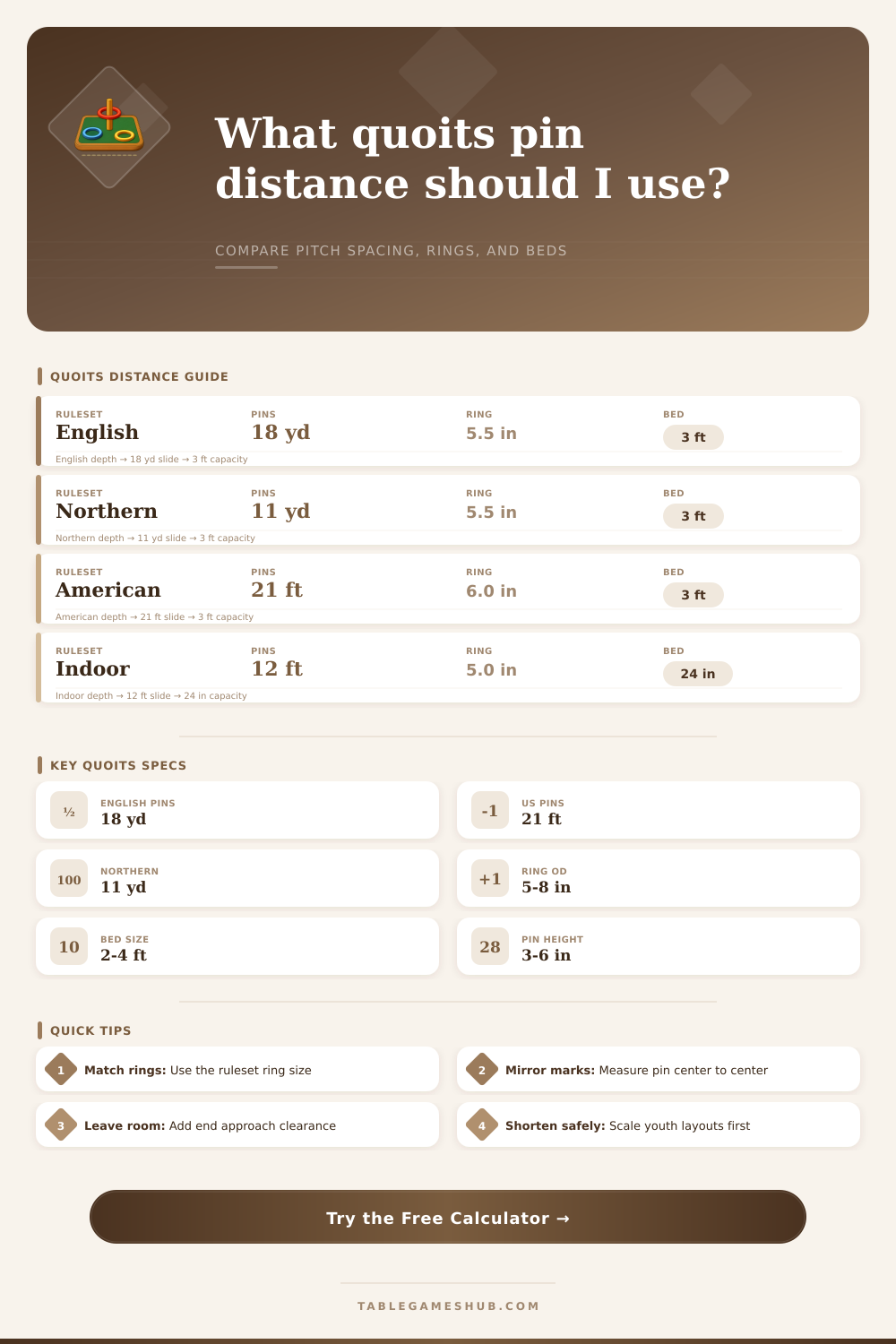
Often marked around 18 yards between pins with heavy metal quoits and clay or prepared beds.
Northern style
Commonly uses a shorter 11 yard pitch, similar ring size, and careful center-to-center marking.
American backyard
Many recreational sets use 21 feet between pins with larger rings and a simple target area.
Indoor or deck
Shorter 9 to 12 foot layouts work with rubber, rope, or deck rings and lower pin targets.
| Ruleset | Pin Distance | Typical Ring OD | Best Use |
|---|---|---|---|
| English long game | 18 yd or 54 ft | About 5.5 in | Traditional long pitching |
| Northern league style | 11 yd or 33 ft | About 5.5 in | Shorter competitive pitch |
| American backyard | 21 ft | About 6 to 7 in | Recreational yard play |
| Indoor rubber quoits | 10 to 15 ft | About 5 to 6 in | Small rooms and halls |
| Ring Type | Outside Diameter | Inside Diameter | Pin Clearance Check |
|---|---|---|---|
| Steel quoits | 5 to 6 in | 3 to 4 in | Opening should exceed pin diameter |
| Backyard rope or metal | 6 to 8 in | 4 to 6 in | Larger opening suits casual throws |
| Deck quoits | 5 to 7 in | 3.5 to 5 in | Use shorter spacing and low pins |
| Junior rubber rings | 5 to 6 in | 3.5 to 4.5 in | Pair with scaled pin spacing |
| Pitch Distance | Bed Diameter | Side Clearance | Total Width Guide |
|---|---|---|---|
| 54 ft | 3 to 4 ft | 3 to 5 ft each side | 9 to 14 ft |
| 33 ft | 3 ft | 3 to 4 ft each side | 9 to 11 ft |
| 21 ft | 2 to 3 ft | 2 to 3 ft each side | 6 to 9 ft |
| 10 to 15 ft | 18 to 30 in | 1.5 to 2.5 ft each side | 5 to 7 ft |
| Layout Goal | Use This Input | Calculator Output | Why It Matters |
|---|---|---|---|
| Mark the pins | Pin center distance | Center-to-center spacing | Keeps both beds aligned |
| Set throw line | Throwing line offset | Line-to-target distance | Handles bed-edge or pin pitching |
| Check ring fit | Ring ID and pin diameter | Clearance and opening ratio | Shows how forgiving the target is |
| Plan footprint | Bed and clearance sizes | Total length and width | Prevents cramped pitch ends |
Tip 1: Measure between pin centers
For most quoits layouts, the marked distance is the straight center-to-center spacing between the two pins, not the outside edges of beds or boards.
Tip 2: Match ring size to distance
Short indoor pitches usually pair better with lighter, larger-opening rings, while long traditional pitches assume smaller, heavier quoits.
The distance between the two pins is the most important factor in a game of quoits. The distance between the two pins will determine whether or not the game is to be fair or frustrating for the participants in the game. If the distance between the two pins is incorrectly set up, skilled players may have their skills relied upon for the games success and incorrect distance may cause frustration for the players.
Many people may feel that the distance between the two pins should be based off personal taste, but the distance between the pins must account for the ruleset, the size of the ring and the skill of the players who is to participate in the game. The calculator will provide mathematical results once you have entered the size of the rings that you would like to use in the game, the height of the pins and the dimensions of the game bed. The calculator will help you to avoid guesswork in determining these measurements for the game.
How to Set the Right Distance Between the Pins
For instance, you must account for the fact that the distance between the pins is not the same as the distance that the players will have to throw the ring. If the players are to stand behind one of the pins or if the players are to step to the edge of the game bed, the distance that the players will have to throw the ring is going to be shorter than the distance between the pins. Such a change in distance between the pins and where the players will have to throw the ring will change the way in which the game plays out for all of the players.
Another of the critical measurements for the game is the clearance for the ring. The size of the opening within the ring allows for the ring to be thrown slightly off of the center line of the ring. If the size of the opening in the ring is small, the players will have to aim for the ring very precise with the ring that they will be throwing.
If the opening in the ring is too small relative to the size of the pin, the ring may rattle within the ring or the ring may continually stick to the pin. If the opening within the ring is too large relative to the size of the pin, the game will lose it’s tension because there will be almost always a score for the players. Some of the different distances between the pins is established for specific reasons related to the type of quoits that are to be played.
For instance, the distance between the pins for traditional English quoits is established to be long to allow for the rings to have weight and for them to spin before they come to a rest on the ground. For indoor or backyard games, however, the distance between the pins may need to be shorter to allow for the rounds to be completed at a faster rate. A reference table is provided on the page to show the different distances between the pins for different types of rules sets.
Once you select the type of quoit that you would like to play, the other elements of the game will make it easier to establish the other elements of the game. Lastly, you should also consider the size of the playing bed and any clearances for the sides of the playing area. If the playing bed is narrow, the players may have to take specific steps to avoid stepping on the scoring area for the players.
Additionally, if the playing bed is relatively wide in relation to the players’ distance from either end of the playing area, the players will be able to retrieve the rings that the players missed. These factors the calculator can take into consideration so that the game is not too cramped for the players when they are playing at the same time. Finally, if there will be any clearances along the sides of the playing area, these distances can be factored in to the distance that the players will have to throw the ring to account for uneven ground or limitations in the playing area.
You should also consider the type of layout that the players will have to use for youth players or for players that are just beginning to play the game. For instance, if youth players are to play the game, it may be a good idea to decrease the distance that the players must throw their ring to ensure that the game remains fun for the youth players and to avoid frustrations for the young players. Additionally, the weight of the ring or the height of the pins can also be adjusted for the beginning players to allow for the young players to experience successes in throwing the ring into the scoring area.
These scaled versions of the game can be programmed into the calculator so that the young players can experience the scaled version of the game without having to guess at the apropriate adjustment. Another factor that you should consider is the position of the throwing line for the players. While the position of the throwing line will not alter the distance between the pins, it will alter the distance that the players must throw the ring.
Additionally, if you are hosting a tournament, you should establish the throwing line in advance to avoid any arguments between the players regarding the distance that the players must throw the ring. The calculator can establish such a throwing line to help determine how the game will play out for the players. Another error that players or game organizers may make is that they may ignore the adjustment for the addition of buffer room for the players.
The distances between the pins are established based upon the assumption that the yard or playing area is even and clear of any obstacles to the players. Adding a percentage for the addition of buffer room will provide the players with the appropriate amount of room to miss a target without the ring rolling into another area of the yard. The calculator can establish this buffer, but the calculator will not factor in this buffer in relation to the official distance between the pins.
Lastly, the material for the ring may have an impact upon the way in which the game is to be established. For instance, steel rings will have more momentum than the other types of rings, thus the players will need to have a firm bed to stop the steel rings. Rubber rings and rope rings may have different distances at which they are likely to come to a rest, thus these types of rings may require a shorter distance between the pins.
While the calculator does not determine the type of ring that will be utilized in the game, the calculator will establish the clearances for the ring to account for the type of ring that is to be used. Weather and the condition of the ground on which the players will be throwing their rings will also have an impact upon the game. For instance, clay playing areas will have the advantage of being able to retain the shape of the playing area while the clay playing areas may require more maintenance.
Additionally, grass and artificial turf may have an impact upon the way that the ring will land or slide on the ground. While the calculator will provide the players with the distance between the pins, it is up to the players to test the ground where the game is to be played. When the distance between the pins is set to be the correct distance, the pins will remain in their appropriate place and the players can focus upon playing the game itself.