Ring Toss Distance Calculator
Set a throw line from ring diameter, target height, target post size, age group, skill level, and lane clearance for backyard, tabletop, field day, and carnival-style ring toss.
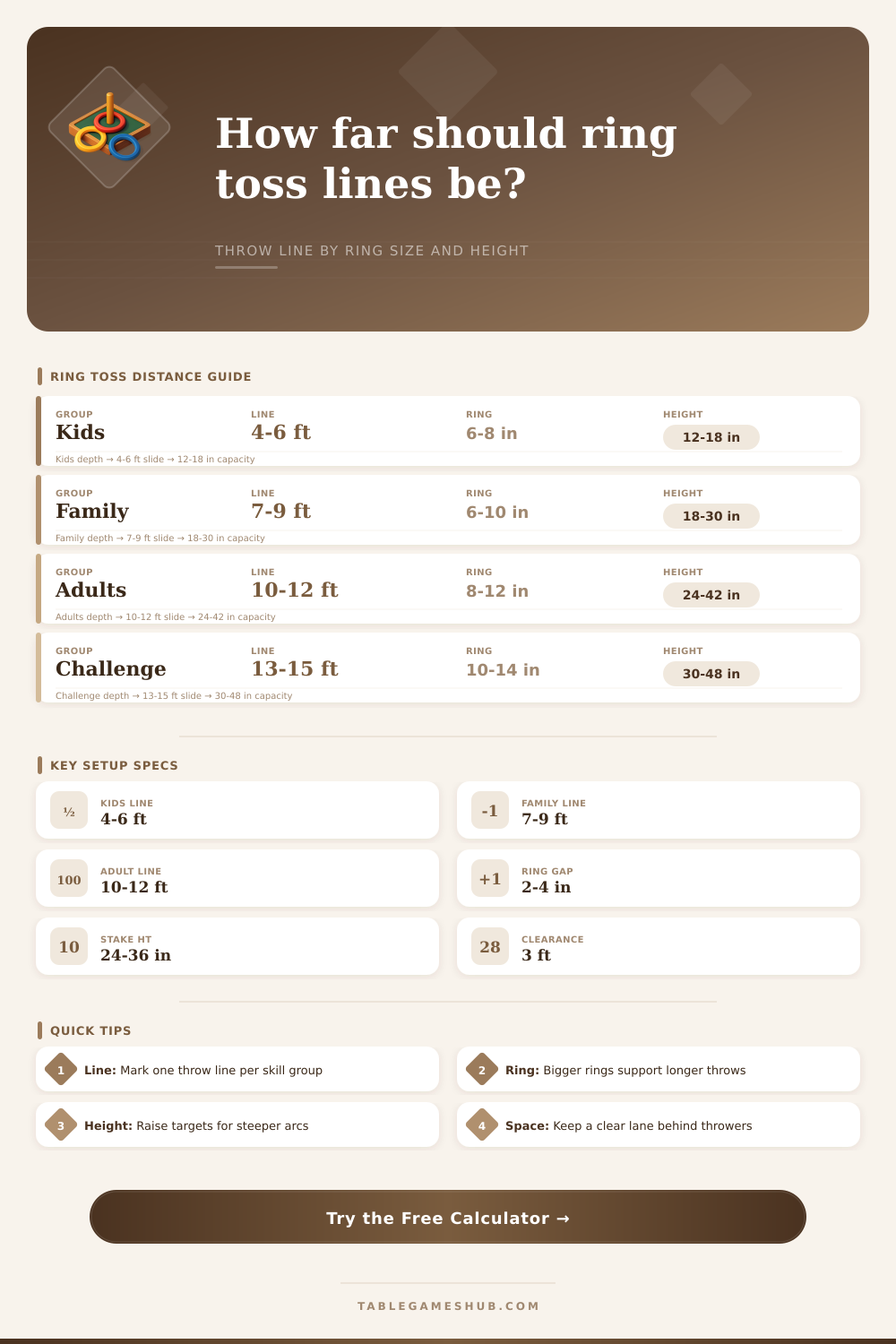
| Player Group | Typical Throw Line | Ring Size Range | Target Height Fit |
|---|---|---|---|
| Kids or first-time players | 4 to 6 ft | 6 to 8 in outside diameter | Low pegs around 12 to 18 in |
| Family casual play | 7 to 9 ft | 6 to 10 in outside diameter | Mid-height pegs around 18 to 30 in |
| Adults, casual accuracy | 10 to 12 ft | 8 to 12 in outside diameter | Targets around 24 to 42 in |
| Advanced challenge line | 13 to 15 ft | 10 to 14 in outside diameter | Taller stakes around 30 to 48 in |
| Accessible seated play | 5 to 7 ft | 8 to 12 in outside diameter | Targets around 18 to 30 in |
| Target Type | Common Post Size | Useful Ring Opening | Distance Effect |
|---|---|---|---|
| Single upright peg | 0.75 to 1.25 in diameter | 4 to 8 in inside opening | Balanced for most backyard lines |
| Three-peg board | 0.75 to 1 in pegs | 4 to 7 in inside opening | Slightly easier because players can choose a peg |
| Tabletop hook target | 0.25 to 0.5 in hook or pin | 2 to 5 in inside opening | Shorter line, higher precision |
| Tall lawn stake | 1 to 1.5 in diameter | 6 to 10 in inside opening | Can support longer throws with a visible target |
| Carnival cone target | 2 to 3 in top diameter | 6 to 10 in inside opening | Needs extra ring clearance before distance increases |
| Target Height | Best Arc Range | Line Adjustment | Setup Note |
|---|---|---|---|
| Tabletop, 6 to 12 in | 25 to 35 degrees | Keep the line short | Use smaller rings and a steady release height |
| Low peg, 12 to 18 in | 30 to 38 degrees | Good for kids and beginners | Mark a clear line and keep the target visible |
| Mid peg, 18 to 30 in | 35 to 45 degrees | Works for family and adult play | Balanced throw arc with moderate loft |
| Tall stake, 30 to 48 in | 42 to 55 degrees | Raise arc before shortening the line | Useful for lawn games and large rope rings |
| Preset | Throw Line | Ring and Target | Clear Lane Needed |
|---|---|---|---|
| Kids party short line | 5 ft | 7 in ring over 1 in low peg | About 7 ft with rear clearance |
| Family picnic | 8 ft | 8 in ring over 1 in mid peg | About 11 ft with rear clearance |
| Adult backyard | 10 ft | 9 in ring over 1 in peg | About 13 ft with rear clearance |
| Tabletop hook toss | 4 ft | 4 in ring over small hook | About 5.5 ft with rear clearance |
| Rope ring challenge | 14 ft | 12 in ring over tall stake | About 18 ft with rear clearance |
Ring toss is a game that requires a specific setup to ensure that it is enjoyable for all of the player. The distance of the throw line is one of the factor that will affect how the game is to be played. If the throw line is too close to the target rings, the player may find it to be too easy.
If the throw line is too far from the target, the rings will hit the target without landing on the post. The distance of the throw line should be established with consideration for the size of the rings, the height of target, and the skill of the players. The size of the rings will have a direct effect upon the distance of the throw line.
How to Set the Throw Line for Ring Toss
If the rings is especially large, there will be more room around the target for the rings to land on the post. Thus, if the rings are large, there will be a greater degree of forgiveness in the game for the players, and as a result, the player can move the throw line farther from the target. In the instance that the rings are small, there will be more precision that are required from the players.
Consequently, small rings will have a shorterer throw line so that they can land on the target post. The height of the target will also play a role in the arc of the rings that are to be thrown, as well as the distance of the throw line. If the target is low, the players will need to throw the ring with a relatively flat arc to the target.
However, if the target is high, the arc will need to be steeper. Furthermore, the height from which the players will throw the ring can also have an effect upon the distance of the throw line. If some of the players will be children or seated player, they will start their throw from a lower height than if the players are adults standing on the ground.
Thus, their rings will have less time to travel forward before they begin to drop toward the target. The skill level of the players can also indicate the distance of the throw line. If the players are beginner, they will have a shorter distance to travel to the target posts.
Thus, they will have an easier time landing on the posts. However, if the players are of higher skill, they may desire the increased challenge of a longer distance between the players and the target. However, even the most skilled player must still ensure that the rings have enough clearance to land on the target posts.
The skill level factor can be adjusted with the forgiveness setting on the calculator. The area behind the throw line is another area that must be considered in the creation of the ring toss game. It is important to ensure that the players has enough clearance behind the line to avoid stepping into an object when performing the game.
The calculator allows for extra space to account for this condition to make sure that the footprint of the ring toss game is realistic for the area to be used for the gathering. The type of gathering that is to be held can have an effect upon the type of ring toss game that is set up. For parties that are for children, short distances and large rings will be used to encourage the children and avoid frustration when they are attempting to land the ring on the target.
For parties that include both children and adults, a medium distance will allow for all of the players to have success. For parties that are for adults only, the distance for the throw line can be longer. Additionally, if it is to be a carnival-style game, the margin will be very tight in relation to the target.
There are a few mistake that should be avoided when throwing the game. For example, one mistake that should be avoided is moving the throw line back for increased difficulty. If the rings are already close to the target post, the additional distance will only make it more difficult for the players to land the ring on the post.
Instead, the designers can increase the height of the target to create an arc for the players that will force them to travel further in the air. Additionally, it is also important for the designers of the game to ensure that they take into consideration the diameter of the target post. For example, if the post is thick, the ring may become caught on the post.
Environmental factor will impact the game. For example, if the grass is wet, the rings will travel further after they land on the grass. Additionally, if the rings are wet, they will drop more quickly after they are thrown.
Additionally, the wind will impact the ring toss game. However, the wind will have a greaterer impact upon the flat throws of the ring rather than the high arcs that are used for the ring toss game. It is recommended that the game is tested with the actual equipment and the actual playing surface.
For instance, if the game is to be held outdoors, it is best to test the equipment in the same area that the game is to be held. This will allow for any impact of the wind and the grass to be taken into consideration prior to the event. Using a calculator to determine the distance of the throw line will remove the guesswork as to where to place the throw line.
For example, if the size of the rings, the target, and the skill of the players are calculated, it is possible to determine the perfect distance for the players to achieve the target posts. Using this initial distance, adjustments can be made according to the abilities of particular players or groups of players. For example, the group of players can be moved forward or backward from the initial position of the throw line.
Additionally, the designers can raise the height of the target for groups of players such as adult. Thus, maintaining the balance in the game allows for all of the players to experience success. By creating a balanced ring toss game, all of the players will have an even chance of success at landing their rings on the target posts.