Samba Canasta Score Calculator
Total a Samba hand with separate bonuses for sambas, pure canastas, mixed canastas, red threes, going out, card points, cards left in hand, and table-rule penalties.
(sambas x samba bonus) + (pure x 500) + (mixed x 300) + red-three bonus + out bonus
meld card points - unplayed hand points - red-three hand penalties - other penalties
bonus subtotal + card point swing, which can be negative after a blocked or unfinished hand
previous score selects 15, 50, 90, 120, or 150 card points before bonuses count
| Score item | Classic value | Fournier value | Calculator handling |
|---|---|---|---|
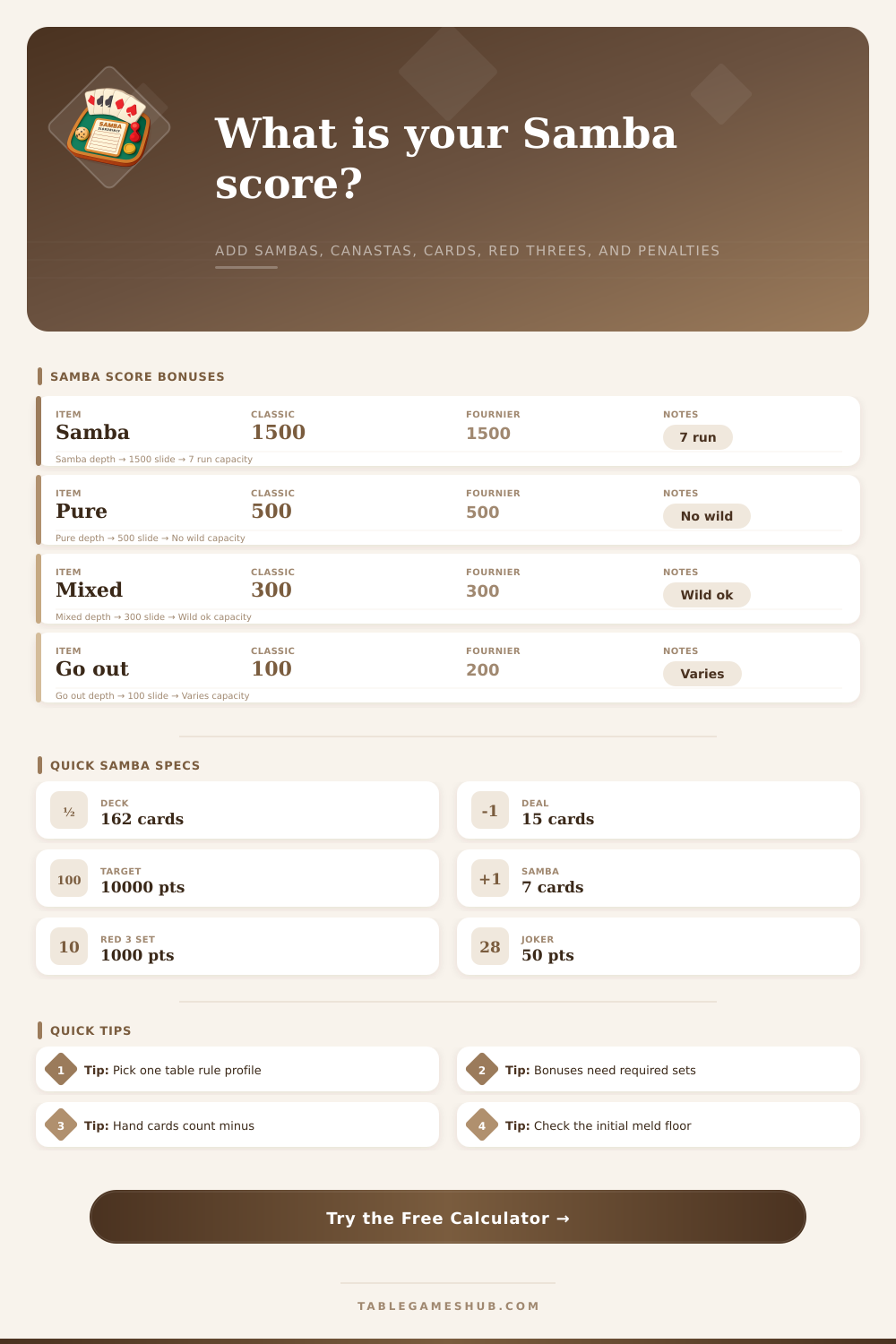
| Samba | 1500 per sequence | 1500 per sequence | Multiplies by completed sambas |
| Pure canasta | 500 per canasta | 500 per canasta | Counts natural same-rank sets |
| Mixed canasta | 300 per canasta | 300 per canasta | Counts canastas with wild cards |
| Red threes | 100 each, 1000 for all six | 100 each, 1000 for all six | Positive only when required sets are met |
| Going out | 100 | 200 | Ignored when stock is exhausted |
| Card group | Point value | Wild or natural | Scoring note |
|---|---|---|---|
| Jokers | 50 points | Wild | Count in meld points or hand penalty |
| Deuces | 20 points | Wild | Also blocks discard pile at many tables |
| Aces | 20 points | Natural | Can finish 8-A samba sequence |
| 8 through king | 10 points | Natural | Common canasta and sequence cards |
| 4 through 7 | 5 points | Natural | Low cards still count in meld totals |
| Black threes | 5 points | Special | Usually melded only when going out |
| Partnership score before hand | Classic minimum | Fournier minimum | What counts |
|---|---|---|---|
| Negative score | 15 points | 15 points | Card values only |
| 0 to 1495 | 50 points | 50 points | Red threes do not count |
| 1500 to 2995 | 90 points | 90 points | Canasta bonuses do not count |
| 3000 to 6995 | 120 points | 120 points | Use visible meld card points |
| 7000 or more | 150 points | 120 or 150 by table | Calculator uses 150 for classic profile |
| Audit check | Pass condition | Calculator field | Why it matters |
|---|---|---|---|
| Red-three bonus | Required completed sets are present | Sambas plus canastas | Otherwise red threes become a penalty |
| Out bonus | Player emptied hand, stock did not end it | Went out, stock ended | Stock exhaustion usually removes the bonus |
| Hand cards | All unplayed card values are entered | Card points left in hand | Unplayed cards are deducted |
| Match finish | New total reaches the target | Previous score, target score | Shows remaining gap after this hand |
Scoring is simple in most card games; add up the points at the end of each round. But with Samba Canasta, you have to manage your points carefuly. One minute you’re sitting pretty with a few hundred points, and the next, a natural canasta changes table flow for a massive five-hundred point swing. The instability of this scoring system make the game exciting, but it’s also a recipe for arguments.
To prevent confusion at the table, keep an easy-to-use method of tracking scores handy. It doesn’t take a mathematician to be good at Samba Canasta, but it does help if you know what all of the scoring elements mean before laying down that last card.
How to Score in Samba Canasta
The other big cause for misunderstanding is that red threes are either a score bonus (if you play them after you’ve played enough cards to form at least one canasta) or a point deduction (otherwise). Playing with all six red threes add a thousand points to your score. That’s not nothing. But if you don’t play them correctly than when it comes time to add up your scores, those very same cards will subtract from your total.
Our site does that for you, it knows what to do with red threes so you don’t have to stop partway through the deal to see if your hands is safe or not. Just tell it how many you’re melding now (and how many you might still have in your hand), pick which profile you want to use, and let it calculate the rest. It takes a complicated conditional test and makes it a button click.
An extra wrinkle in the rules can cause confusion here. At the beginning of the game, meld requirements add more complexity. Until you reach a certain number of card points in your meld, you will not be able to receive any bonus cards from initial deal. To begin collecting bonuses from the initial deal requires reaching a minimum amount of card points which increases as your partnership score rises. Initially it starts low, and then gradually increases during the course of the round.
The computer keeps track of your base line for you (remembering how many points you’ve had already) and adjusts the number up as your score rises. This reminds you that at the start of the game you’re more focused on getting position and surviving rather than trying to aggressively pick up points. Forcing a bonus before you reach the meld minimum limit your options. You shouldn’t of ruin your strategy with forced plays.
The wild cards present the kind of strategic choices that all player need to evaluate with some care. Deuces and jokers are fast-track tickets to building sets, but come at a steep price if left in your hand too long or discarded. At the end of the game, each one you hold onto will deducts twenty or fifty points from your score. Lots of folks get focused too much on the mixed canasta combinations and fail to notice the cards in their hands that could still be worth big bucks.
Scoring is made clear: Points earned by cards appear separately from any penalties deducted so it’s easy enough to calculate whether a risky meld was worth the cost of holding onto those wilds. Just like playing well, selecting appropriate house rules is equally important. Some tables uses the classic structure of going out for a modest bonus. Others opt for a high variance setting which rewards aggression with large payouts.
With just a quick click, the dropdown allows you to swap between those profiles on-the-fly and have your score reflect the deal your group agreed upon before shuffling. Little things like this avoid any embarrassing conversations where someone accuses you of giving them a five hundred point bonus that your table doesn’t support. Sticking to the rules goes a long way in keeping friendships alive long after putting down the cards.
Risk control: This is the essence of samba, maximize your chances of scoring big points by pursuing red three bonuses and natural sequences, but also protect yourself with safe melds. Run the number through this calculator or whatever you use, but ultimately the decision points is all up to you. Great players know when to go out. They know when to let their opponents take their shots. They know when to throw away a hand to get future gains. Always consider the goal score, and realize that the game isn’t over until you cross the finish line first.