Power Grid Fuel Market Calculator
Compare plant fuel demand, market stock, refill pace, player count, step pressure, capacity, fuel tier, and cities powered before the buying phase locks in.
Use board-visible fuel spaces and your expected plant burn. For hybrid plants, split demand across the fuels you can actually buy this round.
⚡Market Presets
📊Fuel Market Inputs
Fuel Market Breakdown
🔧Market Spec Grid
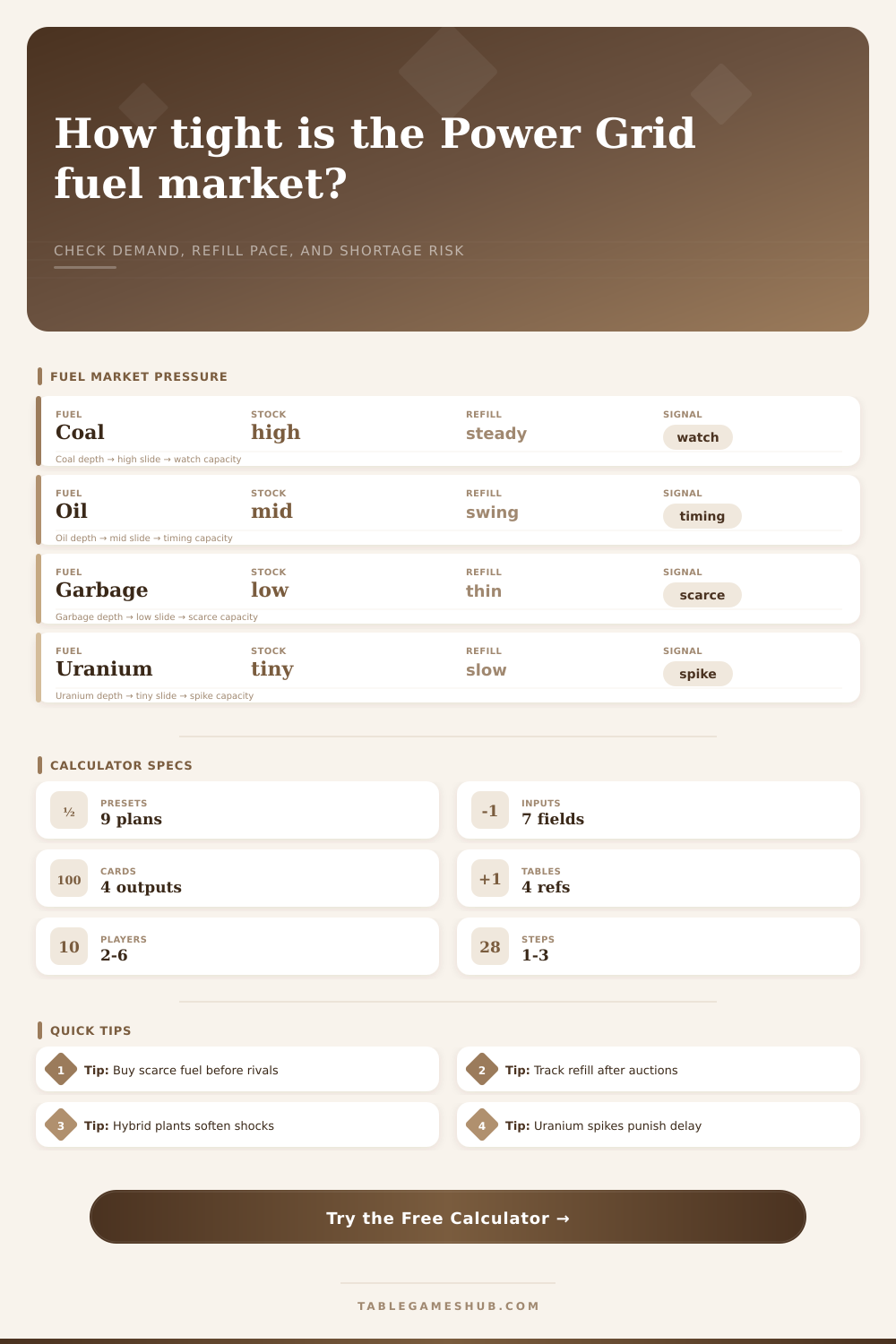
📘Fuel Pressure Reference
| Fuel | Typical Pressure | Best Use | Warning Signal |
|---|---|---|---|
| Coal | Broad but contested | Reliable midgame plants | Large coal plants appear together |
| Oil | Swingy refill timing | Flexible backup capacity | Hybrid buyers empty cheap spaces |
| Garbage | Low stock density | Efficient plants with timing | Two garbage plants enter auction |
| Uranium | Tiny track, sharp jumps | High output from one token | Late plant spike after refill |
📈Step And Player Pace
| Situation | Market Feel | Fuel Buying Note | Calculator Signal |
|---|---|---|---|
| Step 1, 3 players | Roomy | Refill often catches demand | Watch tier more than stock |
| Step 2, 4 players | Balanced pressure | Auctions can create one fuel pinch | Cover below 75% matters |
| Step 2, 6 players | Crowded | Buying order can decide fuel access | Risk climbs quickly |
| Step 3, any count | Volatile | Large plants burn through refill | Refill gap drives posture |
🧮Preset Assumptions
| Preset | Demand Shape | Stock Read | Primary Question |
|---|---|---|---|
| Coal Crunch Auction | Coal-heavy | Thin middle | Can coal buyers all fire? |
| Oil Refill Timing | Oil and hybrid | Healthy but falling | Will refill restore oil? |
| Garbage Scarcity | Low tokens, high demand | Critical | Does one plant sit idle? |
| Hybrid Plant Mix | Split coal and oil | Uneven rows | Which fuel absorbs pressure? |
🗂Buy Posture Guide
| Score Range | Risk Label | Fuel Action | Capacity Read |
|---|---|---|---|
| 0 to 24 | Low | Buy normally | Target cities likely safe |
| 25 to 49 | Medium | Secure main fuel early | Hybrid choices matter |
| 50 to 74 | High | Expect a contested row | One plant may be exposed |
| 75 plus | Critical | Prioritize fuel access | Capacity target is fragile |
💡Fuel Market Tips
Few things hurt worse during a game of Power Grid then losing out on an auction for a power plant. But that’s not the worst part of it. The worst part come a few turns later, when you have purchased the sweet new coal plant only to find that fuel market has dried up. Here you stand, a massive engine, but no gas to fill it.
That’s why managing fuel pressure is so important and it matters more than anyone realize. Plug your board into the calculator up top and let it do heavy lifting. You will no longer guess if that extra token are worth paying a little more. You won’t have to wonder if you should of settle for a single less powerful city. Fuel shortages aren’t random. They’re a consequence of all of us making rational decisions.” “People is thinking about how much revenue their new city could generate. And how much money it will take to buy the plant. They don’t often stop to consider the shelves in the fuel market. That’s a blind spot.
Why Fuel Matters in Power Grid
You can be winning an auction for this huge coal plant. But then you realize you are one of three people doing so and there isn’t nearly enough supply in the market to keep four big engine running. That tension is reflected in the inputs to the tool. Think about not just what’s shown on the board, but how many token you might realy require. The market can look well stocked, but even with only four players, demand can quickly outstrip supply if everyone are eyeing coal.
The refill mechanism makes all the difference. Early on in the game, when there is few players, it takes time for the token output to catch up as the market adjusts, but tokens flow back before they’re depleted. As plants increase in size, the refill mechanism fail to compensate for demand. A step three, six player game seems more akin to another sport entirely: demand exceeds supply, by design.
The problem with uranium, however, is that it’s a special case of this whole system: It’s very volatile (violent price spikes), has limited tokens, and a short track. If someone buys even one unit of uranium they can empty the market in a round. What do other people do then? Do you buy oil instead, as it appears more affordable this turn? Oftentimes, that fails, as oil ends up being “the thing” that’s running low.
The page spells all this out using a reference table. This table shows the risk profile for each type of fuel based off how it is refilled and its overall stock density. And then there’s garbage. On paper, it looks plentiful. But with a small overall supply, it vanishes fast once people start specializing it. Want to build two garbage plants? Better check that shelf; otherwise you’re probably leaving money on the table by paying premium prices later or just failing to power your cities entirely.
The tool calculates how exposed you might be by matching fuel availability with what you plan to cover in your cities. Better check that shelf. Otherwise you might be overpaying and burning cash later, or just running out of power in your cities entirely. The tool calculates how exposed you might be by correlating fuel availability with what you plan to cover in your cities. Instead of telling you what to do, they gives you a posture.
If there is a low risk of running out, feel free to take your time and let the auction finish so you can find something that fits you best. If there’s critical shortage risk, you’d better find yourself some tokens now, at whatever cost necessary. Paying an extra ten euros per token isn’t a question about money. It’s a question of survival. Losing five cities because you couldn’t afford to pay a few extra bucks is no joke.
Fuel is considered an afterthought for most player. When they run out, they purchase it. That’s fine until the market gets scarce. Now you’re playing catch up rather than ahead of the game. If you have a calculator and understand how to predict pressure, you’ll be able to look down the road, knowing that your competitor’s oil plant is going to suck up all available supply next round.
It is more than simply turning on your lights. You’ll close doors for your opponent and leave yours wide open. Your focus will no longer be on getting fuel. Instead you’ll see it as a weapon. The way you buy, the way you bid, and who has the upper hand at the end of the game when all the tokens are gone all change. They change based off how you view the relationship between player count, step progression, and refill rate.