Fudge Dice Average Calculator
Calculate the expected total, target probability, average margin, most likely result, and full score curve for Fudge and Fate dice pools.
1Scenario Presets
Pick a common Fudge or Fate check, then adjust the dice pool, modifier, target, and reroll method.
2Dice And Target Inputs
Calculation Breakdown
Result Distribution
3Fudge Dice Component Specs
4Reference Tables
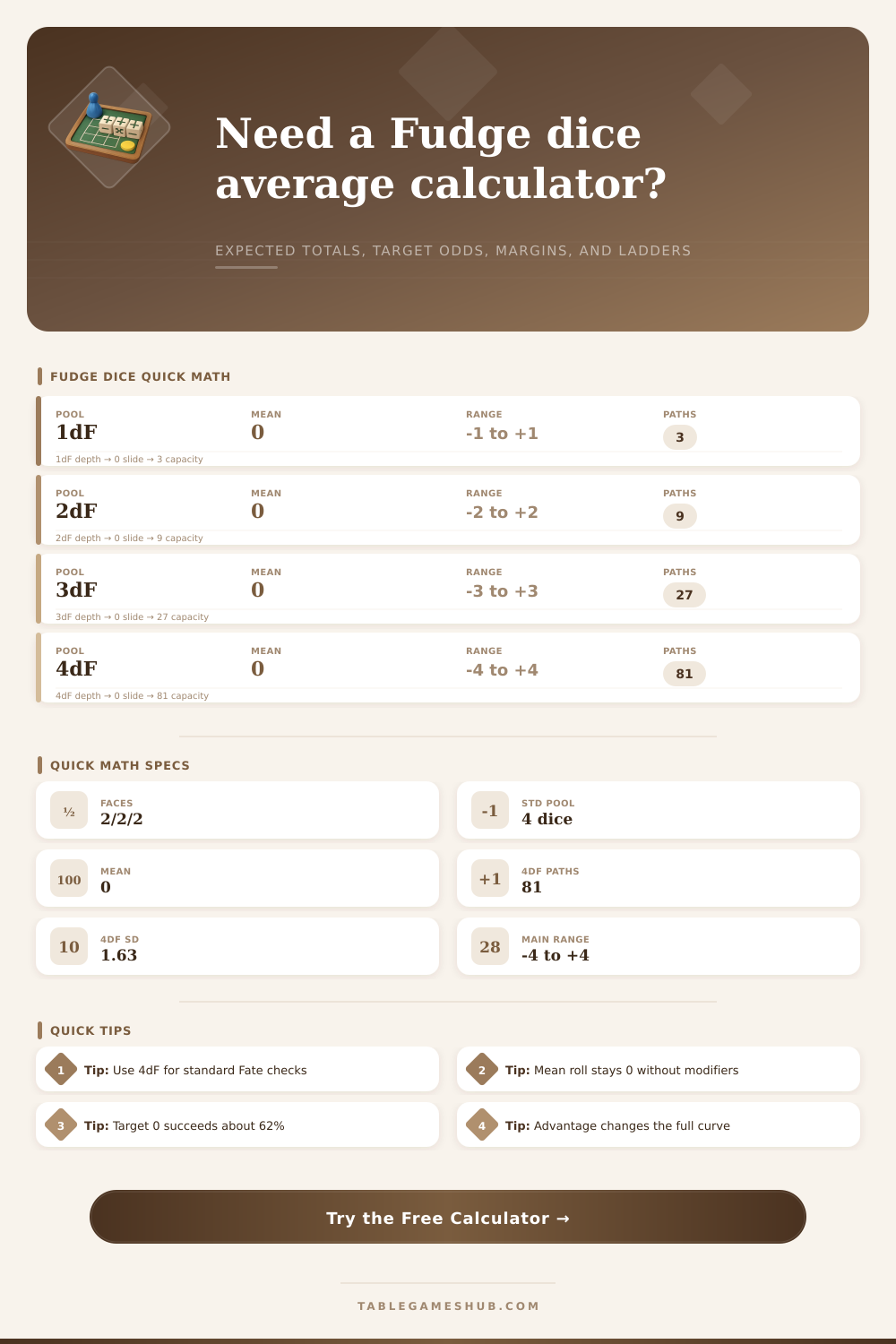
| Raw 4dF Total | Combination Count | Exact Chance | Meet or Beat Chance |
|---|---|---|---|
| -4 | 1 of 81 | 1.2% | 100.0% |
| -3 | 4 of 81 | 4.9% | 98.8% |
| -2 | 10 of 81 | 12.3% | 93.8% |
| -1 | 16 of 81 | 19.8% | 81.5% |
| 0 | 19 of 81 | 23.5% | 61.7% |
| +1 | 16 of 81 | 19.8% | 38.3% |
| +2 | 10 of 81 | 12.3% | 18.5% |
| +3 | 4 of 81 | 4.9% | 6.2% |
| +4 | 1 of 81 | 1.2% | 1.2% |
| Dice Pool | Mean Roll | Raw Range | Probability Paths | Standard Deviation |
|---|---|---|---|---|
| 1dF | 0 | -1 to +1 | 3 | 0.82 |
| 2dF | 0 | -2 to +2 | 9 | 1.15 |
| 3dF | 0 | -3 to +3 | 27 | 1.41 |
| 4dF | 0 | -4 to +4 | 81 | 1.63 |
| 5dF | 0 | -5 to +5 | 243 | 1.83 |
| 6dF | 0 | -6 to +6 | 729 | 2.00 |
| 8dF | 0 | -8 to +8 | 6561 | 2.31 |
| Fate Ladder Value | Ladder Name | Plain 4dF Chance to Reach | Common Use |
|---|---|---|---|
| -2 | Terrible | 93.8% | Weak obstacle or poor trait |
| -1 | Poor | 81.5% | Low difficulty check |
| 0 | Mediocre | 61.7% | Neutral untrained task |
| +1 | Average | 38.3% | Basic competent effort |
| +2 | Fair | 18.5% | Meaningful challenge |
| +3 | Good | 6.2% | Hard check without skill |
| +4 | Great | 1.2% | Rare unmodified success |
| Roll Method | Math Model | Average Shift | Best For |
|---|---|---|---|
| Normal Fudge dice | Convolution of -1, 0, +1 faces | 0 before modifiers | Core Fate and Fudge checks |
| Reroll blanks once | Blank faces are rolled again one time | Still centered at 0 | Higher swing house rules |
| Roll twice, keep better | Maximum of two independent totals | Positive skew | Advantage or strong aspect help |
| Roll twice, keep worse | Minimum of two independent totals | Negative skew | Disadvantage or severe pressure |
5Calculation Tips
Average check: a normal Fudge die has equal negative and positive weight, so the dice pool average is zero before traits, skills, stunts, or situational modifiers are added.
Target check: a target of zero is not a fifty-fifty line on 4dF. Because zero counts as a success when you meet or beat the target, plain 4dF succeeds 50 of 81 times.
The mechanics are simple: you has four dice, each marked with plus signs and minus signs and blanks. Add ’em up. Meet or beat zero? Succeeded! There’s nothing more to Fate or Fudge. And most people treat it as if it were a coin flip.
In fact, its a bell curve masquerading as a coin flip. Once you grasp the curve, your games change. Your choices becomes less about hoping you get lucky and more about figuring out what has highest chance of success. Every decision become meaningful instead of arbitrary.
Why Understanding the Math Makes Your Game Better
This page calculates all the math for you so you never have to pull out a spreadsheet while playing. See exactly where you fall on difficulty scale for any given skill. No need to keep your character sheet open next to Excel.
The next takeaway is that, in these systems, zero isn’t actualy neutral for success. Four average die rolls from a raw fudge dice will give you an average result of… wait for it… zero. Why? Because positive results counteract negative ones in just the right way. If your target number is X, then a “success” is rolling equal to or above X. So if the average challenge is 0, then yes, rolling a 0 is a success.
It’s going to cluster around the mean. There’s a larger probability of hitting that middle zone, rather than either end. Even a vanilla un-modded character still has over a sixty percent chance of passing a completely unmodified check. This is greater than most people would guess. And this is what makes the game seem so generous, even with mediocre starting characters.
Adding in the modifiers doesn’t simply move the average along the probability curve; it move you towards the ends (aka the tails) of the curve. That one-point advantage may seem like nothing, but dragging a big slice of bell curve away from failure and towards success can dramatically increase your chances. Because it’s doing this math in a blink of an eye, it will reveal to you how much a single point of advantage skews results.
And that’s where scene design comes in. When a character calls upon an aspect to get a +2 bonus, what they’re really doing is turning a coin flip into a near certainty. It is not merely a little bit easier. Knowing the difference is important for both the player (so they appreciate the advantage) and the GM (so they can properly price out any potential complications).
The larger pool have a higher standard deviation, but it doesn’t change the mean (the average outcome) much at all. Pool size doesn’t matter that much. Rolling more dice does changes the spread quite a bit. It makes extreme failure and success far more likely. But it keeps the mean right at zero.
That’s one reason why advantage mechanics… Where you roll two pools and take the best (are so potent). They cut off the left side of your suckiness. Not only do they make catastrophic failure less likely, but they completely eliminate the very worst outcomes. There are other ways to model this with the calculator: we could run a “keep-best” scenario where you pick better of two rolls. And then a “reroll” scenario where you repeat until you get a good number. It shows how sharply the odds improve if you can cut down on downside risk.
Having an option at the table is better than being stronger, mathematicaly speaking. As for those reference tables, they lay out precise combinations, but that’s only useful for standard pools. The real power comes from margins. Beating the target by two points is a better result then merely scraping by with one. It’s a system of margin where each roll becomes a question of how much. It’s not a binary win/lose.
Perhaps you stop the attack. Maybe it was close enough to keep your distance. But it was far enough away that you can’t grab their weapons and take control of the situation. That margin is going to drive the story so much further than a yes/no outcome. It reward skill and penalizes waiting too long.
Rerolls are another house rule that sounds harmless but looks different when you see it in distribution. The removal of neutral outcomes means every die has to either add something positive or negative. That makes things more volatile. There are more extremes and fewer middle results. For some groups, this might be great because they love the wild swings and big changes in fortunes. For others, a table with traditional variance is what they enjoy: solid rolls all around. It’s swings and roundabouts; no bad answer here, just make sure it’s an informed one.
But they’re more than math engines; these dice are storytelling tools. They help you craft better scenes because you know the odds. You compose challenges that is neither impossible nor easy, but tense. You know that a +3 target is a wall if the player doesn’t have a good reason to break through. You know that the system puts your characters in a fight where they’ve got a fighting chance, even unmodified. The balance of freedom and structure makes the game engaging, one roll at a time.
You should of seen how much it changes things.