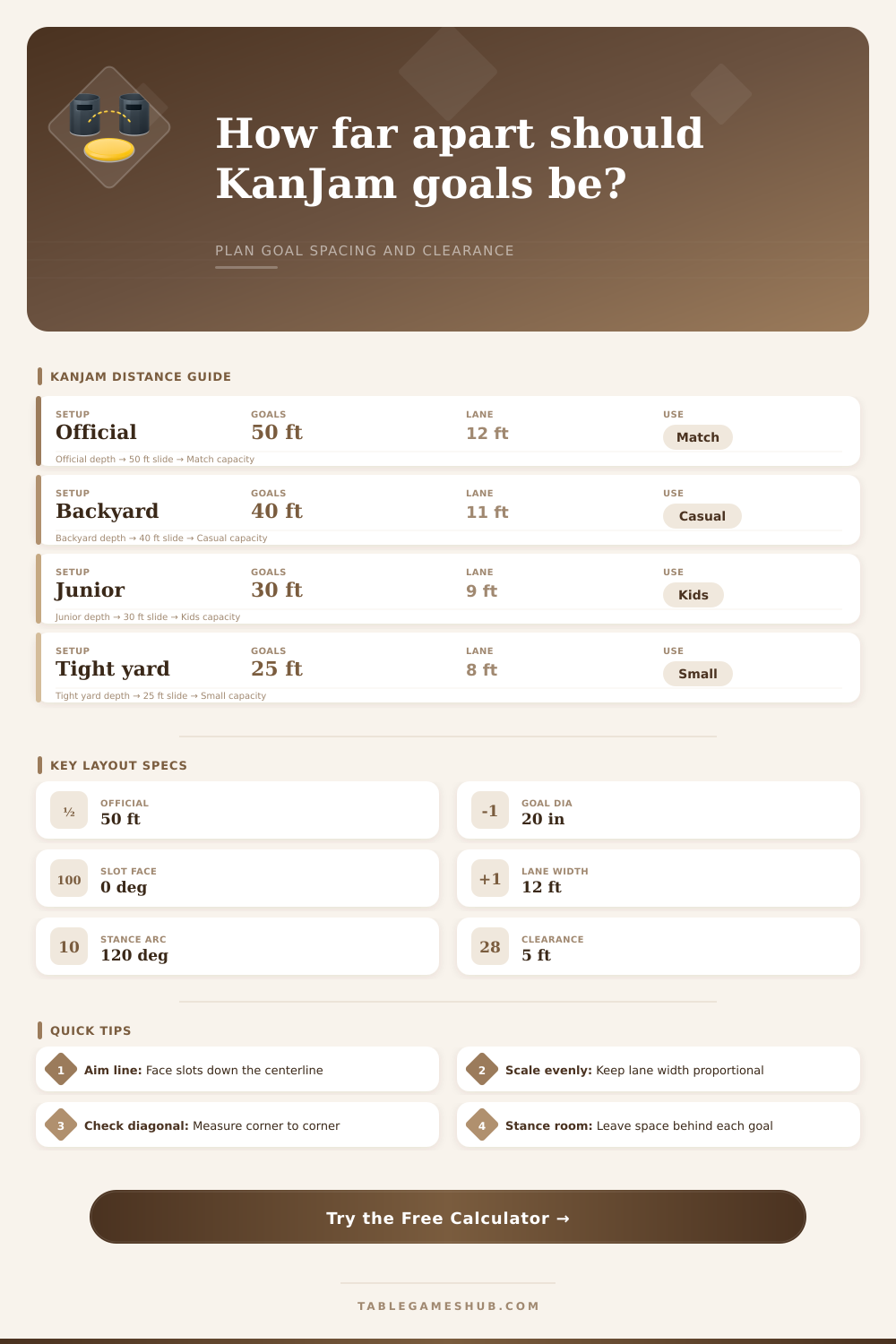
🥏 KanJam Distance Calculator
Set goal-to-goal distance, slot orientation, player stance arc, backyard scaling, disc flight lane width, and diagonal clearance for a clean KanJam layout.
| Setup | Goal Center Distance | Suggested Lane Width | Best Use |
|---|---|---|---|
| Official match | 50 ft / 15.24 m | 12 to 14 ft | Full-speed regulation play |
| Long backyard | 45 ft / 13.72 m | 11 to 13 ft | Nearly full throw with easier fit |
| Casual yard | 40 ft / 12.19 m | 10 to 12 ft | Most residential lawns |
| Compact lawn | 35 ft / 10.67 m | 9 to 11 ft | Shorter throws and mixed skill |
| Junior setup | 25 to 30 ft / 7.62 to 9.14 m | 8 to 10 ft | Kids, first timers, small spaces |
| Slot Orientation | Offset Angle | What It Does | When To Use |
|---|---|---|---|
| Direct centerline | 0 degrees | Slot faces the opposite goal | Default, official-style layout |
| Light toe-in | 5 degrees | Faces slightly toward right-handed throw path | Wind or narrow lane correction |
| Practice angle | 10 degrees | Makes slot approach more visible | Dedicated slot practice drills |
| Do not over-rotate | 15+ degrees | Creates a nonstandard target face | Only for custom skill sessions |
| Clearance Item | Minimum | Comfortable | Layout Note |
|---|---|---|---|
| Behind each goal | 3 ft | 5 to 8 ft | Allows stance, deflections, and retrieval |
| Side of flight lane | 2 ft | 4 to 6 ft | Useful for wind drift and missed discs |
| Stance arc radius | 2 ft | 3 to 5 ft | Gives partners room around the can |
| Lane width | 8 ft | 10 to 14 ft | Keep obstacles out of the disc path |
| Distance Scale | Goal Spacing | Lane Width | Diagonal Needed |
|---|---|---|---|
| 100% official | 50 ft | 12 ft plus clearance | Use for full yards and parks |
| 90% scaled | 45 ft | 11 ft plus clearance | Good compromise for long lawns |
| 80% scaled | 40 ft | 10 ft plus clearance | Works in many backyards |
| 60% scaled | 30 ft | 8 to 9 ft plus clearance | Junior or tight-space layout |
Align the slots before measuring diagonals
Place both goals on the centerline first, rotate the slots toward one another, then measure the total footprint. Small rotations can make a narrow yard feel tighter than the center distance suggests.
Scale distance and lane width together
If you shorten the throw from 50 ft to 40 ft, reduce the lane only a little. The disc still needs drift room, especially in wind or when players throw from an arc behind the goal.
KanJam is a game that requires players to have a certin level of skill with throw the discs. However, the layout of the game determine the way in which the game is to be played. Providing too little space for the disc for players will result in the discs not being able to drift to the goal slots.
However, if there is too much distance between the players and the slots, then the players will miss the slots altogether. A measurement of the distance between the players and the slots can be made prior to the first throw to ensure that the distance between the players and the slots is correct. The calculator that is provided will calculate the distances once the player has selected their available space within the yard and their selection of various preference for the game.
How to Measure and Set Up KanJam
Furthermore, the calculator will remove the guesswork that players may have to perform in determining whether there yard has enough space to setup and play a game of KanJam. The distance of 50 foot between each slot is the distance that is used for most players who have ample space for the game. However, the assumption of 50 feet of distance between each slot assume that the area has plenty of space to the side of the slots and behind each slot.
The width of the lane and the clearance of each side need to be input into the calculator to account for the way in which the discs are thrown. The stance arc can be set to different distances for those who would like to share the area behind each slot. The area behind each slot need to be accounted for to allow for both players to move without colliding with one another when they are using the slots behind the opposing goal.
Shortening the distance between the players and the slots will impact the stance arc that each player uses when they are setting up to throw the discs. Thus, the stance arc should of been accounted for prior to setting up the distance between each player. The slot orientation is another that can be accounted for prior to the game beginning.
The players typically set the slots facing the center of the playing area. However, slight rotation of the slots can be set to account for issue with the wind or the playing area being narrow in certain areas. However, increasing the rotation of the slots increases the chance of the slot being visually incorrect to the players when the game is being played.
Thus, the slot orientation can be accounted for in the setup of the game using the calculator. Scaling the game down to play in smaller yard requires certin adjustments to ensure that the discs are allowed to travel in their proper manner. Common setups in the reference tables include various distance from the longest to the shortest distances for players in younger age groups.
The reference tables ensure that the ratio between the distance to travel and the width of the lane remain the same for all distances. Another measurement to account for is the diagonal distance of the area. Many players tend to forget about this distance until they begin to place the slots in the yard.
By comparing the total rectangle of the area to the longest diagonal line in the yard, the players and planners can ensure that each slot has proper space to allow for proper throw. Furthermore, by calculating the diagonal space required for the game, players will save themselves from the frustration of attempting to place the slots in an area that doesnt have enough space for the discs to travel in their proper manner. Yards have many variable that may impact the distance that the discs can travel.
For example, trees may interfere with the discs’ movement, as may the location of hoses, uneven ground or fences. Furthermore, the area behind each goal should be provided for the discs when they are missed. If discs are to be thrown on hard surfaces, then they may bounce off those surface and into those players who is standing behind the goal.
Within the yard may be various area for different age groups to play. For instance, shorter distances may be required for younger players to increase the rate at which the games can occur. Furthermore, these shorter distances may require less power to throw the discs to the goal slots.
However, the stance arc should be the same as the area is required for both adults and children to stand when using the goal slots. Thus, the calculator may be used to account for these various distance between the players. Another factor in the game is the possibility of the presence of wind.
The distance between the players and slots as well as the clearance of each side of the slots can be adjusted to account for the presence of the wind. Thus, the players will be able to account for the presence of the wind in their planning without having to rebuild their game plan after placing the goal slots. An additional reason to measure the distances between each player and each goal is to ensure that the game is played in the same way each game.
The players may develop a feel for the distance between each player and the slots, as well as for the slot itself. This muscle memory will dissapears if the players are forced to use different distance each game. Thus, the calculator will allow players to use the same distances in each game and account for any changes in the available space within the yard.
Once the players have placed the goals and cleared the lane, the game can begin. The players will have forgotten the measurements between each player and each goal. Thus, the game should disappear into the flow of the players’ throws and caught discs.
Furthermore, the well-planned distances between each player will allow the game to be played without any distraction from other players.