🎯 Washer Toss Box Dimensions Calculator
Size the inside box, outside footprint, cup center, wall heights, and washer-to-cup clearance for a washer toss target box.
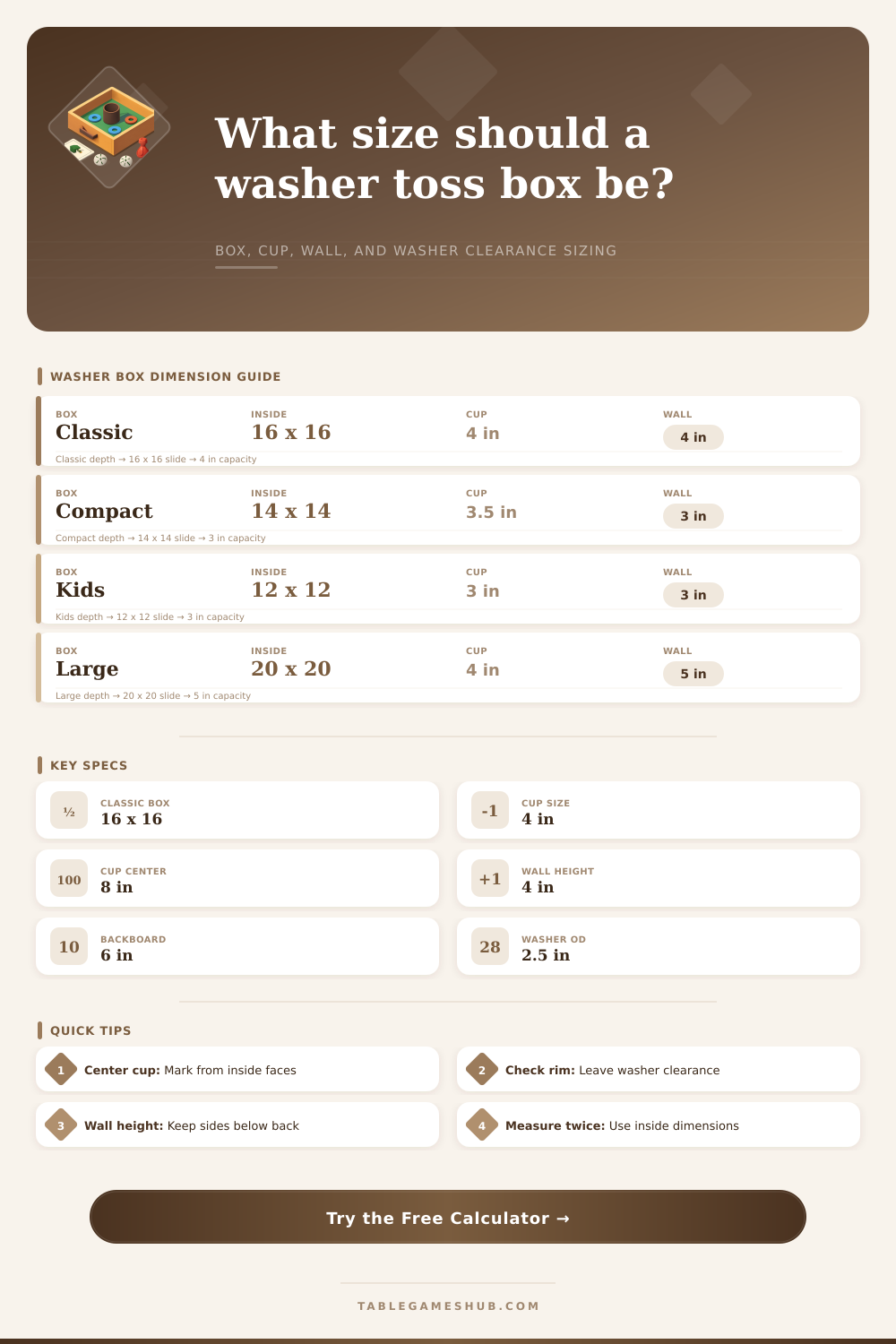
| Box Style | Inside Length | Inside Width | Best Dimension Use |
|---|---|---|---|
| Classic square | 16 in | 16 in | Standard centered-cup target box |
| Compact travel | 14 in | 14 in | Smaller box with full-size washers |
| Kids practice | 12 in | 12 in | Shorter box with smaller cup and washer |
| Large backyard | 18 to 20 in | 18 to 20 in | More floor around the target opening |
| Cup Diameter | Washer OD | Diameter Clearance | Fit Feel |
|---|---|---|---|
| 4 in | 2.5 in | 1.5 in | Common relaxed opening |
| 3.5 in | 2.5 in | 1 in | Tighter compact opening |
| 3 in | 2 in | 1 in | Small-box practice setup |
| 4.5 in | 2.5 in | 2 in | Easy target opening |
| Height Element | Compact | Classic | Raised Back |
|---|---|---|---|
| Inside cavity height | 3 in | 4 in | 4 in |
| Side wall height | 3 in | 4 in | 4 in |
| Backboard height | 3 to 4 in | 4 to 6 in | 8 to 12 in |
| Wall thickness input | 0.5 to 0.75 in | 0.75 in | 0.75 to 1 in |
| Marking Point | Formula | 16 x 16 Example | Dimension Purpose |
|---|---|---|---|
| Centered cup from front | Length / 2 | 8 in | Front-to-back target center |
| Centered cup from side | Width / 2 | 8 in | Left-to-right target center |
| Cup edge clearance | Center - radius | 6 in | Space between cup rim and wall |
| Outside footprint | Inside + 2 walls | 17.5 in | Overall box size, no materials list |
Tip 1: Mark cup centers from inside faces
Measure the cup center from the inside front and inside side walls. Outside measurements include wall thickness and can shift the cup off center.
Tip 2: Check washer clearance before cutting
Compare washer outside diameter to cup diameter. A clearance near 1 to 1.5 inches keeps the opening playable without changing box spacing.
To build a correct washer toss box, you must understand how the dimension of the box affect the game. The dimensions of the box include the size of the cavity within the box, the placement of the cup within the box, the height of the wall of the box, and how much clearance there is around the opening of the box. The size of the cavity and the clearance around the opening of the box will determine how the game feels for the individual who are throwing the washers.
A small size for the cavity will make it so that slight miss will result in the washer falling short of the target. An oversized cavity, in comparison, create a guessing contest for the player. Using the calculator to determine the dimensions of the box will ensure that the game within the box feel even to all who play.
Washer Toss Box Size and Cup Placement
The inside length and width of the box create the playable floor for the toss of the washers into the box. Many who chooses the dimensions for the box will opt for the size to be square to ensure that the cup is always centered within the box. Furthermore, players often choose a square box that is 16 inches in length and width as it allows the player to place the washer flush upon the floor of the box, while still allowing for the game to remain compact and easy transported.
Smaller boxes are created for travelers or young players, while larger boxes provide for more accuracy in the placement of the washer. The calculator will convert the length and width of the box to determine the outside footprint of the box. This outside footprint is important in that two boxes may need to be placed side-by-side upon a porch or within a garage.
The placement of the cup within the box will alter the way in which the game is to be played. You should measure the center point of the cup from the inside faces of the front and side walls of the box. The center point should never be measured from the outer edge of the walls.
This will ensure that the cup remains centered within the box after the walls are added. The calculator will show the clearances of the edge of the cup from the walls of the box. If the clearances are less than 1 inch in measurement, then there will be little room for the washer to fall into the cup before it will begin to rebound off of the edge.
Such a clearance will lead to a game that rely upon luck to place the washer into the cup. The desired clearance should range from 1 to 1.5 inch to provide the washer with enough time and room to drop into the cup. The height of the walls of the box will affect the way in which the washers begin to rebound off of the walls.
Low side walls will allow for the players’ washers to easily escape the box, which may frustrate the new player who are attempting to learn how to successfully place the washers into the cup. Taller side walls will allow the washers to remain within the box, but will affect the way in which the washers naturaly rebound off of the rim of the cup. The height of the backboard that is placed behind the cup is also another dimension to consider when setting up the box.
A modest height for the backboard will allow the players to aim for the cup, but will prevent the players from knocking the washers off of the backboard. An exaggerated height for the backboard will change the style of the game. The calculator will track the heights of the sides and back of the box.
The diameter of the cup should relate to the size of the washers that are to be thrown into the box. Standard washer are 2.5 inches in diameter. The diameter of the cup should be larger than the size of the washers to allow the player’s washers to drop into the cup.
If the cup is too tight, the player will feel as if the game does not reward the precision of their placements of the washer. The calculator should account for a gap between the washer and the cup. A gap of 1 inch between the washer and the cup is often the most desirable size as it allows the player to have an even goal for their washer.
Beyond the size of the box and the size of the cup, the thickness of the material from which the box is built is another dimension to consider. The thicker the material of the walls of the box, the more substantial the box will be. However, the thickness will also have an impact upon the footprint that the box will require.
Additionally, rounded corners within the box will reduce the area within which the player may drop the washer into the cup. The calculator will adjust for such a reduction in playing area by adjusting the placement of the center point of the cup within the box. This will prevent the individual who builds the box from becoming frustrated when they find the cup to be off-center within their box after they have constructed it.
Consistent measurements will provide for consistent play within the box for all players. If all boxes have the same dimensions and the same placement of the cup, then all players will have an even playing field. However, if the individual who builds the boxes relies upon memory to determine these measurements, there is a chance that the box will not have the same dimensions.
Using the calculator to determine these measurements will allow the individual to have a record of these measurements, which they can then utilize the following time that they may wish to build a box of this type. Testing the box once it is built will allow for the individual to ensure that the dimensions were correctly set up during the building of the box. One method of testing the box is to place it upon the ground and to toss washers into the box.
If the washer rattles within the cup, then the clearance of the rim of the cup from the sides of the box is too close to the rim of the washer. A washer that is frequently seen bouncing out of the cup indicate that the walls of the box are too low to contain the washer. Using the dimensions calculated with the calculator will allow for the individual to make any necessary small tweak to the dimensions prior to beginning to construct the box.
Thus, the calculator contains each of these variables and dimensions for the individual to consider prior to the building of the box.