Cornhole Distance Calculator
Set board front distance, hole-to-hole spacing, foul lines, board specs, age divisions, and diagonal clearance for backyard, pro, and tournament layouts.
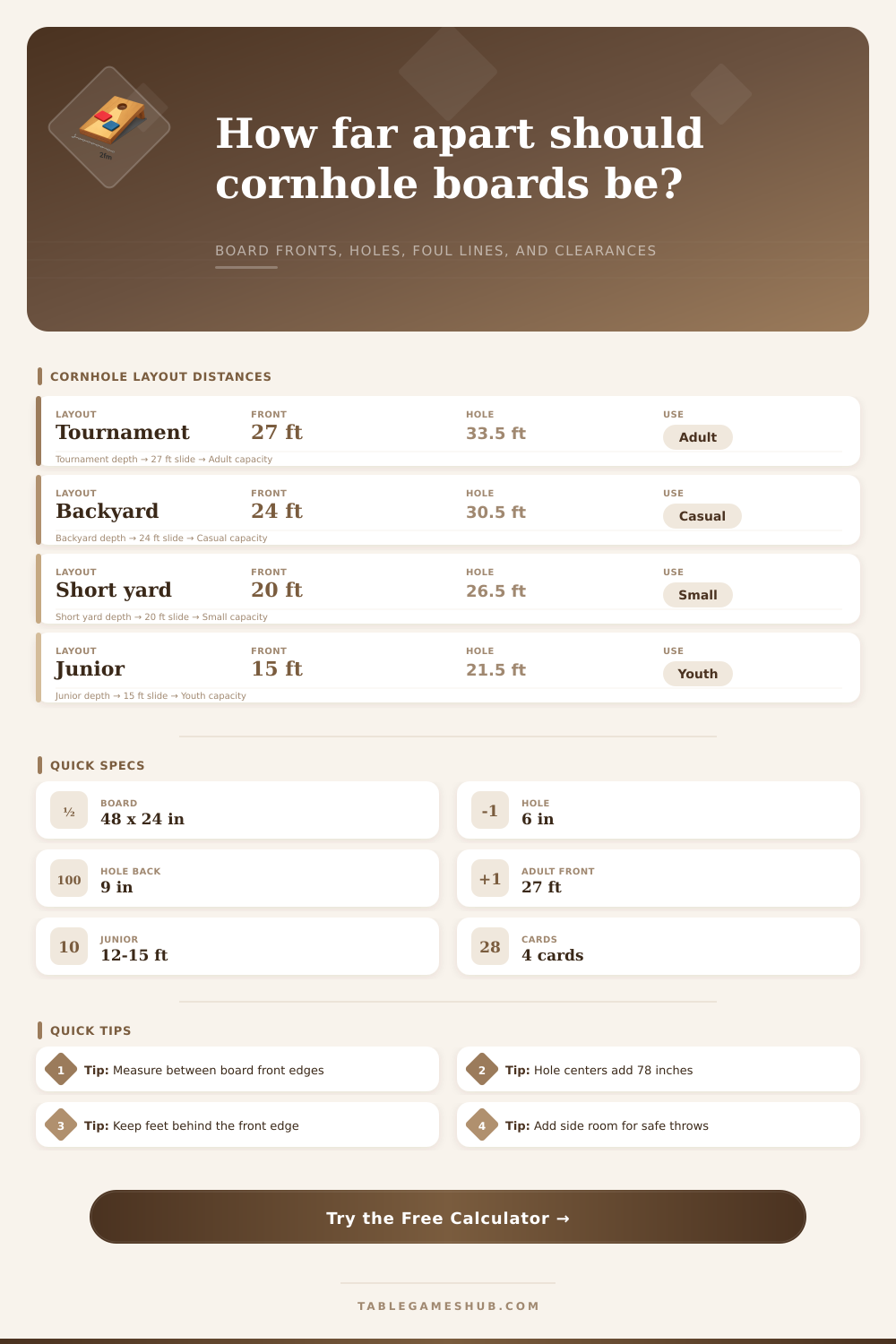
| Layout | Age division | Board front distance | Hole-to-hole distance | Best use |
|---|---|---|---|---|
| Tournament regulation | Adult / open | 27 ft | 33 ft 6 in | League, event, serious practice |
| Pro practice | Adult / open | 27 ft | 33 ft 6 in | Full distance with extra runoff |
| Backyard casual | Mixed adults | 24 ft | 30 ft 6 in | Parties and uneven skill groups |
| Short yard | Beginner adults | 20 ft | 26 ft 6 in | Patio, driveway, narrow lawns |
| Junior | Youth players | 12 to 15 ft | 18 ft 6 in to 21 ft 6 in | Kids, family games, skill building |
| Item | Regulation spec | Calculator field | Why it matters |
|---|---|---|---|
| Board length | 48 in | Board length | Sets court footprint and hole offset |
| Board width | 24 in | Board width | Affects total court width and lane room |
| Hole diameter | 6 in | Hole diameter | Checks target size against board spec |
| Hole center from back | 9 in | Hole center from back edge | Converts front spacing to hole centers |
| Foul line | Front edge | Calculated result | Player feet must stay behind this line |
| Clearance item | Typical minimum | Comfort target | Calculator use |
|---|---|---|---|
| Side space each side | 2 ft | 3 to 4 ft | Pitcher box and walking room |
| Behind each board | 2 ft | 3 to 6 ft | Bag pickup and board runoff |
| Total court length | Front distance + 8 ft | Front distance + 10 to 16 ft | Board length plus back clearances |
| Total court width | 8 ft | 10 to 14 ft | Lane width plus side buffers |
| Diagonal throw line | Offset dependent | Clear of furniture and walls | Checks angled release distance |
| Measurement | Imperial | Metric | Note |
|---|---|---|---|
| Adult board fronts | 27 ft | 8.23 m | Main regulation distance |
| Adult hole centers | 33 ft 6 in | 10.21 m | Assumes 48 in boards and 9 in back offset |
| Board size | 48 x 24 in | 122 x 61 cm | Common tournament board |
| Hole diameter | 6 in | 15.2 cm | Centered side-to-side |
| Junior front range | 12 to 15 ft | 3.66 to 4.57 m | Local events may set exact distance |
When you set up a cornhole court, you must measure the distance between the cornhole boards corectly. From the front edge of one cornhole board to the front edge of the other cornhole board is the distance use for cornhole leagues and tournaments. This distance isnt as same as the flight path of the cornhole bag.
The hole on the cornhole board is closer to the back of the board, meaning the flight path of the bag will be longer. If you dont account for this extra distance, the child’s cornhole game will feel different than a professional cornhole game. When you plan the cornhole space, you must consider more than the distance between the boards.
How to Measure and Set Up a Cornhole Court for Kids
You must consider the total footprint of the cornhole court. A person needs to have room to stand, to swing there arm, and to walk behind the boards to retrieve they bags. If the boards are too close to an obstacle, the child might bump into that object while playing.
The court should have enough space between the obstacle and the cornhole court to ensure the child does not hit that obstacle during play. A cornhole calculator can help you find the dimension of a cornhole court given the dimensions of your cornhole boards. A cornhole calculator can calculate the hole offset and the total area that a cornhole court will take up in your space.
Using a cornhole calculator will tell you if your driveway is wide enough for a cornhole court or if you will have to opt for a casual cornhole court layout instead. Knowing the total footprint that the cornhole court will take up will ensure that the boards dont take up your doors or other exits. If you are playing with children, you may want to change the distance between the cornhole boards.
If the distance is too far for the child, they may struggle to hit the boards. The child may begin to lose interest in playing. However, if you move the boards closer to the child, they can experience hit the boards and possibly making a hole in one.
Hitting the cornhole boards will help the child build muscle memory. Once they have mastered hitting the boards, you can move them further apart by one foot increment to make the game more challenging for the child. A foul line is necessary for a cornhole game.
When playing a professional cornhole game, a player must keep their feet behind the front edge of the cornhole board. This foul line will ensure that everyone play on the same footing. For casual play, children may move their feet past the foul line.
This shortens the game for the players. Having a foul line that all players respect will ensure a fair game for all players. When you design a cornhole court, consider the diagonal clearance of the boards.
Children may not always release the cornhole bag from the center of the board. The bag may be released at an angle. If the boards are too close to a fence or other obstacle, when a child releases the bag at an angle they may hit that obstacle.
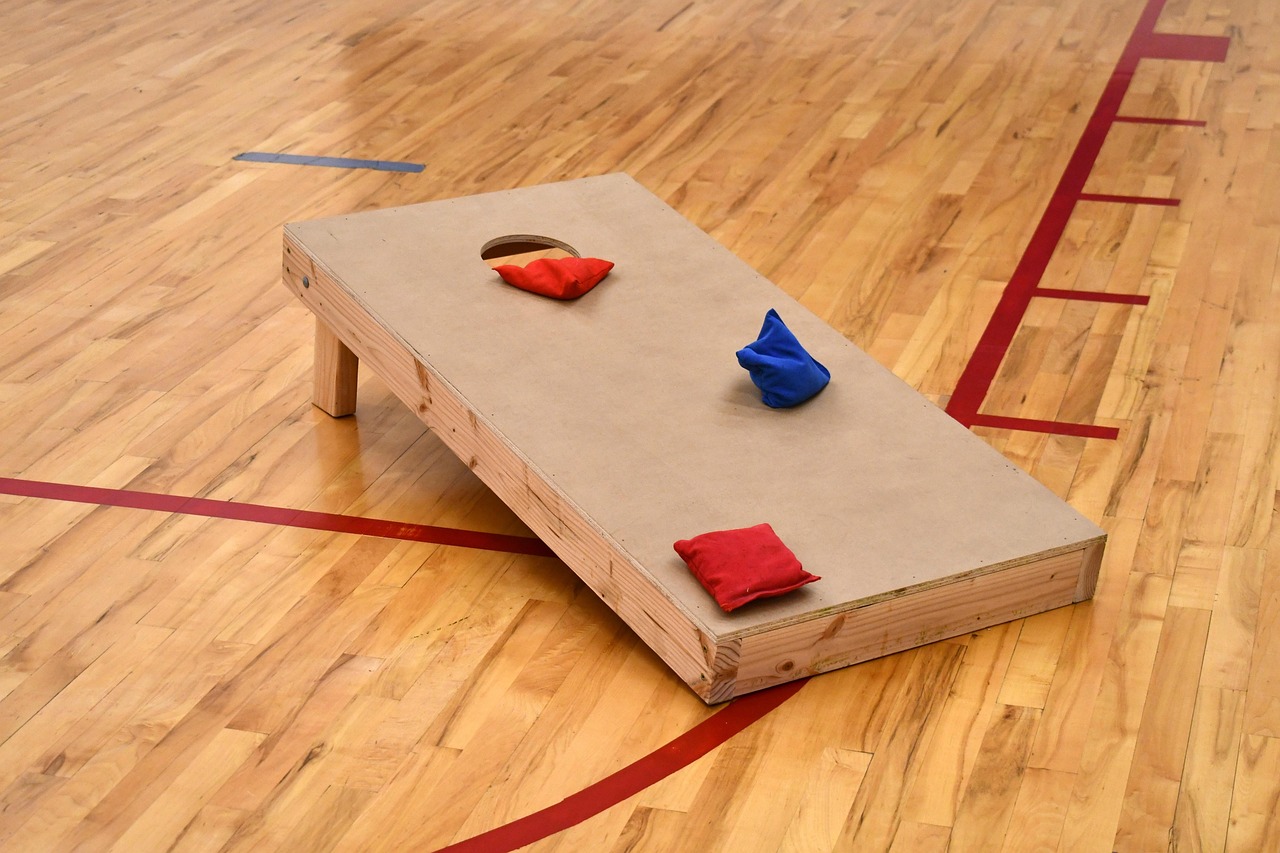
Calculating the diagonal clearance will ensure that the pitchers box is design to accommodate all players and throwing styles. If you are playing cornhole at home with the intention of competing in a cornhole tournament, make sure that the distance between the boards and the offset of the holes are to regulation cornhole court specifications. If the dimensions of the home cornhole boards are incorrect, the child’s brain will learn incorrect pattern for tossing the bags.
If the child’s brain learns incorrect patterns, the bags will land in the wrong spot when playing on a regulation cornhole court. Ensuring that the home cornhole court is set up the same as a regulation cornhole court will allow for consistence scoring when the child plays on a regulation cornhole court. Once you have determined the measurement of the cornhole court, mark the corner of the cornhole court.
Use stakes or chalk to mark the corners. Marking the corners ensures that the cornhole boards are set in the proper position. If the boards are in the proper position, the child can focus on the flight of the cornhole bag instead of the measurements of the cornhole court.
You should of checked the measurements twice.