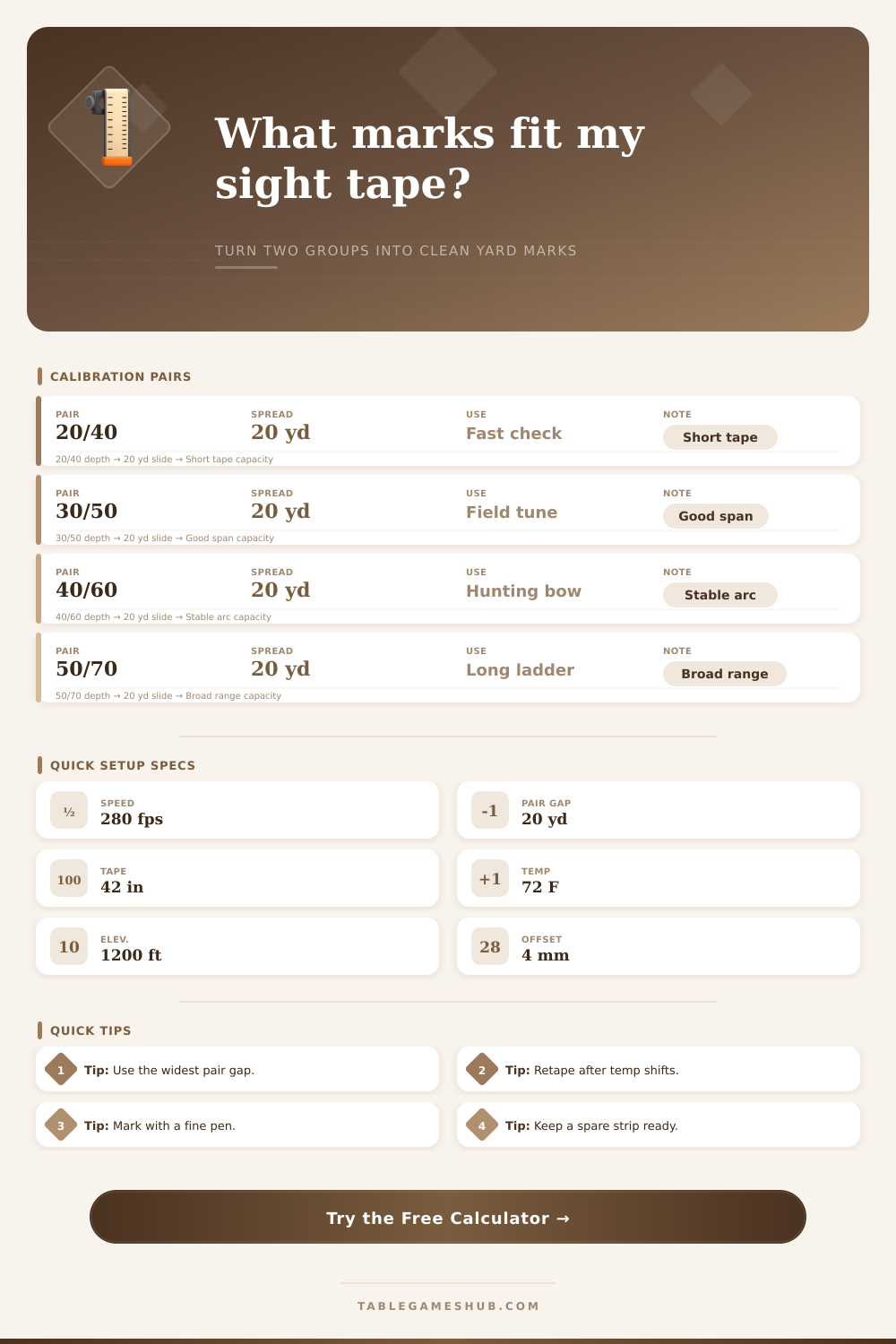
Archery Sight Tape Calculator for Calibration Marks
Map two sight-in groups into a clean slider strip, compare spacing, and refine the tape for your bow, arrow speed, and shooting conditions.
Preset calibration profiles
Sight-tape inputs
Sight system comparison grid
Reference tables
| Pair | Gap | Best use | Note |
|---|---|---|---|
| 20/40 | 20 yd | Quick setup | Short strip |
| 30/50 | 20 yd | Field tune | Common span |
| 40/60 | 20 yd | Hunting bow | Stable arc |
| 50/70 | 20 yd | Long ladder | Broad range |
| 60/80 | 20 yd | Long arc | Rare use |
| Speed band | Mark style | Curve feel | Use case |
|---|---|---|---|
| 240-260 | Wide | Gentle | Indoor bow |
| 260-280 | Normal | Moderate | Target lane |
| 280-300 | Tight | Steeper | Fast recurve |
| 300+ | Dense | Sharp | Speed rig |
| 310+ | Very tight | Cramped | Elite setup |
| Spacing | Range | Scale | Note |
|---|---|---|---|
| 8-12 mm | Short | Fine | Indoor line |
| 12-18 mm | Mid | Balanced | Most bows |
| 18-24 mm | Long | Bold | Hard arc |
| 24+ mm | Wide | Large | Strong drop |
| 30+ mm | Extra wide | Slow | Rare lane |
| Build factor | Low | Medium | High |
|---|---|---|---|
| Temp drift | 5 F | 15 F | 30 F |
| Altitude | 0 ft | 1000 ft | 3000 ft |
| Strap width | 6 mm | 9 mm | 12 mm |
| Field use | Indoor | 3D | Hunt |
| Label style | Thin | Clear | Bold |
Calibration tips
How the marks are derived
The calculator interpolates your two sight-in marks, then nudges the starting mark for speed, temperature, altitude, and eye offset so the tape behaves like a real slider chart.
Because the same pair can produce different tape lanes on different days, the confidence score highlights how steady the calibration should feel before you trim the strip today.
A second pass with a fresh pair lets you confirm whether the tape needs a tighter span, a wider scale, or only a small zero shift after travel.
If the strip feels crowded, widen the calibration pair rather than forcing the marks together.
Use a fresh print preview to confirm the slider scale still matches the far pin after trimming.
A sight tape is an tool used by archers to adjust for the distance between the archer and the target. When an archer aim at a target, the arrow dont go in a straight line to the target. Instead, the arrow takes a curved path to the target, and this path is called the trajectory of the arrow.
Additionally, because gravity drops the arrow, the archer has to adjust the sight of the archery bows. The sight tape allow the archer to adjust the sight to account for the drop of the arrow. Archers attempt to use pre-printed sight tapes to adjust the archery sight.
How to Make a Sight Tape for Your Bow
However, pre-printed sight tapes is not often made to match the specifications of the archers bow. Each individual archery bow has a specific arrow speeds with which it shoots its arrows. With each bow, the arrow follow a specific trajectory curve.
The trajectory curve can change with changes in the speed of the arrow and air temperature. For example, if the air temperature drop, the air becomes denser. Dense air cause the arrow to drop more quickly.
Additionally, at high altitudes, the air is thinner so the arrow travels further. To create an accurate sight tape for an archers bow, the archer has to find two specific point on the sight tape. The archer should avoid using the maximum distance of the target to find these points.
Instead, the archer should find the two points at a closer distance, such as twenty yards. The archer should first find the group of arrows at twenty yards to calibrate. Once this is complete, the archer should find the second point at a further distance, such as forty yards.
The distance between these two marks is called the gap between the marks. Using a twenty-yard gap between these two marks will help create a stable baseline for the archers sight tape. The gap between these two calibration marks on the sight tape is critical to understand what information the sight tape will contain.
If the gap is narrow, such as only ten yards between marks, the sight tape may only be useful for indoor archery ranges. On the other hand, using a twenty-yard gap between forty and sixty yards will create a sight tape that is more useful for archers hunting game. This is because the sight tape will allow for more stable adjustments for the archer.
The slope or mathematical equation used to calculate the distance between the archer and target will allow the archer to understand how the sight tape will work when the archer make sight adjustments to the bow. Another critical component for making an accurate sight tape is the speed of the archers bow. Fast bows require the archer to make more precise adjustments of the sight slider to reach the target.
Slower bows allow for more space between the marks on the sight tape. The archer must take into account the speed at which the archers bow will fire the arrows because this will change the trajectory of the arrow. Once the archer has established the two calibration marks for the archers bow, the archer can use interpolation to determine where the marks should be placed for distances in between these two marks.
Interpolation is the process of estimating value between two known values. For example, if there is a mark at thirty yards and another at fifty yards, the archer can estimate where the marks for thirty-five, forty, and forty-five yards should be made on the sight tape. The archer should use a fine-tip pen to make these marks on the sight tape.
Using a pencil could smear the marks made on the sight tape. Additionally, the archer should trim the sight tape to the length of the sight slider. Finally, the archer should test the far end of the sight tape when it is complete.
This is to avoid the effect of humidity on the sight tape. There are some common mistake that archers should avoid when making their sight tapes. Archers should avoid crowding too many yardage marks on the sight tape.
Such crowding will make it difficult for the archer to adjust the sight of the bow. Archers should also not ignore the changes in air temperature. The temperature of the air impact the trajectory of the arrow.
Finally, the archer should consider the width of the archers sight strap when making the sight tape. Depending on what type of archery the archer will perform, they will require a different type of sight tape. Indoor archers typically use bows with slower rates of arrow travel.
Therefore, they will require sight tapes with wide markings in between the measurements. Archers that shoot 3D shots must have more stable markings in the middle distances of their sight tapes. Finally, those who hunt require sight tapes that allow them to shoot at different distances with their bows.
Therefore, these archers will use sight tapes with wider gap between forty and sixty yards. The trajectory of the arrow is not a linear path to the target. The arrow takes a curved path.
With different distances between the archer and the target, the arrow curves more at further distances from the archer. To account for this, the archer must take note of the curved path of the arrow. If the archer takes care in the measurements of the sight tape and honest inputs the information into the sight tape, it will become a reliable tool that allows the archer to hit their targets at many different distance.