Disc Golf Payout Calculator for Cash Split Planning
Shape the purse, map the paid line, and estimate what a finish or tie should return before prizes get read aloud.
Preset payout models
Payout inputs
Payout structure grid
Reference tables
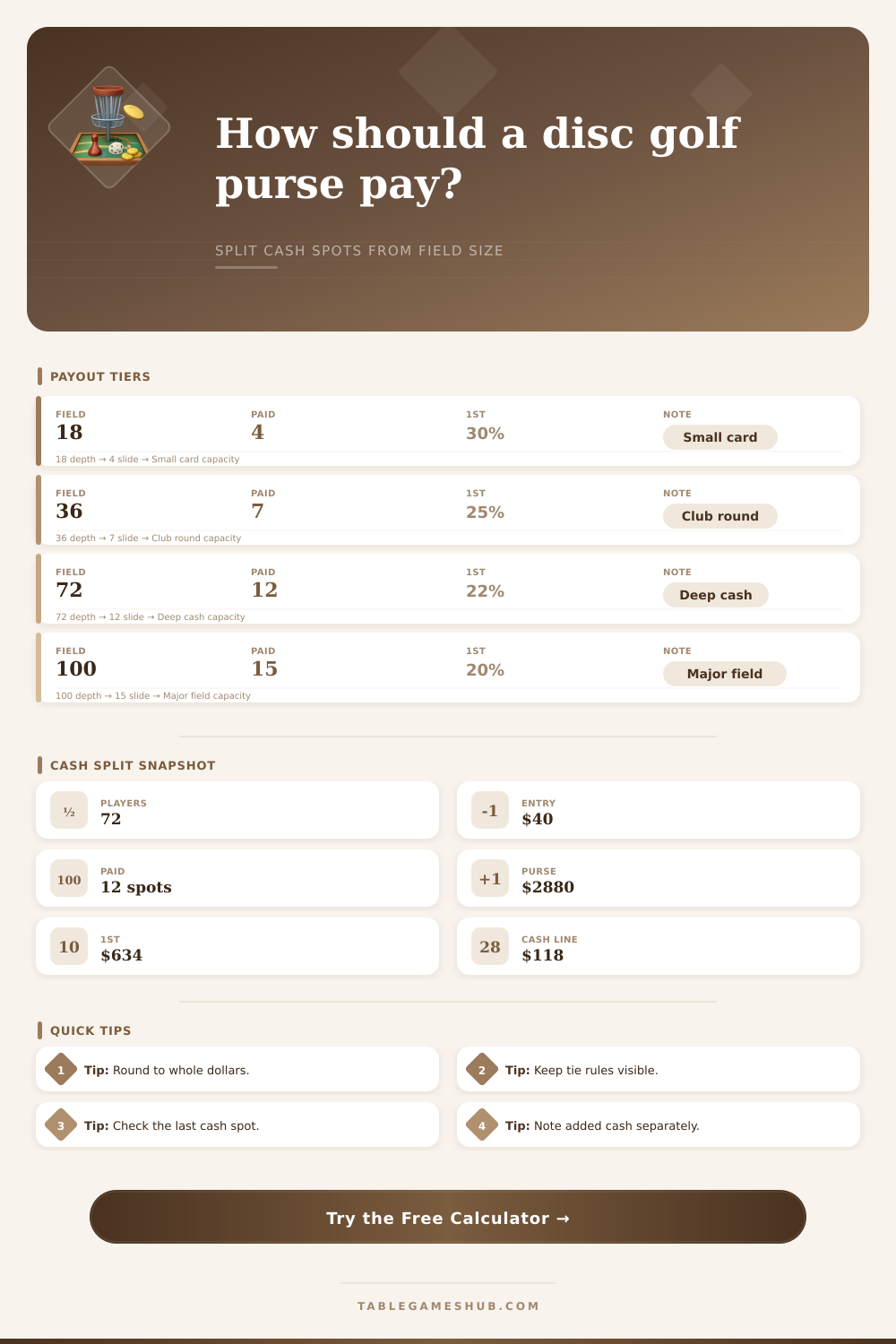
| Field | Paid | 1st | Style |
|---|---|---|---|
| 18 | 4 | 30% | Small card |
| 36 | 7 | 25% | Club round |
| 72 | 12 | 22% | Deep cash |
| 100 | 15 | 20% | Major field |
| 144 | 20 | 18% | Big open |
| Format | Pct | Depth | Note |
|---|---|---|---|
| Flex start | 35% | Top 4 | Fast pay |
| Club C-tier | 40% | Top 20% | Balanced |
| Amateur finale | 45% | Top 25% | Deeper |
| Showcase | 50% | Top 30% | Very deep |
| Major split | 55% | Top 35% | Heavy top |
| Tie parts | Split style | Use | Note |
|---|---|---|---|
| 1 | No split | Clear card | Full prize |
| 2 | Half each | Two-way tie | Clean split |
| 3 | Third each | Three-way | Rare tie |
| 4+ | Even share | Large tie | Round down |
| 5+ | Pool share | Stacked tie | Use cents |
| Cash line | Low | Mid | High |
|---|---|---|---|
| Floor | 2% | 3% | 4% |
| Depth | 8 | 12 | 18 |
| Style | Top-heavy | Balanced | Deep |
| Field fit | Small | Medium | Large |
| Prize line | Thin | Even | Wide |
Prize split tips
How the payout curve is built
The calculator uses field size, entry fee, and payout percentage to create a top-heavy prize pool, then spreads the remaining spots with a weighted ladder.
That makes first-place money, the last cash line, and your net result easy to compare before anyone signs the scorecard.
If a tie lands on the edge of the cash line, the split math keeps the announced amount consistent even when more than two players share a spot.
The ladder view also gives tournament staff a quick way to confirm how much room remains between payout depth and the top prize.
The payout structure for disc golf events are determined by several mathematical factors, including the entry fees, the size of the field, and the percentage of the total pot that will be distribute to the players who finish the course the most best. The total pot can be calculated by taking the total entry fees for the player who enter the tournament and then subtracting the cost for administrative or trophy prizes. Most disc golf events distributes between 35 and 50 percent of the total, or gross, pot to the players.
The specific division of the total prize money is known as a payout split. Some tournament director create a payout split that is top heavy, meaning that the tournament director gives a large percentage of the prize money to the first-place winner. These types of payout splits are used to attract a higher number of player to the disc golf tournament.
How Disc Golf Prize Money Works
The size of the field is one of the primary factors that dictate the payout structure. Fields with 24 players will typically pay out the top four players, and the top player will recieve 30 percent of the total prize money. For fields composed of 72 players, there will typically be 12 prize position, and the top player will only receive 22 percent of the total prize money.
Fields with a large number of players requires deep prize positions to maintain interest in the tournament from amateur players. Tournament directors will typically payout between 15 and 20 percent of the total entrants in the field. The entry fees will dictate the total prize money that will be offered to the players.
A field composed of 50 players who enters for $30 will have a smaller total prize money than a field composed of 50 players who enter for $50. Additionally, sponsors of the tournament can add prize money to the total prize pool. This additional prize money, referred to as sponsor cash, does not require an increase to the entry fee for the players.
The prize pool will also include a floor for the prize money. The floor is the minimum amount of prize money that will be given to the player in the last position to receive prize money. Floors are typically between 2 and 4 percent of the total prize pool.
Floors are established to ensure that the player in the last prize position still receive some prize money. Should there be a tie in a disc golf tournament, specific rules will be set within the payout structure. Should two player tie for a position, they will split the prize money for that position.
Should three or more players tie for a position, they will divide the prize money by the number of player who tied for that position. The tournament director will round the split prize money down to the nearest dollar to avoid giving prize money to players in a tie for fraction of a dollar. A payout calculator will help determine prize money for different position in a field in the case of ties.
The spread of prize money for players in a field is another common consideration in the creation of the prize money split. A top-heavy split give the highest prize money to the players with the lowest scores but gives less prize money to the middle scorer. An even split of prize money gives the players more prize money, but it rewards fewer player for having a low score.
A top-heavy split can be tested by simply changing the percentage of prize money given to the first-place player. External factors can alter the payout structure after the event has begun. For instance, bad weather might cause some players to leave the disc golf event.
The number of players in the field will change, and with a change in the number of players, the total prize pool will change as well. The tournament director may have to adjust the prize money for each field position based off the number of player who actualy competed in the disc golf tournament. The rules for the tournament should state how the tournament director will adjust the payout structure in the case of no-show player or weather delay.
Finally, different types of disc golf event will have different prize pool structures. Disc golf events with a flex start time will have a tight prize pool and pay the top four players 35 percent of the total prize pool. Showcase events will pay out 30 percent of the total field.
Professional players will be awarded a top-heavy prize pool to encourage them to compete in the tournaments, while amateur players will receive a spread prize pool award to encourage more of them to compete in the disc golf events. Through understanding these prize pool structures, disc golf tournament director and players can determine how much prize money they will receive in each position.