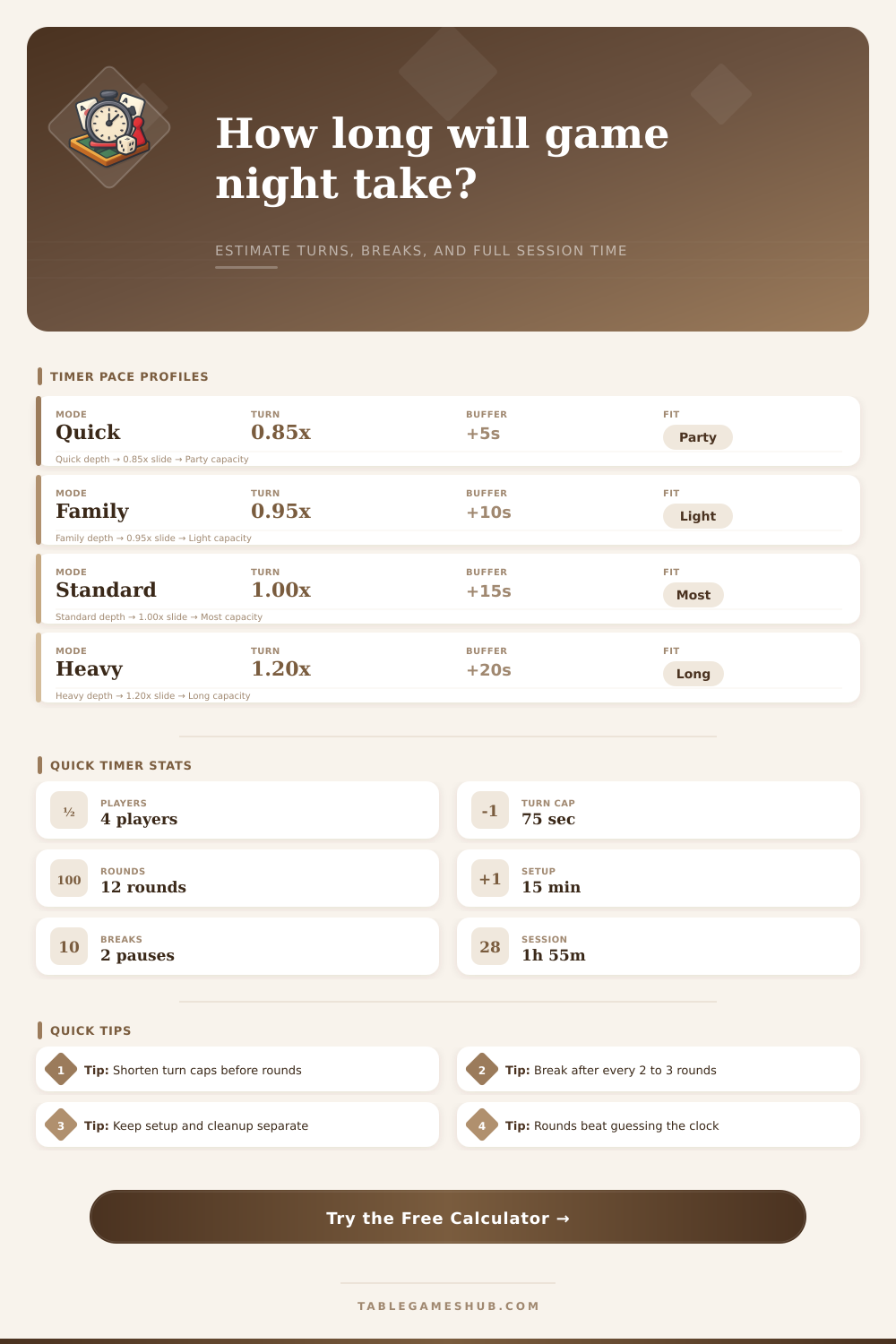
⏰ Board Game Timer Calculator
Estimate session length, turn limits, breaks, and setup time for game night.
| Measure | Value | Formula | Note |
|---|
| Mode | Turn factor | Buffer | Best fit |
|---|---|---|---|
| Quick party | 0.85x | +5 sec | Fast table |
| Family night | 0.95x | +10 sec | Light rules |
| Standard strategy | 1.00x | +15 sec | Most games |
| Heavy euro | 1.20x | +20 sec | Long think |
| Players | Turn cap | Round feel | Session feel |
|---|---|---|---|
| 2 | 45-60 sec | Tight duel | Quick finish |
| 4 | 60-90 sec | Balanced | Classic night |
| 6 | 75-120 sec | Busy table | Longer slot |
| 8+ | 90-150 sec | Slow lap | Marathon |
| Break plan | Gap | Length | Use case |
|---|---|---|---|
| Short | Every 2 | 5 min | Most sessions |
| Medium | Every 3 | 8 min | Long games |
| Long | Every 4 | 10 min | Campaign play |
| None | 0 | 0 min | Fast casual |
| Term | Formula | Unit | Note |
|---|---|---|---|
| Effective turn | turn x factor + buffer | sec | Safe clock |
| Round cycle | players x turns x turn | min | One table lap |
| Break count | floor((r-1)/b) | count | No end break |
| Session total | setup + play + breaks | min | Final slot |
Turn first
Trim the turn cap before you drop rounds.
Break smart
Use short pauses every two or three rounds.
Using a timer for board games is a method that will assist you in managing the time that you spend playing a board game. Using a timer will ensure that your game does not last longer then you would like it to last, and it will ensure that the energy of the players are maintained throughout the game. Without the use of a timer, it is likely that the turn will take longer than you would like, which can make the players feel tired and bore of the game after a few turn.
By using a timer, you can ensure that the game is on schedule for each turn or game round. The pacing for the game will determine how long each turn will take for each player. Each turn will likely take a different amount of time depending upon the type of game that is being play.
Use a Timer to Keep Board Games on Time
Some games will take very little time for each turn, while others will require the player to take longer to complete their turn. In order to account for these vary times, you can use a pace profile to determine how much time will be required for each turn. A pace profile can include the base time for each turn and the buffer for the players to talk or think during their turn.
By using a pace profile that fits the players that you are entertaining, you can account for how long the game will take to play. The number of players that will be playing the game will also have an impact upon the length of the game. With fewer player, the game will move quick around the table.
With a larger number of players, it is likely that the game will move more slow around the table. Additionally, the number of action that each player will take during their turn will affect the length of each turn. With more actions, there will be more time for each player’s turn.
With fewer actions, there will be less time for that turn. By knowing how many turns will occur during each round, it is possible to calculate the total length of the game. To keep the players focused during the game, it is recommended that you include breaks every two or three rounds.
This will allow the players to stretch out or refill their drink. Including breaks will help to reset the focus of the players and will help the players to avoid making mistakes due to fatigue. Additionally, it is also important to include time to set up and clean up the game in the total length of time that you calculate for the game.
Setting up the game can take a significant amount of time, as can the breaking down of the game when it is over. By including this time in the total time calculation, you can more accurately calculate the total length of time that will be required for the game to run its course. There are some trade-offs that you can make when you select a timer for your games.
By wanting to shorten the length of the game, you could shorten the time for each turn. However, shortening each turn will reduce the opportunity for strategy to be played within the game. For example, ninety second for each turn for a four-player game will allow for more rounds in a two-hour time span.
Yet, if you use a heavy pacing profile for players who take a while to think their moves, the game will last longer and players will need to take longer break. You can announce these time limits to the players before the game starts so that the players are familiarized with the time limit that you will place upon them during the game. Many people will make mistakes when calculating the length of the game.
One of the mistakes people make is focusing solely upon the length of the game when players are actually on the board. People forget to factor in the time for the setup of the game, the breaks, and the cleanup. If people ignored this step, they would likely make a significant underestimation of the time that the game will require to play.
Another common mistake is ignoring the dynamics of the players. People of different ages and skills require different pacing profiles to accommodate their skill in the game. Some other factors that will affect the length of the game are the size of the game table and the experience level of each player.
Small tables can take longer for the players to move the game components. New players may take longer than experienced players to learn the moves or strategies required for success within the game. By accounting for these factor in your game time calculations, you can ensure that your game runs smoothly without any surprise.
Should the players begin to move at a faster or slower rate than you had calculated for the game, you can always refer to your created time breakdown to make adjustments to the game as necessary. Using a timer for each game will allow you to manage the game effectively. Using a timer will help you to avoid playing scenario in which the game ends too late.
Additionally, using a timer will help the players remain engaged in the game. With the use of a timer and the announcement of the rules for the timer, the players will adhere to the time limits that you created for the game. By using a timer, you can ensure that the game lasts long enough for everyone to enjoy themselves but not so long that they are forced to remain at the game longer than they would like.